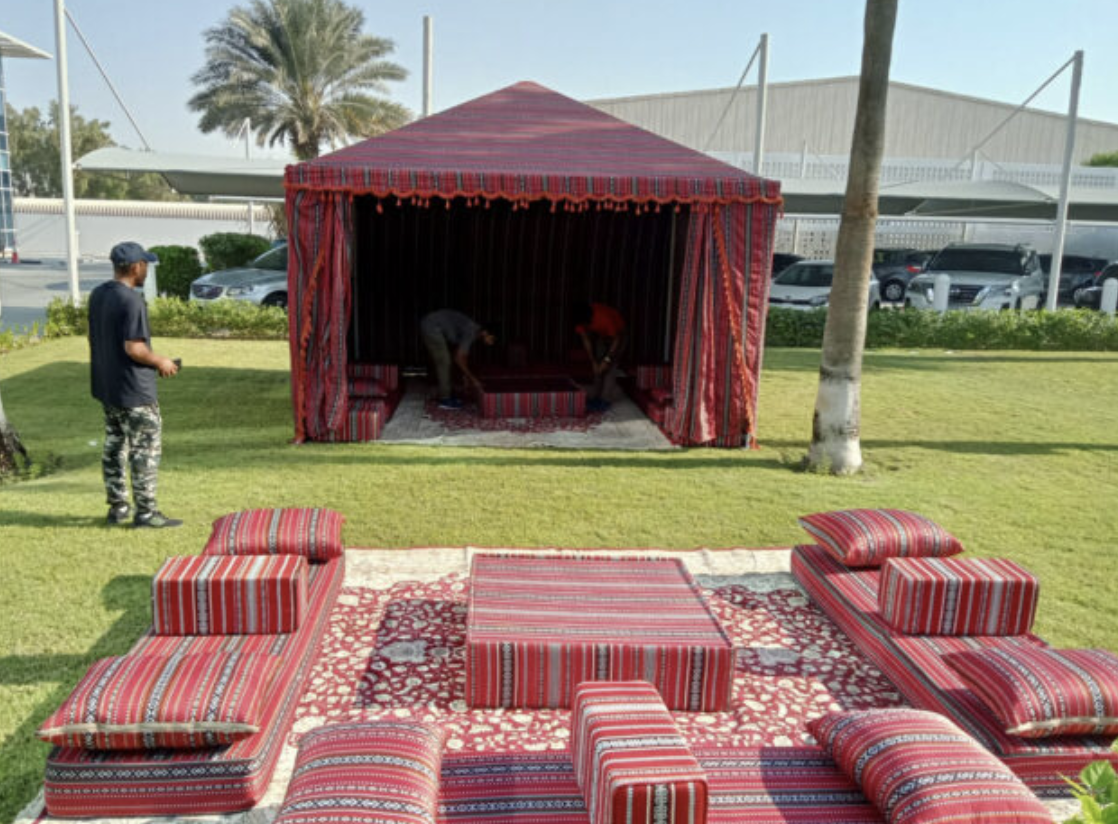
With Ramadan approaching, the Department of Municipalities and Transport (DMT) has confirmed the official guidelines for installing temporary Ramadan Iftar tents in front of homes and residential villas across the Emirate of Abu Dhabi.
The good news? The permit is completely free, and the process is fully digital.
How to apply for a Ramadan tent permit
Residents and companies can apply through the TAMM platform by:
Logging in using UAE Digital ID
Submitting the application
Receiving approval before installation
No additional documents are required, and there are no fees for the service.
Ramadan tent rules in Abu Dhabi
Only one tent per residence
Must be installed directly in front of the property
Placement allowed between the plot boundary and the pavement only
Must not block traffic, pedestrian walkways, or public services
No installation over visible utilities (manholes, fire hydrants, service lines)
No excavation work allowed
Technical specifications
Maximum area: 60 square metres
Maximum height: 4.5 metres
Materials must be approved (fabric tents, traditional بيتشعر, tarpaulin, or similar tent-specific materials)
The following are not allowed:
Cooking equipment
Charcoal use
Loudspeakers
Commercial or rental activities
Buying, selling, or promotional events
Liability & Compliance
The property owner is fully responsible for:
Any damage to public or private property
Ensuring installation matches the approved location
Removing the tent once the permitted period expires
Abu Dhabi Municipality reserves the right to request immediate removal in case of:
Emergencies
Complaints
Violations of permit conditions
Failure to comply may result in legal action under DMT regulations.
If you’re planning to host family and friends for `iftar this Ramadan, make sure your tent is fully compliant before setting it up.
With over 35 years of experience in journalism, copywriting, and PR, Michael Gomes is a seasoned media professional deeply rooted in the UAE’s print and digital landscape.
UAE motorists won’t have long to wait to find out whether fuel prices will increase in August, with the Fuel Price Committee set to announce the new rates on Thursday, July 31.
The revised petrol and diesel prices will take effect from August 1.
Will fuel prices go up?
After a welcome price cut in July, the outlook for August is less certain.
Global oil prices initially fell below $70 a barrel earlier this month, raising hopes of another reduction. However, prices have since rebounded sharply, clouding the picture for motorists.
Brent crude briefly climbed above $100 a barrel, while US benchmark WTI rose to nearly us$92. Abu Dhabi’s Murban crude also surged past us$105, reflecting renewed strength in global energy markets.
Because UAE fuel prices are based on average international oil prices over the month, the late-July rally could limit or even reverse last month’s cuts.
Current UAE fuel prices
Motorists are currently paying:
Super 98: Dh3.40 per litre
Special 95: Dh3.29 per litre
E-Plus 91: Dh3.21 per litre
Diesel: Dh3.60 per litre
These rates were introduced in July after global oil prices eased earlier in the summer.
How UAE fuel prices are set
The UAE reviews petrol and diesel prices every month based on average global crude oil and refined fuel prices.
The August rates will be announced on July 31 through official government channels and will come into effect the following day.
Abu Dhabi Police are urging motorists to switch off their engines and take their keys whenever leaving their vehicles, warning that even brief stops can increase the risk of theft, fires and other safety hazards.
The advisory applies to drivers stopping at shops, petrol stations, ATMs or mosques, where some motorists continue to leave vehicles unattended with the engine running.
Police said leaving a running vehicle unattended creates an opportunity for theft and could also lead to mechanical problems or fire-related incidents.
Motorists were also reminded never to leave children, especially infants, inside a running vehicle, describing the practice as a serious threat to their safety.
Traffic laws
Abu Dhabi Police also highlighted that UAE traffic laws prohibit leaving an unattended vehicle with its engine running.
Drivers who fail to comply with traffic rules and official instructions can face a Dh500fine under the Federal Traffic Law.
Authorities urged motorists to adopt safe habits by turning off the engine, removing the key and locking the vehicle every time they step away, no matter how briefly.
Passengers travelling through Dubai International Airport (DXB) can now check if they’re eligible to use Smart Gates before reaching passport control.
Dubai Airports has introduced the new Smart Gates Pre-Eligibility Verification service in partnership with the General Directorate of Identity and Foreigners Affairs (GDRFA) to make immigration faster and reduce waiting times.
How it works
Every improvement at @DXB is designed around the objective of making the journey through the #airport more seamless for our guests.
Developed in collaboration with @GDRFADUBAI, the new Smart Gates Eligibility Pre-Check gives travellers instant confirmation of their Smart Gates… pic.twitter.com/cg8irvnbfY
Travellers can instantly verify their Smart Gate eligibility through the Pocket Flights platform or by scanning QR codes placed across airport terminals and boarding gates.
The service lets passengers know in advance whether they can use the automated passport gates, helping them avoid uncertainty at immigration.
Faster airport experience
Dubai Airports says the new feature is part of its ongoing efforts to streamline passenger journeys and improve the overall airport experience.
By allowing travellers to confirm eligibility before reaching passport control, the airport aims to speed up immigration processing and make travel through DXB more seamless for millions of passengers each year.