A total of 400 Ghiath smart patrols worth Dh196 million will be added to the Dubai Police’s fleet over the next five years, Lieutenant-General Abdullah Khalifa Al Marri, commander-in-chief of the force, said. The made-in-UAE patrols will hit Dubai streets soon.
The Ghiath is one of the first cars to be fully manufactured in the UAE. It is produced by Emirati carmaker W Motors.
The cars will be manufactured at W Motors’ headquarters in Dubai Silicon Oasis.
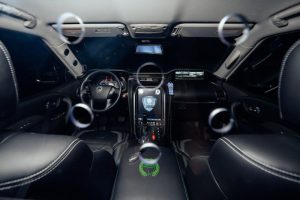
These smart patrols have a 360-degree camera and eight exterior surveillance cameras. There’s a facial and licence plate recognition system in each car.
The patrols also boast of an integrated 16-inch central screen and a powerful onboard computer linked to the main control centre.
Each car has a custom-built drone box with an advanced drone on board.
We are proud to launch the Ghiath Smart Patrol in partnership with Dubai Police.
The first batch of highly advanced security vehicles was delivered during the World Police Summit at Expo 2020 with a further 400 Ghiath Smart Patrol to join Dubai Police fleet in the coming years. pic.twitter.com/zXrnE1UzEv
The police chief said the fleet will soon be expanded to include unmanned vehicles, bicycles, e-vehicles, rapid intervention vehicles and rescue vehicles. A prototype of the Ghiath made its debut at GITEX.
Lt-Gen Al Marri made the announcement during the official launch of the second generation of the smart patrol in partnership with W Motors and Safe City Group.
He confirmed that the first batch of 10 vehicles has been delivered during the World Police Summit at Expo 2020.
“The features and capabilities of the Ghiath are exactly in line with our requirements and allow us to stay at the forefront of international security vehicle standards.”
Ralph R. Debbas, founder and chief executive officer of W Motors, said: “We are proud to have delivered the first Ghiath smart patrols to Dubai Police. This is a milestone not only for W Motors, but for the UAE’s automotive industry as we pave the way for manufacturing high-tech and pioneering vehicles locally. From design and engineering to innovative software development, with Ghiath we have created a state-of-the-art security vehicle that is now ready for duty.”
Emirates Engineering has launched a new programme giving UAE university students the chance to transform retired aircraft materials into innovative products while gaining hands-on experience with the airline’s engineering teams.
Called Material Futures Studio, the six-week initiative is led by Emirates Engineering’s Upcycling department. It aims to inspire the next generation of aviation engineers by challenging students to find creative new uses for materials recovered from retired aircraft.
The first edition brings together 23 students from Khalifa University, Emirates Aviation University and the University of Sharjah.
Students began the programme with an orientation session and a behind-the-scenes tour of Emirates Engineering’s facilities in Dubai, where they met senior leaders, explored aircraft maintenance operations and visited the airline’s upcycling workshop to see how retired aircraft materials are already being turned into new products.
How the programme works
Over six weeks, participants will develop concepts and prototypes using materials recovered from retired aircraft, with guidance from Emirates Engineering specialists throughout the design and development process.
The programme will conclude with a showcase where students present their final ideas and prototypes.
According to Emirates, the initiative is designed to bridge the gap between academia and industry by giving students practical engineering experience while enabling the airline to tap into fresh ideas and emerging talent.
Part of Emirates’ sustainability efforts
Material Futures Studio builds on Emirates’ wider sustainability strategy and its multi-billion-dollar aircraft retrofit programme.
The airline is currently refurbishing 219 Airbus A380 and Boeing 777 aircraft, one of the largest retrofit projects in the aviation industry. Rather than discarding materials removed during the upgrades, Emirates Engineering has been repurposing them into new products through its in-house upcycling projects.
These include the Aircrafted by Emirates collection of limited-edition luggage, bags and accessories made from reclaimed aircraft materials, as well as Aircrafted KIDS, which transforms retired aircraft fabrics into backpacks for children. Emirates says more than 4,000 backpacks have already been donated to children in 11 countries.
Getting around Jumeirah Lakes Towers (JLT) is about to become much easier. A new fully electric bus service, JLT Link, launches on August 1, offering residents and visitors a convenient way to travel across the neighbourhood for just Dh3 per ride.
Replacing the existing bus service, the new network is designed to make short trips around JLT quicker, cheaper and more sustainable.
How does JLT Link work?
The service operates a fleet of turquoise electric buses across two circular routes:
Route 1: Clusters A to N
Route 2: Clusters O to Z
There’s no need to book. Simply head to the nearest bus stop, scan the QR code to pay and hop on.
Metro connections and 18 stops
JLT Link connects directly with both DMCC Metro Station and Sobha Realty Metro Station, making it easier to continue your journey across Dubai.
The network serves 18 stops across JLT and Uptown Dubai, with buses arriving every 20 minutes.
Sustainable and accessible
The fully electric buses are part of DMCC’s wider sustainability strategy and feature:
Low-floor boarding
Wheelchair accessibility
Space for standing passengers
The launch complements other sustainability initiatives across JLT, including solar-powered infrastructure, Dubai Can refill stations and community recycling facilities.
UAE motorists could see petrol prices fall for a second consecutive month in August, although any reduction is expected to be modest as global oil markets remain volatile.
Experts are predicting lower crude oil prices during July will support another cut at the pump, but the ongoing geopolitical tensions and tight fuel inventories are likely to limit how much prices fall.
Based on current trends, experts estimate Special 95 could fall to around Dh3.13 per litre, while Super 98 could drop to about Dh3.24 per litre.
Oil markets continue to react to geopolitical developments, particularly tensions involving Iran and concerns over shipping routes in the Gulf.
However, prices are capable of moving up sharply if regional tensions escalate.
July fuel prices
Super 98: Dh3.40 per litre
Special 95: Dh3.29 per litre
E-Plus 91: Dh3.21 per litre
Diesel: Dh3.60 per litre
The UAE is expected to announce fuel prices for August this week, with many motorists hoping for another reduction to help ease the rising cost of living and daily commuting expenses.