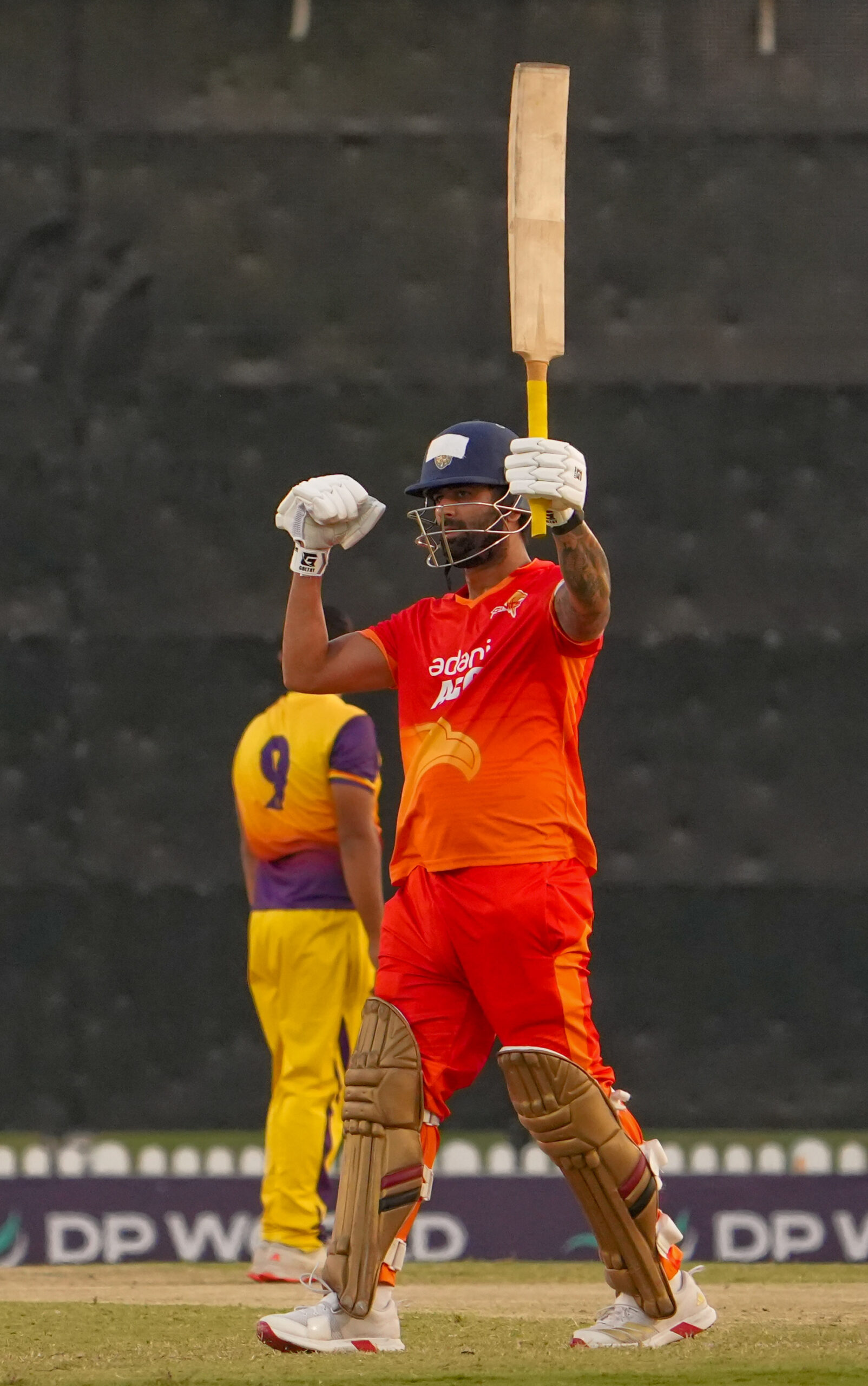
Muhammad Waseem’s explosive 89, Falak Noor’s sensational six-wicket haul, including a hat-trick, and Sagar Kalyan’s match-winning 80 headlined an action-packed round of the fourth edition of the DP World ILT20 Development Tournament, with MI Emirates Development, Abu Dhabi Knight Riders Development, Dubai Capitals Development and Gulf Giants Development all securing victories at the ICC Academy in Dubai.
With all teams having played four fixtures each, Gulf Giants Development lead the points table with six points. Meanwhile, Abu Dhabi Knight Riders Development, Sharjah Warriorz Development, Dubai Capitals Development and Desert Vipers Development are all level on four points, while MI Emirates Development have two points.
On Sunday evening, Muhammad Waseem’s blistering 89 off 48 set up MI Emirates Development for a 32-run win over Sharjah Warriorz Development.
Waseem smashed seven fours and five sixes as MI Emirates posted 177 before being bowled out in 19.5 overs, with Zahoor Khan also adding a rapid 22 off nine. Hafiz Almas Ayub was the pick of the Warriorz bowlers with 3/28, while Shahid Iqbal and Junaid Siddique claimed two wickets apiece.
In reply, Harpreet Bhatia top-scored with 51 off 42 and Luqman Faisal struck 38 off 20, but Ibrahim Masood (3/32), Vishnu Sukumaran (2/7), Zahoor Khan (2/13) and Muhammad Rohid Khan (2/25) helped MI Emirates total stay out of reach. The Warriorz were eventually bowled out for 145 in 17.3 overs.
In Sunday’s first fixture, Abu Dhabi Knight Riders Development were powered by a sensational six-wicket haul from Falak Noor as they defeated Desert Vipers Development by 88 runs
After Knight Riders Development posted 196/8, Falak Noor ripped through the Vipers batting line-up, claiming 6/15, including a hat-trick in the 14th over, as Desert Vipers Development were bowled out for 108 in 15.5 overs. Nilansh Keswani top-scored with 35 off 23, while Harshit Kaushik struck 18 off eight.
Earlier, Usaid Amin (41 off 33) and Muhammad Aftab Alam (30 off 25) led the Knight Riders Development batting effort, while Alishan Sharafu smashed 16 off four balls. Muhammad Uzair Khan finished unbeaten on 20 off 10 as they posted 196/8. Wali Muhammad Afridi (2/31), Khuzaima Tanveer (2/37) and Sanjay Pahal (2/53) were the pick of the Vipers attack.
On Saturday evening, Dubai Capitals Development beat Abu Dhabi Knight Riders Development by three wickets
Knight Riders Development were bowled out for 123 in 17.1 overs, with Uzair Haider Maan top-scoring with 40 off 27, including three sixes. Tahir Zaman led the Capitals attack with an impressive 4/16, while Muhammad Arfan, Muhammad Farooq and Muhammad Saghir Khan claimed two wickets each.
In reply, Raees Ahmed anchored the chase with an unbeaten 44 off 45, while Akshdeep Nath provided a quickfire 22 off nine, including three fours and a six. Muhammad Saghir Khan added an unbeaten 21 off 15 as the Capitals reached 125/7 in 19 overs
Earlier in the day, Sharjah Warriorz Development endured their first defeat of the season, falling to Gulf Giants Development by 21 runs.
Tanish Suri (21 off 8) set the tone for the Giants’ innings before they lost four wickets inside the powerplay. Sagar Kalyan’s (80 off 33) dominant innings then ensured the Giants posted a formidable 203/10. Kalyan smashed eight fours and five sixes, while Junaid Shamsu (30 off 19), Zuhaib Zubair (27 off 21) and Haider Razzaq (15 off 7) made important contributions.
Hafiz Almas Ayub was the pick of the Warriorz attack with figures of 3/38.
In reply, Luqman Faisal (51 off 30) extended his fine form for the Warriorz with a half-century at the top of the order. Mohit Kalyan (46 off 29) also kept the Warriorz in the fight along with a late flourish from Dhruv Parashar (27* off 13) but potent spells from Mohammed Irshad (3/44), Awais Ahmed (2/29) and Zuhaib Zubair (2/38) were enough to restrict the innings to 182/8.
Brief Scores
MI Emirates Development defeated Sharjah Warriorz Development by 32 runs
MI Emirates Development 177/10 in 19.5 overs (Muhammad Waseem 89, Zahoor Khan 22; Hafiz Almas Ayub 3 for 28, Shahid Iqbal 2 for 28) Sharjah Warriorz Development 145/10 in 17.3 overs (Harpreet Bhatia 51, Luqman Faisal 38; Vishnu Sukumaran 2 for 7, Zahoor Khan 2 for 13)
Abu Dhabi Knight Riders Development defeated Desert Vipers Development by 88 runs
Abu Dhabi Knight Riders Development 196/8 in 20 overs (Usaid Amin 41, Muhammad Aftab Alam 30; Wali Muhammad Afridi 2 for 31, Khuzaima Tanveer 2 for 37) Desert Vipers Development 108/10 in 15.5 overs (Nilansh Keswani 35, Harshit Kaushik 18; Falak Noor 6 for 15, Zahid Ali 2 for 24)
Dubai Capitals Development defeated Abu Dhabi Knight Riders Development by three wickets
Abu Dhabi Knight Riders Development 123/10 in 17.1 overs (Uzair Haider Maan 40, Masood Gurbaz 20; Tahir Zaman 4 for 16, Muhammad Arfan 2 for 28) Dubai Capitals Development 125/7 in 19 overs (Raees Ahmed 44 not out, Akshdeep Nath 22; Asel Sigera 2 for 23, Zahid Ali 2 for 31, Ibrar Ahmed 2 for 33)
Gulf Giants Development defeated Sharjah Warriorz Development by 21 runs
Gulf Giants Development 203/10 in 19.3 overs (Sagar Kalyan 80, Junaid Shamsu 30, Zuhaib Zubair 27; Hafiz Almas Ayub 3 for 38, Udish Suri 2 for 28, Shahid Iqbal 2 for 39) Sharjah Warriorz Development 182/8 in 20 overs (Luqman Faisal 51, Mohit Kalyan 46, Dhruv Parashar 27; Mohammed Irshad 3 for 44, Awais Ahmed 2 for 29, Zuhaib Zubair 2 for 38)