Emirates Engineering has launched a new programme giving UAE university students the chance to transform retired aircraft materials into innovative products while gaining hands-on experience with the airline’s engineering teams.
Called Material Futures Studio, the six-week initiative is led by Emirates Engineering’s Upcycling department. It aims to inspire the next generation of aviation engineers by challenging students to find creative new uses for materials recovered from retired aircraft.
The first edition brings together 23 students from Khalifa University, Emirates Aviation University and the University of Sharjah.
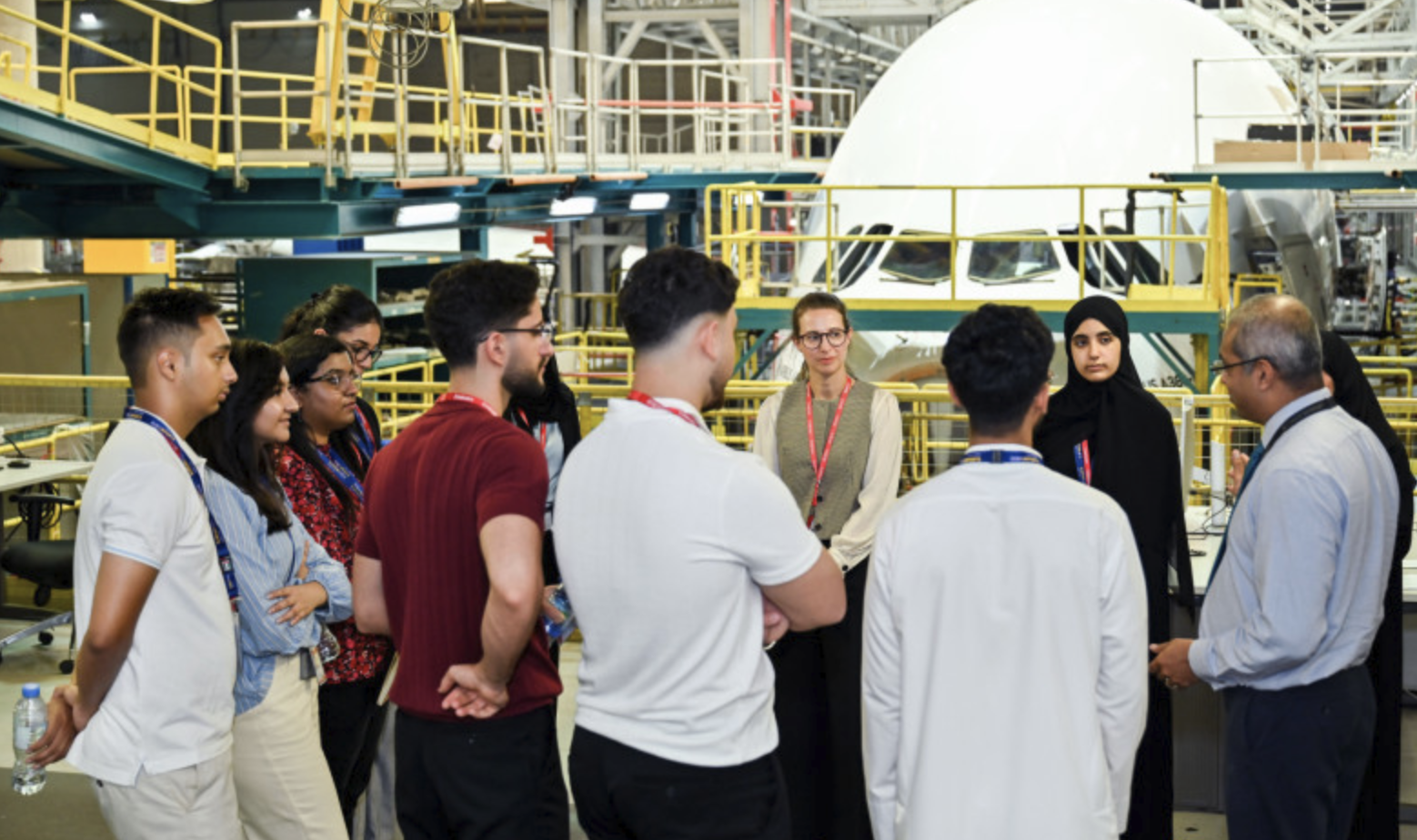
Students began the programme with an orientation session and a behind-the-scenes tour of Emirates Engineering’s facilities in Dubai, where they met senior leaders, explored aircraft maintenance operations and visited the airline’s upcycling workshop to see how retired aircraft materials are already being turned into new products.
How the programme works
Over six weeks, participants will develop concepts and prototypes using materials recovered from retired aircraft, with guidance from Emirates Engineering specialists throughout the design and development process.
The programme will conclude with a showcase where students present their final ideas and prototypes.
According to Emirates, the initiative is designed to bridge the gap between academia and industry by giving students practical engineering experience while enabling the airline to tap into fresh ideas and emerging talent.
Part of Emirates’ sustainability efforts
Material Futures Studio builds on Emirates’ wider sustainability strategy and its multi-billion-dollar aircraft retrofit programme.
The airline is currently refurbishing 219 Airbus A380 and Boeing 777 aircraft, one of the largest retrofit projects in the aviation industry. Rather than discarding materials removed during the upgrades, Emirates Engineering has been repurposing them into new products through its in-house upcycling projects.
These include the Aircrafted by Emirates collection of limited-edition luggage, bags and accessories made from reclaimed aircraft materials, as well as Aircrafted KIDS, which transforms retired aircraft fabrics into backpacks for children. Emirates says more than 4,000 backpacks have already been donated to children in 11 countries.
With over 35 years of experience in journalism, copywriting, and PR, Michael Gomes is a seasoned media professional deeply rooted in the UAE’s print and digital landscape.
Parents and students in Abu Dhabi can now obtain an officially attested private school fee certificate in just six minutes through the TAMM government services platform, making the process quicker and more convenient than ever.
The fully digital service allows users to request and receive a certified tuition fee certificate without uploading any supporting documents. This certificate is commonly required for government procedures, financial aid requests, scholarship applications, and other official purposes.
Applying is simple and can be completed entirely online. Users need to sign in using their UAE PASS account, submit the application, pay the Dh15 service fee electronically, and download the certified digital certificate once it is issued.
By moving the entire process online, TAMM helps families save time while providing fast access to an important document whenever it’s needed for official or financial requirements.
Parents and teachers in Dubai will soon have a direct role in shaping the future of education, following the launch of two new advisory councils by the Knowledge and Human Development Authority (KHDA).
Building on the success of the Dubai Students Council, KHDA has announced the creation of the Dubai Parents Council and Dubai Educators Council, both set to begin work at the start of the 2026-27 academic year.
Giving parents and teachers a voice
Each council will consist of 15 members selected through a transparent process and will serve as a formal platform for dialogue between the education community and regulators.
The initiative attracted strong interest, with KHDA receiving 152 applications for the Parents Council and 160 applications for the Educators Council, including submissions from Emirati parents and teachers across Dubai.
Supporting Dubai’s education vision
The new councils are designed to strengthen community participation in education and support the goals of Dubai’s Education 33 Strategy.
Members will have the opportunity to share ideas, highlight challenges and contribute recommendations on key issues affecting schools and early childhood centres across the emirate.
Focus on student success
The councils are expected to discuss a range of topics, including student wellbeing, inclusion, teaching quality, parental engagement and school-community partnerships.
KHDA said the move reflects its commitment to collaborative decision-making and aims to strengthen trust between families, educators and education authorities.
By formally including parents and teachers in the conversation, Dubai is taking another step towards creating a more inclusive and responsive education system that reflects the needs of its diverse school community.
Dubai’s private schools will face short-notice inspections from the 2026-27 academic year under a revamped quality assurance framework announced by the Knowledge and Human Development Authority (KHDA).
Under the new approach, schools will receive no more than 24 hours’ notice before inspectors arrive, marking a significant shift in how education quality is monitored across the emirate.
KHDA said the updated system will include two types of visits. Full inspections will be carried out by teams of specialist education experts, while shorter monitoring visits will focus on specific areas of school performance and quality assurance.
Return of formal inspection
The move signals the return of formal inspection activity after KHDA paused inspections during the 2025-26 academic year. At the time, the authority said the break would allow for greater collaboration with schools and a review of how educational quality is assessed and supported.
The new model aims to provide a more responsive and differentiated approach to evaluating schools, with visits designed to offer a clearer picture of day-to-day operations and educational standards.
Dubai’s private school sector serves hundreds of thousands of students across a wide range of international curricula, making quality assurance a key part of maintaining educational standards and supporting continuous improvement.
Further details on how the inspection and monitoring framework will operate are expected ahead of the 2026-27 academic year.