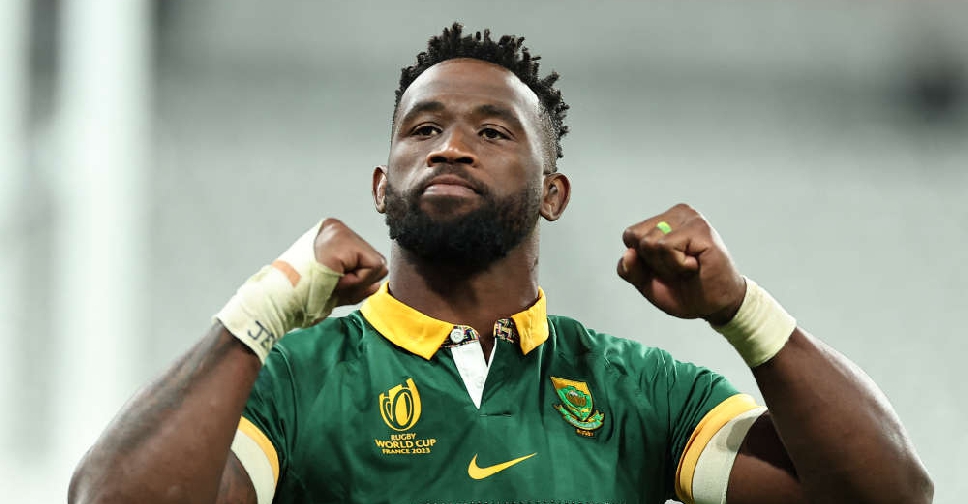
South Africa crushed France’s hopes of a maiden World Cup title after withstanding a Paris storm to emerge 29-28 winners of a ferocious and breath-taking quarter-final on Sunday.
A scintillating first half gave way to a brutal street fight and the Springboks’ experience made the difference against a French team playing their first knockout game since coach Fabien Galthie took over four years ago.
South Africa, who will meet England for a place in the final, prevailed thanks to tries by Kurt-Lee Arendse, Damian de Allende, Cheslin Kolbe and Eben Etzebeth and the kicks of Mannie Libbock and Handre Pollard.
France captain Antoine Dupont returned from cheekbone surgery, but the mercurial scrumhalf ran out of steam and ideas as Les Bleus could only score through tries by Cyril Baille (2) and Peato Mauvaka, Thomas Ramos adding 13 points from the tee.
The result marked a brutal blow for France’s new generation, who came into the tournament with the self-belief to claim a first World Cup title.
Les Bleus, however, suffered only their second home defeat in 26 home tests under Galthie, and this one will hurt forever.
“We are very sad tonight. I think we gave everything to win that game. We knew it would be a very tight game and we had to score every opportunity. We had good opportunities but unfortunately we couldn’t convert them into points,” France manager Raphael Ibanez said.
South Africa captain Siya Kolisi said the bench was critical.
“I just thought we really wanted it. We knew how tough it was going to be. I must give credit to the guys that came off the bench, they came and made a huge difference,” he said.
South Africa’s kick-and-collect the crumbs tactics worked wonders in an explosive first half and Jacques Nienaber’s team rallied back from a three-point deficit in a more sober, controlled second period.
With a scrum cap and a titanium plate under his cheekbone, Dupont made his mark early with a brilliant kick to tear the South African defence open, but it was prop Baille who touched down in the corner to put the hosts ahead after France cut their opponents to ribbons.
It was a swashbuckling start by France, with Mauvaka intercepting the ball in the midfield and making a bee-line towards the posts, only to be brought down five 10 metres from the line.
Jonathan Danty was held up and Arendse dived over for South Africa after collecting a fortunate bounce from a speculative kick.
De Allende added South Africa’s second try after France failed to deal properly with yet another high kick. Les Bleus, however, responded quickly and Mauvaka dived over in the corner from a tap-and-go penalty after Dupont had drawn the tackler to set his hooker up.
Kolbe charged Ramos’s conversion attempt down and the two missing points proved costly in the end.
With barely time to breathe, South Africa regained control when Kolbe outpaced Damian Penaud with astonishing ease to collect Jesse Kriel’s kick and score.
The momentum pendulum was swinging in a blur and after another driving maul Baille touched down for the hosts again.
Ramos gave France a 22-19 halftime lead after Eben Etzebeth was sin-binned following a head-on-head collision with Uini Atonio.
The start of the second half was more of a street fight and France threw themselves into the South African defenders head first.
Nienaber made all but one of his changes within the first 10 minutes and South Africa defended tooth and nail, conceding only one penalty during France’s dominant spell.
Les Bleus’ then went on the back foot and the visitors got their reward when Etzebeth showed great strength to score following a tap penalty and Pollard converted to put the Springboks one point ahead.
Pollard added another penalty before Ramos brought France back within a point, but South Africa defended brilliantly to keep out a late French onslaught.

Football fans travelling with Emirates this summer won’t have to worry about missing any FIFA World Cup 2026 action. Dubai’s flagship airline Emirates, has announced that it will broadcast every match of the tournament live onboard its flights through Sport24, its dedicated live sports channel available on the award-winning ice entertainment system.
Passengers will be able to follow every moment of the world’s biggest football tournament while flying at 40,000 feet. The move ensures customers can stay connected to the action no matter where they are travelling, with live coverage available throughout the competition.
Emirates said the complete FIFA World Cup 2026 broadcast schedule is featured its ice magazine, allowing passengers to plan their journeys around key fixtures and follow their favourite teams during the tournament.
The live coverage will be available on most Emirates aircraft equipped with Sport24 and Sport24 Extra, although availability may vary depending on aircraft type and route. Selected FIFA World Cup matches will also be shown in Emirates Lounges across Dubai, giving travellers additional opportunities to catch the action before departure.
Mexico City’s iconic Estadio Azteca was transformed into a global stage on Thursday Night as the FIFA World Cup 2026 officially got underway, marking the beginning of the biggest edition in the tournament’s history.
A vibrant opening ceremony showcased a blend of Mexican culture, music and modern spectacle, with performances from international stars including Shakira and Burna Boy. The ceremony was designed to reflect both the heritage of the host nation and the global nature of the tournament, which for the first time will be staged across three countries — Mexico, the United States and Canada.
Before the first whistle of the competition, the atmosphere inside the historic stadium reached a crescendo as thousands of fans filled the stands, waving flags and lighting up the arena in a sea of colour. The Estadio Azteca, already steeped in football history, has now become the first venue in the world to host matches across three separate FIFA World Cups, having previously staged the 1970 and 1986 finals.
In a further highlight of the ceremony, Italian tenor Andrea Bocelli performed the tournament’s official anthem, adding a classical flourish to an evening otherwise defined by high-energy performances and large-scale choreography.
FIFA officials described the opening event as a “symbolic bridge between continents”, underlining the expanded format of the 2026 tournament. For the first time, the World Cup will feature 48 teams — up from 32 — and a total of 104 matches, spread across 16 host cities across North America. The expansion is intended to increase global participation and bring the tournament to a wider range of supporters.
Immediately after the ceremony, hosts Mexico faced South Africa in the tournament’s opening match, kicking off what is expected to be a month-long football spectacle. The match began under heavy security and heightened global attention, with millions watching around the world.
The expanded format has also brought logistical challenges, with teams required to travel across vast distances between venues in multiple countries. Organisers have emphasised investments in transport infrastructure, stadium upgrades and sustainability measures aimed at reducing the environmental footprint of the tournament.
The 2026 edition also arrives at a time when football’s global profile continues to grow rapidly, with record broadcast deals, increased digital streaming access and heightened commercial interest from sponsors. Analysts expect the tournament to break previous viewership records, particularly given its tri-nation hosting model and expanded team lineup.
Estadio Azteca itself remains one of football’s most storied venues. It famously hosted Brazil’s Pelé lifting the trophy in 1970 and Diego Maradona’s “Hand of God” and “Goal of the Century” performances in 1986. Its role in opening the 2026 tournament has been widely seen as a nod to football’s rich history in Mexico, while also signalling a new era for the sport.
As fireworks lit up the Mexico City skyline following the ceremony, attention now turns to the next phase of the tournament’s opening schedule, with matches set to continue across North America in what promises to be the most geographically expansive World Cup ever staged.
For fans, players and organisers alike, the message from Mexico City was clear: the world’s biggest sporting event has begun, and it is set to be bigger, broader and more ambitious than ever before.
Emirati International Arbiter Abdullah Murad Al Mazmi has been appointed to the officiating panel for the 2026 FIDE World Rapid and Blitz Team Championships, one of the biggest events on the global chess calendar.
The championship will take place in Hong Kong from June 16 to 22 and is expected to feature many of the world’s leading grandmasters, including world number one Magnus Carlsen.
Al Mazmi’s selection highlights the growing international recognition of Emirati chess officials. He currently serves as Chairman of the Arab Chess Federation’s Arbiters Committee and Tournament Director of the prestigious Sharjah Masters International Chess Championship.
Speaking about the appointment, Al Mazmi said he was proud to represent the UAE at one of chess’s most prestigious global events. He described the selection as a reflection of FIDE’s confidence in Emirati arbiters and their ability to officiate at the highest international level.
He added that the role carries significant responsibility and offers a valuable opportunity to exchange expertise with some of the world’s top chess officials while showcasing the progress of UAE chess on the global stage.
The appointment marks another milestone for Emirati representation in international sports administration and reinforces the UAE’s growing presence in the world of chess.