Historian Gabriel Chubinidze was wandering through a Tbilisi flea market in early December when he noticed a collection of Soviet-made photographic films that had been developed then apparently left curled up inside their boxes for decades.
Gabriel Chubinidze
‘The seller had zero idea of what was on the films,’ Chubinidze says.
When the historian spotted handwritten Russian-language notes scribbled on the film boxes, he took a closer look.
On one was written, ‘January 1992.’
A fireman inside the burned-out Georgian parliament building in January 1992
The winter of 1991-92 was one of the most traumatic episodes in Georgia’s modern history. Beginning in December 1991, fighting erupted in Tbilisi as a collection of rebel groups banded together to overthrow Zviad Gamsakhurdia just months after he was voted into power as independent Georgia’s first president.
The Tbilisi War, as it became known, was highly concentrated — fighting was limited largely to just a few city blocks around the parliament building — yet immensely destructive.
Howitzers, tanks, and mortars blasted several buildings into rubble along some of Tbilisi’s most elegant streets. More than 100 people died in the violence, and the coup eventually led to a wider civil war that raged for two years.
A statue of Georgian writers and national figures Ilia Chavchavadze and Akaki Tsereteli in front of a gutted building next to the Georgian parliament
As Chubinidze held the strip of film up to the light and looked over professional-quality images of devastation in central Tbilisi, he realized he had made an important discovery.
He bought the images, for a fee he is unwilling to state publicly in case other sellers jack up prices, then had them scanned.
A column of the Georgian parliament building that was severed by heavy artillery
When he posted the photos to his personal Facebook page on December 5 in the hopes he could track down the photographer, Chubinidze admits he was ‘psychologically unprepared’ for what happened next.
The red, black, and white flag of the Democratic Republic of Georgia stands in front of the Georgian parliament. The flag was created in 1918 and later adopted by Georgians as the symbol of their nation as the Soviet Union began to collapse in the early 1990s.
The images spread like wildfire through Georgian social networks, and the national media began to assail him with requests.
‘They were writing me aggressively [saying], ‘Gabriel, you must give us an interview,” he recalls.
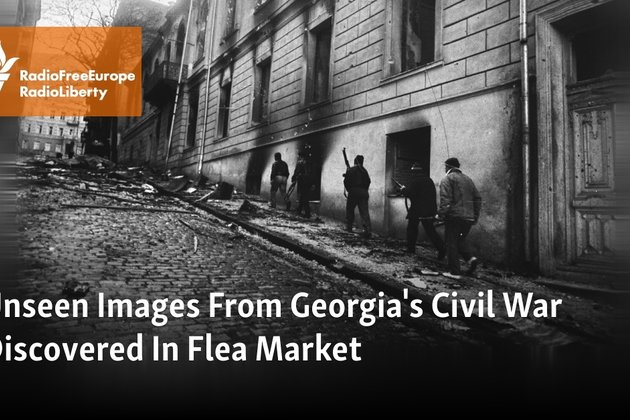
Gunmen walk up a street in central Tbilisi.
Some elderly Tbilisi residents then began sharing personal insight into what had preceded the photos.
‘This is Shevchenko Street. My grandmother Babelina lived in the last building on the third floor; you can see her balcony in the photo,’ one commenter noted under an image (above) of gunmen walking up a fire-scorched street.
‘She was lost without a trace,’ the eyewitness continued. ‘I twice went into her [burning] apartment, but she could not leave with me and then shooting broke out. I was in the building opposite and was too scared to cross the street. The next day the building had been destroyed by fire. These are very hard photos for me.’
A cameraman records in front of the Georgian parliament.
Remarkably, the story of the deceased woman was then apparently verified by another commenter who replied, ‘Oh, the late Babelina. Her husband’s name was Apollo. They lived on the floor above us. I remember those days. There was so much panic. No one could stop it. There was a rain of artillery, and we couldn’t bring her out.’
A previously unpublished photo shows destroyed buildings in central Tbilisi after the 1991-92 coup.
For Chubinidze, the overwhelming response to the images by the still-unknown photographer brought mixed emotions.
‘Maybe it’s interesting that people are reflecting on this time in our history, but on the other hand, it’s a very big horror,’ he says.
Men look over a destroyed vehicle.
Many of the commenters online, he says, had been defending the besieged Georgian president, who would die in December 1993 under mysterious circumstances.
‘They are traumatized people, and you could see that from their comments. I mean, they still live in that time, they still live as if it is 1991 or 1992. They were recognizing the faces, like, ‘Oh, this is the guy who was shooting at us.”
A destroyed building near the Georgian parliament that was later demolished.
The young historian believes the conflict that shattered the heart of his country’s capital remains a taboo subject today.
Georgians overwhelmingly view the violent overthrow of Gamsakhurdia as damaging for Georgia, yet Chubinidze says it is rarely discussed because ‘a lot of the people in [Georgia’s current political scene] were involved in the coup.’
A memorial event in 1992 or 1993 attended by Eduard Shevardnadze (center, with white hair), a Soviet then Georgian politician who came to power following the 1991-92 coup. The photo, which is published here for the first time, shows Shevardnadze alongside notorious Georgian coup leaders Jaba Ioseliani (center left in black coat) and Tengiz Kitovani (front right).
Chubinidze now hopes the images he discovered could serve as a foundation for some kind of open-source archive to safeguard some of Georgia’s visual history.
‘I want to make a place where people can come and scan their negatives, then upload them,’ he says. ‘Because we have a huge problem of the archives.’
Through years of unrest through the 1990s, the historian says, whole archives were stolen or lost.
“A lot of people just dumped photos,” Chubinidze says, adding that much of Georgia’s historic imagery is now “just sitting in people’s flats” vulnerable to the whims of elderly Georgians or their descendants.
A previously unpublished photo from immediately after Zviad Gamsakhurdia fled the capital, showing the entrance to Tbilisi’s National Gallery.
Chubinidze says his first goal is to identify the mystery photographer, whose style is unique for its technically expert yet scattershot visual record. Where other photographers tended to spend time on one scene, this photographer seemed to have sought only to make as varied and extensive a record as he could.
A visual journalist records the scene in front of the Georgian parliament.
‘He was filming everything in the street,’ the Tbilisi historian told RFE/RL. ‘And I’m sure that when he first arrived in the war zone, he was shocked, and he was just photographing everything. Like every corner, every barricade, everything. In a single day, the photographer captured around 200 photos showing the immediate aftermath of the coup that resulted in President Zviad Gamsakhurdia fleeing Tbilisi.’
A woman looks through a destroyed apartment in central Tbilisi.
Chubinidze has vowed to make the images he discovered in the flea market freely accessible online.
‘Making it public requires some investment in time and money, but regardless, sooner or later the photos will be available to all,’ he said.
Copyright (c) 2018. RFE/RL, Inc. Republished with the permission of Radio Free Europe/Radio Liberty, Washington DC 20036