Connect with us

Business

Young Dubai businessman behind unique SDaaS for SMEs

Published

on

Spread the love

A Dubai-bred young serial entrepreneur is disrupting the local Software as a Service market with a unique AI-driven platform for the Middle East and North Africa (MENA) region, launched at the start of the year.

Called Zoftware, it is “Software Democratisation as a Service, where software products of the people (companies) are recommended by our people (the team), for the people (B2B clients) for any problems they face in their businesses,” says Aayushman Dalmia, 29.

Within the first quarter of operations, Zoftware already has arrangements with a growing list of over 6,000 companies – including the Microsoft and Zoho suites, Google, Adobe and others.

“You can find a packed suite of software just with a generic search, but do you require everything in that or can you customize it? Maybe not. Zoftware is free for the customers while we work with them to understand their needs and even do the work for them in customising solutions from the software companies. Consider us as the Zomato or Tripadvisor for the software industry.

“Avoiding wastage of resources by reducing the gap between the capability knowledge of any software’s offerings and solving the problems of the end users is core to Zoftware’s mission,” says Dalmia, who came up with the idea when he could not find such a solution while searching for his needs himself.

“Zoftware is about marrying software with the best of customer experience. We make it easy for customers to navigate the ocean of software to find the right tools for their business and purpose. We offer deep insights on software and match organisations to the right product, be it for accounting, customer relationship management (CRM), project management, IT, payroll and many more,” says Dalmia, confident his idea will revolutionise the convenience of running a business.

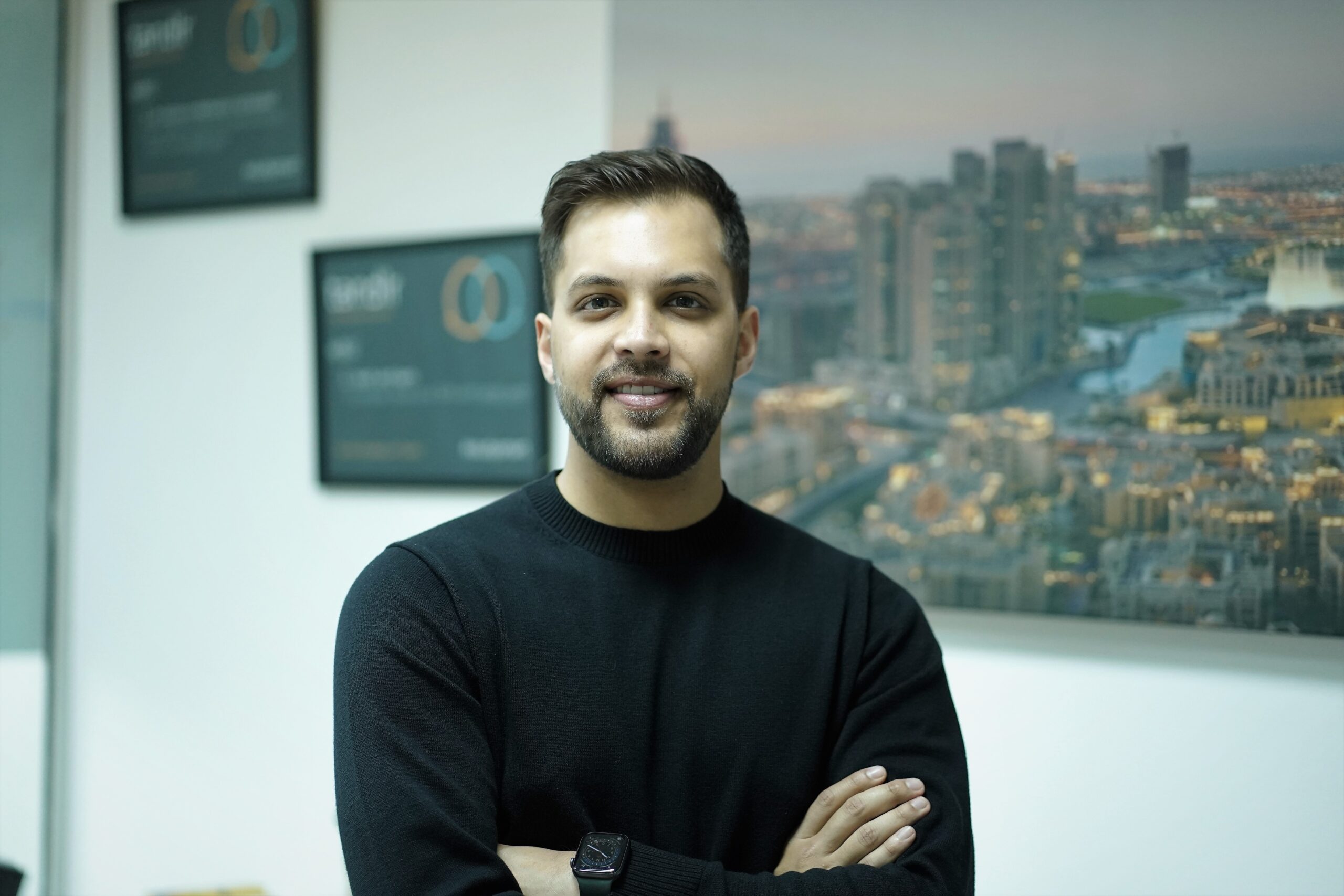
Aayushman Dalmia set up Zoftware after getting stuck with the wrong software as a choice for his family business. Supplied

Zoftware is a unique startup offering a choice of business tools in software with a personalised touch, using Open AI’s ChatGPT, for SME owners and companies. There are plans to take this to India, a huge market for SaaS providers and consumers.

“We have raised 500,000 dollars as a convertible note. And there are plans to raise another $1.5 million in the next round,” he says. “We are aiming for a revenue of $1.5 million by end of 2023.”

The rise of ChatGPT has only become an enabler for the Zoftware team. “Our technical analysts have been nimble to stay ahead on the transformation curve. We are in the process of setting up an AI bot with whom people can converse with, we understand what the customers want from the platform and give them the relevant output data while connecting with the vendors.

“If they want, we can also onboard it for them. With ChatGPT, it can give you out the names, but it cannot do comparisons and the prices that are out there. It cannot help you come to a decision, while we can help find the best value for the clients.

“According to studies, 75 percent of businesses fail in their software implementation. We want to make it to zero, because it is a waste of capital and resources such as time, effort and money. In the SME section, that is not something one can afford. We want to reduce the wastage cycle as much as possible. And we want to build the trust of our customers.”

Zoftware is Dalmia’s latest fruit of labour, coming from his own personal experiences when he saw a gap in the market. He set up Yalla Referral, a referral and benefits platform, is co-founder of an online diamond-purchasing platform Carat Finder and Director of Growth and Innovation at Data Direct Group.

“I remember, in 2018, when I wanted to implement CRM for my sales team, I ended up putting so much effort and money only to realise a year later that I had a complex setup which wasn’t needed at all. Several dollars went in waste apart from the time and effort. Many startups and SMEs may not be able to come out of the wrong direction taken.”

Real estate

Dubai is testing tokenised property: What it means for first-time buyers

Published

on

Spread the love

Dubai is taking a new step in how people can invest in property, and it doesn’t require buying an entire apartment or villa.

The Dubai Land Department (DLD) has launched Phase II of its Real Estate Tokenisation Project, which allows property tokens to be resold in a controlled secondary market starting February 20. In simple terms, this means Dubai is testing how digital ownership shares in real estate can be bought and sold under official regulation.

What is “real estate tokenisation”?

Think of a property as a pizza. Instead of one person buying the whole pizza, tokenisation allows it to be cut into many digital slices. Each slice, called a token, represents a small ownership share in that property.

These tokens are recorded digitally and linked to official property records. Owners of tokens may benefit from price changes or rental income, depending on how the product is structured.

What’s new in Phase II?

Earlier this year, Dubai ran a pilot phase to test whether property tokenisation could work legally and technically.

Phase II is different because:

  • Tokens can now be resold in a secondary market
  • Real trading activity is being tested
  • Regulators are watching closely to ensure fairness and safety

About 7.8 million tokens will be available in this phase, but only through approved platforms and under strict rules.

Why is Dubai doing this?

The goal is to:

  • Make property investment more accessible
  • Attract new types of investors
  • Improve transparency and efficiency
  • Test innovation without risking the wider market

Dubai wants to modernise real estate — but in a careful, regulated way.

Is this crypto or risky trading?

Not in the usual sense.

While tokens are digital, this project:

  • Is overseen by the Dubai Land Department
  • Is regulated with support from the Virtual Assets Regulatory Authority (VARA)
  • Operates within existing property laws

This is not an open crypto marketplace. It’s a controlled government-backed test.

Can anyone invest right now?

Not everyone, and that’s intentional.

This phase is limited and focused on testing. Authorities are collecting data on:

  • Pricing
  • Demand
  • Liquidity
  • Investor behaviour

Future expansion will depend on how well this phase performs.

What should first-time investors keep in mind?

If you’re curious but new to property investing:

  • This is not a get-rich-quick scheme
  • It’s a long-term experiment
  • Rules may evolve as regulators learn from real use

Dubai has been clear: expansion will be based on data, not hype.

Why this matters long-term

If successful, tokenisation could:

  • Lower entry barriers to property investment
  • Allow people to invest smaller amounts
  • Increase market transparency
  • Strengthen Dubai’s position as a global real estate hub

For now, it’s best seen as a carefully supervised trial, not a finished product.

Continue Reading

Business

UAE unveils gold and silver coins to mark 5 years of Mohamed bin Zayed University of AI

Published

on

Spread the love

The Central Bank of the UAE (CBUAE) has unveiled a set of gold and silver commemorative coins to mark the fifth anniversary of the Mohamed bin Zayed University of Artificial Intelligence (MBZUAI).

The special issue celebrates five years since the university officially opened its doors in 2020, highlighting the UAE’s growing role as a global leader in artificial intelligence, innovation and advanced technology.

Limited-edition gold and silver coins issued

To mark the occasion, the CBUAE has issued:

  • 10 gold coins
  • 500 silver coins

Each commemorative coin weighs 50 grams and will be available for purchase through the Central Bank of the UAE and MBZUAI.

Coin design details

One side of the gold coin features an image of MBZUAI, along with the years 2020–2025. The reverse side displays the UAE national emblem, surrounded by the name “Central Bank of the UAE” in both Arabic and English.

The design also includes the inscription “Power from Knowledge to Serve”, encircled by the name “Mohamed bin Zayed University of Artificial Intelligence” in Arabic and English, alongside the university’s official logo.

The silver coin carries the same design, with its reverse side featuring a face value of Dh50.

Celebrating innovation and leadership

The commemorative release marks MBZUAI’s fifth anniversary and reflects the UAE’s commitment to advancing cutting-edge research, artificial intelligence and knowledge-based development.


Continue Reading

Announcements

Dubai Loop explained: What Elon Musk’s underground transport project means for city’s residents

Published

on

Spread the love

Getting around Dubai could soon become much faster and easier. The city has confirmed that work on the Dubai Loop, an underground high-speed transport system developed by Elon Musk’s Boring Company, is set to begin soon, starting in some of Dubai’s busiest areas.

The announcement was made by Matar Al Tayer, Director General and Chairman of the Board of Executive Directors of the Roads and Transport Authority (RTA), at the World Government Summit.

The project aims to cut travel times, reduce traffic congestion, and make daily commutes smoother, especially in high-density districts.

So, what exactly is the Dubai Loop?

The Dubai Loop is a network of underground tunnels where electric vehicles will transport passengers directly from one station to another, without stopping in between. Think of it as skipping traffic lights, junctions and road congestion altogether.

Once completed, the system will span 24 kilometres and could move up to 20,000 passengers every hour, with plans to expand capacity even further in the future.

Where will it start?

The first phase of the project will launch in key areas that many residents already commute through daily:

  • Dubai International Financial Centre (DIFC)
  • Dubai Mall area

These locations were chosen because they see some of the heaviest traffic in the city, especially during peak hours.

When is it happening?

According to Dubai’s Roads and Transport Authority (RTA), construction on the first phase will start immediately once contracts are finalised.

  • First phase: 6km (costing Dh600 million)
  • Total project: 24km (Dh2.5 billion)
  • Estimated completion: Around two years

How fast will it be?

Very fast. The vehicles inside the Dubai Loop could travel at speeds of up to 160km/h, meaning residents could move between major destinations in just minutes.

Why underground?

By going underground, Dubai avoids:

  • Road closures and surface disruption
  • Weather-related delays
  • Expensive road expansion projects

The tunnelling technology used is also cheaper and faster than traditional road construction, helping the city deliver infrastructure efficiently.

How will this help residents?

For people living and working in Dubai, the Dubai Loop could mean:

  • Shorter commutes in congested areas
  • Less time stuck in traffic
  • Better connections between business districts, malls and transport hubs
  • A smoother “first and last mile” journey to metro stations

The system is expected to serve around 13,000 passengers daily in its early stages, with numbers growing as the network expands.

Has this worked elsewhere?

Yes. A similar underground transport system already operates in Las Vegas, where it has carried more than 2 million passengers since 2021. Dubai’s version will build on that experience, adapted for local needs.

What’s next?

Dubai Loop is part of the emirate’s broader push towards smart, sustainable transport. If successful, the network could expand to more areas of the city, helping residents get from A to B faster, without adding more cars to the roads.

For Dubai residents, this could mark the beginning of a new era of stress-free commuting beneath the city streets.


Continue Reading

Popular

Exit mobile version
https://headline.ae/