

Business
Dubai’s Sheikh Mohammed launches UAE rail freight operations




Abu Dhabi: Sheikh Mohammed bin Rashid Al Maktoum, Vice President, Prime Minister and Ruler of Dubai, launched the cargo train operations of the national rail network from its operations control centre in Al Fayah region, Abu Dhabi, on Friday.
Praising the efforts of those involved, Sheikh Mohammed said “connecting the Emirates via a national railway network strengthens our capabilities and competitiveness, and consolidates our unity,” he said.
Sheikh Theyab bin Mohamed Al Nahyan, member of the Abu Dhabi Executive Council and chairman of Etihad Rail, said: “Emirati talents, with the support of the UAE leadership, have turned the dream of our founding fathers into reality. We succeeded in launching a railway network with international specifications that extends to about 900 kilometres across the Emirates. We announce the inauguration operation of the freight trains throughout the UAE with a fleet of 38 locomotives and more than 1,000 wagons capable of transporting all types of goods.”
He pointed out that the completion of the network according to the schedule and the approved budget would not have been possible without the cohesion of the talented Emirati cadres.
The network contributes to supporting companies’ businesses and enhancing investment opportunities. The main line of the UAE National Rail Network extends from Ghuweifat on the border of the Kingdom of Saudi Arabia, to Fujairah, forming an essential part of the global supply network.
The stage one of the Network has been fully operational since January 2016, where the stage two of the project started in early 2020.

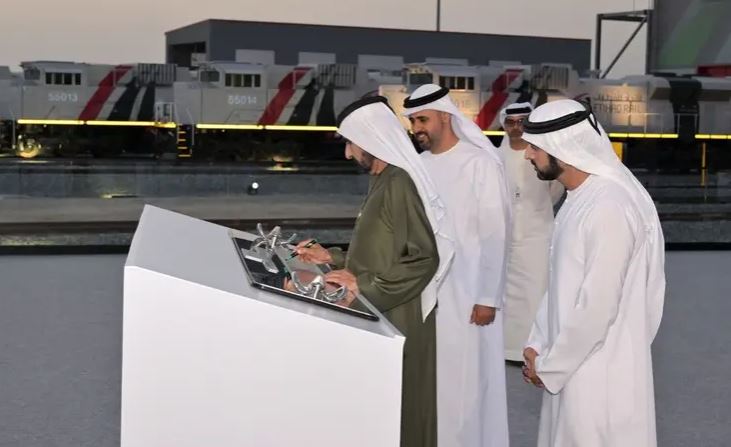
Sheikh Mohammed bin Rashid, Vice President and Ruler of Dubai, opens the UAE’s freight train network, the latest stage of Etihad Rail, the country’s mega national network project. WAM
The UAE national railway network will contribute to supporting the national economy at a value of AED200 billion, and saving AED8 billion in the cost of road maintenance. The network’s tourism benefits are estimated at AED23 billion.
The project has contributed to supporting the local industry by assigning 215 companies and local entities. also, 70 percent of the building materials used in the project are produced by the local industry.
The project also supports the UAE’s sustainable development goals and contributes to achieving the UAE Net Zero by 2050, through reducing carbon emissions in the road transport sector by 21 percent, and reducing road transportation emissions per capita by 40 percent, by 2050.
The project has enlisted 11 contractors, 25 consultants, and 28,000 specialists. It took 133 million working hours to complete, and 40,000 approvals from 180 government agencies.
More than 1,000 operational documents have been produced, including instructions, handbooks, guidelines, policies, operating procedures, agreements, and others.
The UAE national railway network passes through a variety of geographical terrains, within a large-scale engineering plan that includes the construction of 593 bridges and crossings of all types, and 9 tunnels with a length of 6.5 km. It took 120 million cubic metres of excavation work to complete, to ensure the highest levels of vehicular traffic flow under the tracks of the railway network.
HH Sheikh Mohammed bin Rashid Al Maktoum Announces Launch of National Railway Network#UAE #Dubai #AbuDhabi @HHShkMohd@Etihad_Rail pic.twitter.com/TmDe1meBMn
— UAE Forsan (@UAE_Forsan) February 23, 2023
The fleet of the most modern freight trains in the region includes 38 locomotives, with a capacity of 60 million tonnes of goods annually, and more than 1,000 multi-purpose vehicles.
Each goods transport’s locomotive operates with a power of 4,500 horsepower, equivalent to 3,400 kilowatts. It is one of the most powerful freight train engines in the Middle East.
The freight trains will run up to 120 km/h. The standard width of the rail is 1,435 metres, and it operates under the European ETCS level 2 signalling system. It has been specially designed to withstand the geographical nature, climatic conditions, high temperatures and humidity in the GCC region, to ensure high levels of performance, efficiency and sustainability.
The freight trains will connect four major ports. It will include seven logistics centres across the country, to serve trains and related businesses.







Announcements
New-look Abu Dhabi T10 raises the stakes with star-studded 2026 draft; Naseem, Hales, Amir and Shanaka among top picks





Dubai-born HOP Events targets 25 cities in global expansion

New-look Abu Dhabi T10 raises the stakes with star-studded 2026 draft; Naseem, Hales, Amir and Shanaka among top picks


