News
Hamdan bin Mohammed opens Dubai-Al Ain Road Improvement Project
DUBAI, 29th May, 2022 (WAM) — H.H. Sheikh Hamdan bin Mohammed bin Rashid Al Maktoum, Crown Prince o



WAM
DUBAI, May 29: Sheikh Hamdan bin Mohammed bin Rashid Al Maktoum, Crown Prince of Dubai and Chairman of Dubai Executive Council, has officially opened the Dubai-Al Ain Road Improvement Project built at a cost of AED2 billion.
Undertaken as part of Dubai’s master transport plan, the project affirms Dubai’s efforts to accelerate its economic development with major projects.
Speaking on the occasion of the opening, Sheikh Hamdan bin Mohammed said: “Dubai continues to advance the implementation of infrastructure development plans aimed at enhancing human welfare and catalysing sustainable economic growth. It is also part of our broader strategy to transform Dubai into the world’s best place to live, work and visit as well as strengthen our readiness to meet future needs in one of the fastest growing cities worldwide.”
Sheikh Hamdan further said that the government has always placed the highest priority on constantly improving Dubai’s road infrastructure, since it plays an important role in raising the emirate’s competitiveness in addition to creating an attractive business and investment environment and providing a high quality of life for the community.
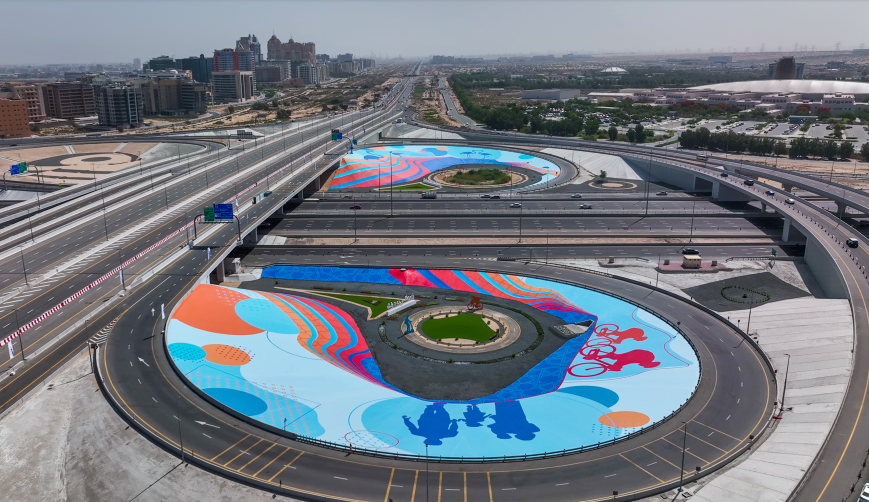
The scope of the Dubai-Al Ain Road Improvement Project spans 17 km from the intersection of Emirates Road to the intersection of Ras Al Khor Road along the Dubai-Al Ain Road. Construction works included widening the road from three to six lanes in each direction, and constructing six main interchanges along with bridges and ramps stretching 11.5 km.
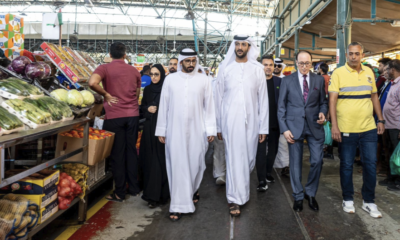
Upon arrival at the project site, Sheikh Hamdan was received by Mattar Al Tayer, Director-General, Chairman of the Board of Executive Directors of the Roads and Transport Authority (RTA).
Benefits to the community
The project will ease traffic flow and improve links with the Sheikh Mohammed bin Zayed Road, Sheikh Zayed bin Hamdan Al Nahyan Road, and Emirates Road, besides serving the current and future communities such as Dubailand Residence Complex, Liwan and Silicon Oasis on either side of the Dubai-Al Ain Road.

This stretch of Dubai Al-Ain road connects the Mohamed bin Zayed and Emirates roads. Courtesy WAM
It will benefit a population of 1.5 million living or working in the neighbourhood on both sides of the road. It also serves 25 universities and colleges where a total of 27,500 students are enrolled. The improvements will double the intake of the road from 12,000 to 24,000 vehicles per hour in both directions.
It will also slash the travel time on the Dubai-Al Ain Road from the intersection of Ras Al Khor Road to the intersection of the Emirates Road by 50% from 16 minutes to eight minutes during peak time. Furthermore, it will solve traffic snarls that used to extend about two kilometres.
Connectivity
Sheikh Hamdan was also briefed on two projects under construction. The first is the Al Manama Street Improvement Project where the existing roundabouts will be transformed into signalised junctions. Construction for the project is expected to be completed in September.
The other is the improvement of the junction of the Academic City on Sheikh Zayed bin Hamdan Al Nahyan Street Project, which is scheduled for completion in December this year. In future, the sector of Sheikh Zayed bin Hamdan Al Nahyan Street from the Academic City to the junction of Al Awir Road will be further improved.
Ramping it up
Outlining the project’s highlights, Al Tayer said, “The improvement of the Dubai-Al Ain Project included the construction of four two-lane ramps at the junction of Sheikh Mohammed bin Zayed Road extending 2,600 metres to ensure free and smooth traffic movement in all directions at the junction.


The previous bridge on Sheikh Mohamed bin Zayed Road had been improved to allow for the widening of the Dubai-Al Ain Road from three to six lanes in each direction in addition to the construction of service roads on both sides of the road. The total capacity of bridges at the junction will jump to 36,000 vehicles per hour in all directions, which will ensure smooth traffic flow on the Sheikh Mohammed bin Zayed Road from Al Qusais in the direction of Al Ain.”
Works included widening the road from three to six lanes in each direction and constructing service roads on both sides to enhance traffic safety levels. Overall, the project covered the improvement of six key junctions with the Emirates Road, Sheikh Zayed bin Hamdan Al Nahyan Street, Sheikh Mohammed bin Zayed Road, Nad Al Sheba Road, Al Meydan Road and Ras Al Khor Road.
These junctions facilitate smooth traffic flow and serve the residential communities on both sides of the road such as the Academic City, Dubai Silicon Oasis, Dubailand Residential Complex, Liwan, and the Dubai Design District. The bridges at the six junctions stretch 6,600 metres in length and their ramps span 4,900 metres in total.
Six junctions
The improvement of Dubai-Al Ain Road junctions included the construction of a ramp at the intersection with the Emirates Road and a 220-metre bridge to link Sheikh Zayed bin Hamdan Al Nahyan Street with it.
The works will ease congestion seen in recent times from inbound traffic from the Dubailand Residential Complex as well as ease commute for those heading into Academic City and Silicon Oasis from nearby areas. Service roads have been constructed on both sides of the road along with turns to serve other traffic movements and development projects.
Other project works included the improvement of the Nad Al Sheba intersection to serve traffic from the Dubai-Al Ain Road to Nad Al Sheba and vice versa along with improvements of the inward and outwards surface roads of the Nad Al Sheba district.
Improvements covered the junction of Al Meydan Road with the Dubai-Al Ain Road, which has been linked with Al Manama Street by a four-lane bridge in each direction to link Al Meydan Road with Al Manama Road. Moreover, the previous bridge connecting Al Meydan Road and the Dubai-Al Ain Road has been improved to serve the residential projects of Meydan.
-
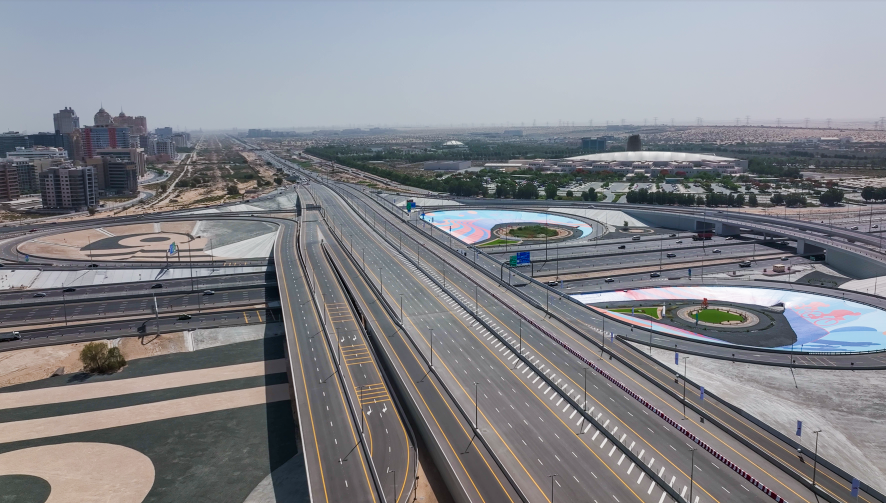
This stretch of Dubai Al-Ain road connects the Mohamed bin Zayed and Emirates roads. Courtesy WAM









Tributes have poured in after the son of former Chelsea star Eddie Newton was found dead alongside his friend following a hike in the UAE, where temperatures soared to 50C.
Cassius Newton, 34, and his friend Aran Martinson, 33, were found by rescuers on July 18 after setting out on a hike in the mountainous Wadi Naqab region.
The pair, from Dorset and Essex respectively, both lived and worked in the UAE. Their bodies were discovered between 3km and 4km from their vehicle.
According to a report, Chelmsford area coroner Michelle Brown said their provisional causes of death included cardiac and respiratory arrest.
Cassius, a non-league footballer, was the son of former Chelsea midfielder and coach Eddie Newton, who spent more than a decade with the club.
His wife was in the UK when she became concerned after Cassius failed to contact her following the hike and reported him missing.
The two men had been living at a luxury resort in Ras Al Khaimah.
Tributes after desert tragedy


Tributes poured in after the deaths.
Aran’s wife described him as “incredibly driven, hardworking and ambitious”, saying he had recently begun a new chapter in his career and was excited about the future.
Blackfield & Langley Football Club paid tribute to their former player, saying: “It is with heavy hearts that we share the sad news of the passing of former player Cassius Newton; our thoughts and deepest sympathies are with his family and friends during this difficult time.”
National League club Eastleigh, where Cassius had previously played, said it was “deeply saddened” by his death.
Chelsea connection


Cassius’ father Eddie Newton played for Chelsea from 1990 to 2001 and famously scored in the club’s 1997 FA Cup final victory.
The former midfielder also represented Cardiff City, Birmingham City, Oxford United and Barnet.
After retiring as a player, Newton moved into coaching, working as assistant manager at MK Dons and West Brom before returning to Chelsea.
He later served as assistant manager under Roberto Di Matteo and Rafael Benítez.
(With inputs from BBC, The Sun)




Flying-car trials planned in Ras Al Khaimah under new UAE-China agreement

Yas Marina to stage first Abu Dhabi F1 Sprint as 2027 calendar expands