News
SCRF: Grandma tales fame Sudha Murty looks at audiobook to connect with children


Celebrated author, educator and philanthropist Sudha Murty left a packed hall of all age groups at the Sharjah Children’s Reading Festival (SCRF) captivated and craving for more just as her books do even at the age of 72.
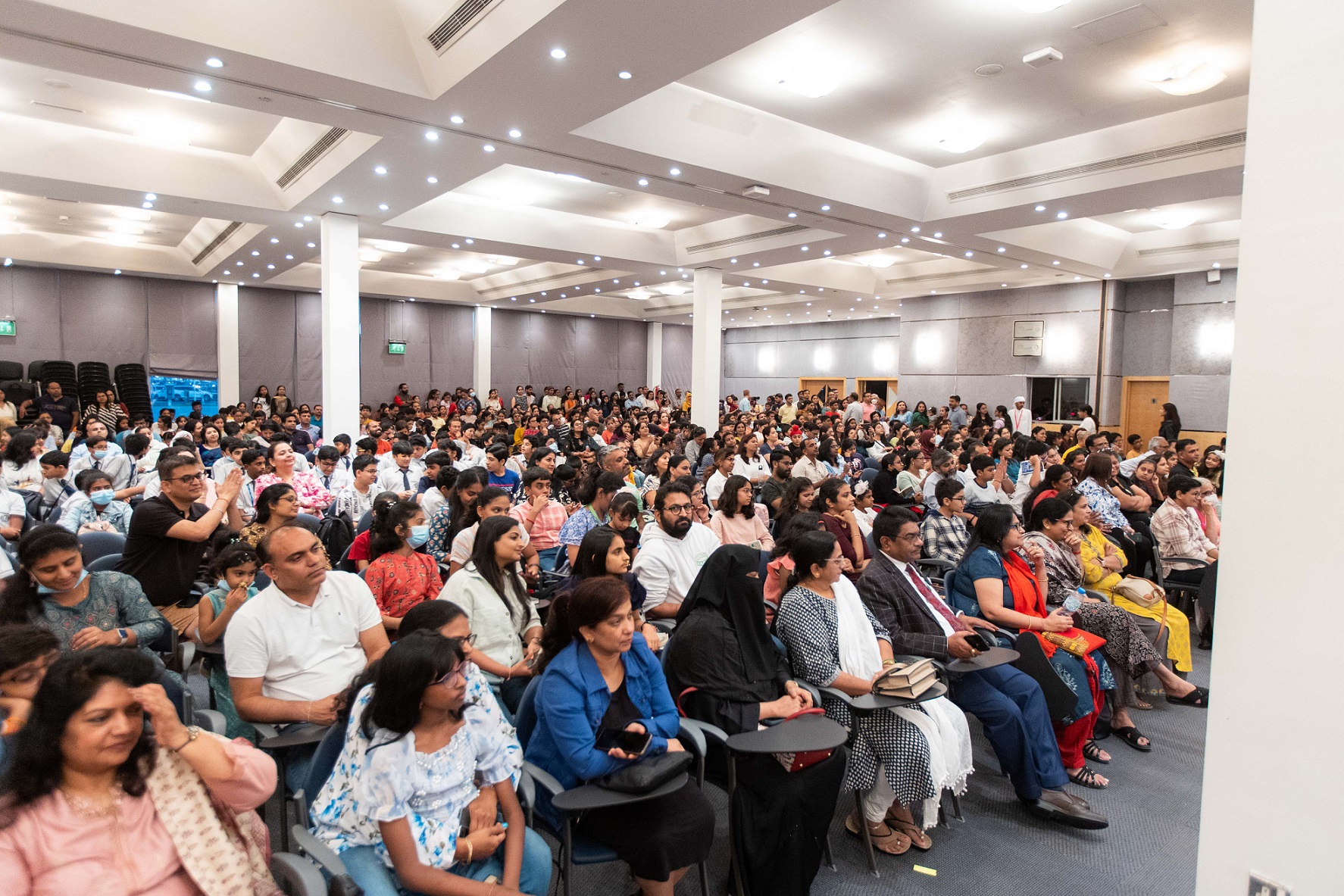
Her session, titled ‘Tales of Grandma’, was the highlight of the day and the organisers even had to shut the doors midway into the session after the alleys also filled up with people standing. Many trooped in a little late because there were no clear directions on the agenda.
The love and affection from the children and parents alike, clamouring for pictures, blessings and signed autographs on her books, became so overbearing that the SCRF security had to called it off fearing a stampede on the dias.
Ms Murty, awarded India’s highest civilian honour Padma Bhushan last month, regaled the audience with tales as a grandmother would. Asked to choose a favourite among her published works, she said: “It is difficult to ask a mother to choose between her children, and my books are my children.” the author of 44 books (29 in English and 15 in Kannada) acknowledged that she now releases one book a year.


The Intellectual Hall at the Expo Centre was packed to the rafters. SCRF
To an interesting question about embracing technology through mediums such as podcasts to deliver her stories, Ms Murty gave a revealing confession. “I have always been comfortable just writing. Lately, I have been told that I need to look into new formats to share my stories. Podcasts are not for me. However, I recently requested my daughter to look into the possibility of audiobooks”.
Ms Murty’s advice to the young audience is to develop hobbies. “It can be anything, even one is fine if you pursue it in all earnest without letting your studies get affected. In fact, the hobby will help you focus on your studies, while also helping you become a better person.”
For the uninitiated, most of Ms Murty’s books are based on her real-life experiences, and hence “non-fiction to a large extent,” she said. Among her latest works has been a three-book set: Gopi Diaries. Citing the latest trilogy as an example, Ms Murty revealed that Gopi in the book is actually his dog. She also shared anecdotes of how the dog was initially unwanted, but ended up becoming “my son” within a year of entering the household.
Ms Murty is a philanthropist and wife of tech multinational Infosys head Narayan Murthy. Their daughter Akshata is married to British Prime Minister Rishi Sunak. Recently, a video of her casual chat about Sunak went viral.

House of Wisdom visit
The author then visited the House of Wisdom (HoW), Sharjah’s iconic cultural centre and futuristic library, where she was introduced to the emirate’s efforts to promote culture, knowledge and innovation amongst the younger generation in the UAE and beyond. She sifted through HoW’s exhaustive physical and digital archives and was briefed on the various programmes and initiatives led by HoW to stimulate imaginations and boost cross-cultural understanding and exchange.
As part of her tour through HoW’s world-class facilities, Ms Murty stopped at the Little Reader section, where she was briefed on the events and workshops that are designed exclusively for children in order to develop their skills in a variety of areas. She also reviewed the wide-ranging collection of children and young adult titles in English, Arabic and other languages.












Tributes have poured in after the son of former Chelsea star Eddie Newton was found dead alongside his friend following a hike in the UAE, where temperatures soared to 50C.
Cassius Newton, 34, and his friend Aran Martinson, 33, were found by rescuers on July 18 after setting out on a hike in the mountainous Wadi Naqab region.
The pair, from Dorset and Essex respectively, both lived and worked in the UAE. Their bodies were discovered between 3km and 4km from their vehicle.
According to a report, Chelmsford area coroner Michelle Brown said their provisional causes of death included cardiac and respiratory arrest.
Cassius, a non-league footballer, was the son of former Chelsea midfielder and coach Eddie Newton, who spent more than a decade with the club.
His wife was in the UK when she became concerned after Cassius failed to contact her following the hike and reported him missing.
The two men had been living at a luxury resort in Ras Al Khaimah.
Tributes after desert tragedy


Tributes poured in after the deaths.
Aran’s wife described him as “incredibly driven, hardworking and ambitious”, saying he had recently begun a new chapter in his career and was excited about the future.
Blackfield & Langley Football Club paid tribute to their former player, saying: “It is with heavy hearts that we share the sad news of the passing of former player Cassius Newton; our thoughts and deepest sympathies are with his family and friends during this difficult time.”
National League club Eastleigh, where Cassius had previously played, said it was “deeply saddened” by his death.
Chelsea connection


Cassius’ father Eddie Newton played for Chelsea from 1990 to 2001 and famously scored in the club’s 1997 FA Cup final victory.
The former midfielder also represented Cardiff City, Birmingham City, Oxford United and Barnet.
After retiring as a player, Newton moved into coaching, working as assistant manager at MK Dons and West Brom before returning to Chelsea.
He later served as assistant manager under Roberto Di Matteo and Rafael Benítez.
(With inputs from BBC, The Sun)




Yas Marina to stage first Abu Dhabi F1 Sprint as 2027 calendar expands

Football community mourns ex-Chelsea star’s son after tragic desert hike