Connect with us

Technology

DFS Dialogue: FinTechs and banks joining forces in welcome trend

Published

on

Spread the love

Collaboration and not collision of interests is the emerging pathway for FinTech companies and banks to build a better economic system in the UAE and the world. This is the message coming out of Dubai International Financial Centre where 10 head honchos came together for the second of Dubai FinTech Summit (DFS) Dialogues, a precursor series to the main event on May 8 and 9.

Mohammad AlBlooshi

The 10 speakers deliberated the challenges which face the financial sector, and how the industry can de-risk while building sustainable institutions. Host Mohammad AlBlooshi, Head of DIFC Innovation Hub and FinTech Hive, said: “As an industry predicated on confidence and trust, we are currently seeing the banking sector experience a time of disruption. Given global headwinds, we have an opportunity to build more resilient institutions through collaboration between banks and FinTechs.”

According to recent research by Report Ocean, the global FinTech lending market was valued at approximately US$ 573 billion in 2021. It’s expected to grow at a healthy cumulative growth rate of more than 27.4% over the forecast period of 2022-2029.

Banks v FinTechs is history

The FinTech sector, widely recognised as a major competitor to banks, is expected to double in size from $135.9bn in 2021 to $266.9bn in 2027, according to a 2022 report by DIFC FinTech Hive. Additionally, with approximately 50 per cent of the MENA region currently unbanked or underbanked, FinTechs have been playing a crucial role in promoting inclusive economic growth in the region.

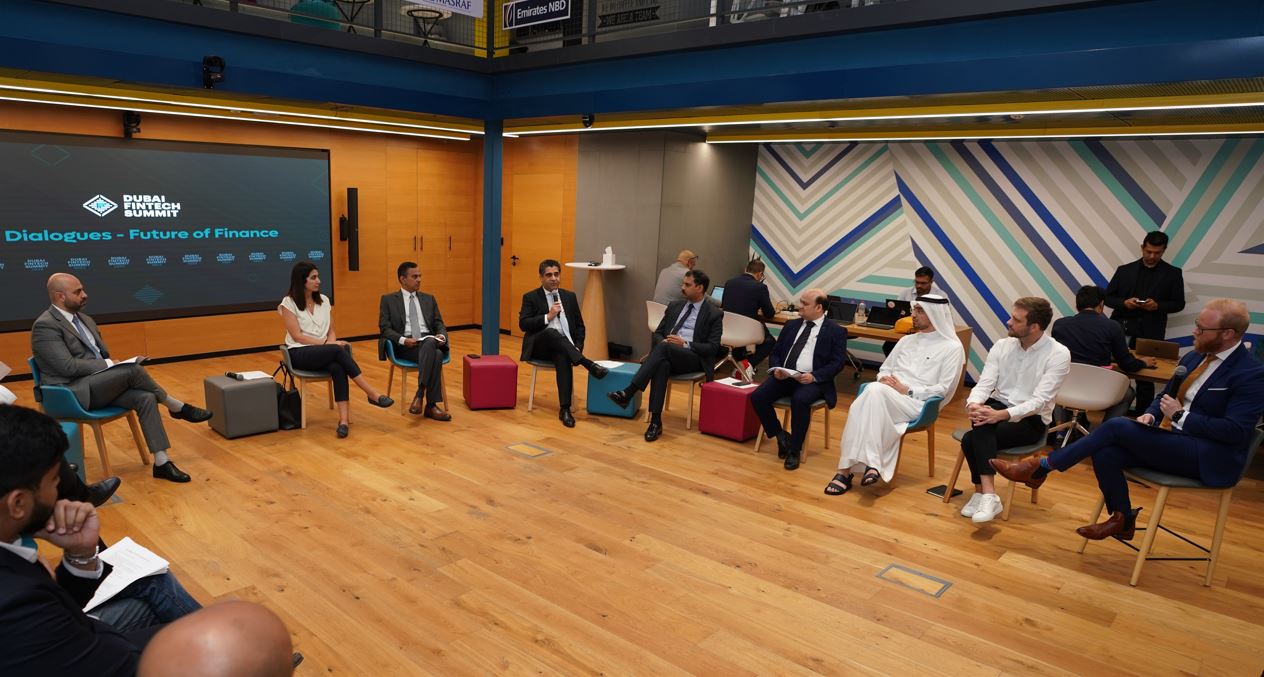
Ten head honchos from banks and FinTechs came together to discuss disruption in the industry. Trescon Global

However, a unanimous takeaway from all banks at the DFS Dialogue captured how both entities are in fact symbiotic. Sanjay Sethi, Senior Managing Director, Head of Global Transaction Banking at First Abu Dhabi Bank, said, “this is an age of collaboration and co-creation where leading financial institutions and pioneering FinTechs can embark on a journey of innovative discovery together. This is especially true when we look at opportunities to expand into new geographies, improve product capabilities, grow revenues, or scale or optimise our business faster and more efficiently. Alongside this, FinTech solutions in transaction banking are growing in agility every day.”

Earlier this year, the UAE Central Bank announced the implementation of its Digital Dirham currency strategy, which promises to be a critical step in the country’s payments industry. “As such, the synergy between banks and FinTechs proves to be unavoidable as the industry inches towards a cashless economy,” added AlBlooshi.

Enhancing trust

A report by Economist Impact and supported by Google has predicted that the financial services and banking industry will emerge as the primary spender for AI technology in the MENA. The industry will make up nearly 25 per cent of all AI investments in the region, with banking tech alone expected to contribute 13.6 per cent to the region’s gross domestic product by 2030.

Mehdi Tazi, Chief Operating Officer, Lean Technologies, stated, “I believe customers still trust banks more than FinTechs – they are larger more established institutions. However, something FinTechs do very well is streamlining processes when helping onboard customers into these larger banks. As a result, we are seeing a marriage between FinTech and banking that enhances the customer’s journey, ultimately building trust.”


The onset of Web 3.0 ushers in a transformative moment for financial services, capital markets and banking, shifting customer expectations and revolutionising the sector. The total transaction value of embedded finance is estimated to reach $7 trillion in 2026, as per Rakesh Reddy, CEO, Cloud4u, “This is particularly useful for Platform as a Service (PaaS) providers who will strongly benefit from this growth, undeniably becoming a key industry disruptor.”

Nilay Singh, Chief Executive Officer, State Bank of India, DIFC, pointed out, “We cannot ignore AI. It has to be adopted but cleverly and effectively, and this is where we need to understand what to outsource and when to collaborate.”

With a unified goal to enhance inclusive banking solutions for the region, traditional financial establishments are optimistic in growing partnerships with FinTech companies to bridge gaps and stay ahead of the curve strategically.

More such conversation starters will be on show at the Dubai FinTech Summit, to be held at Madinat Jumeirah on May 8-9. Visitors can purchase tickets with early bird prices available until 15 April 2023.

HEADLINE READERS GET DISCOUNTED TICKETS: As media partners, Headline UAE can get you 10% off on the big ticket to the most high-profile event in town. All you have to do is hit a like on the Instagram post to this story on our page and DM us. We will send you a code to use in the booking, so hurry!   
Business

Middle East set to attract over $100bn a year in energy, healthcare and digital investment by 2026

Published

on

Spread the love

The Middle East is on track to attract more than $100 billion (Dh370 billion) a year in major investments by 2026, spanning energy, renewables, healthcare, digital infrastructure and manufacturing, according to a new industry outlook by Grand View Research (GVR).

Despite the global shift towards cleaner energy, the region, led by the UAE and Saudi Arabia, is expected to remain a global powerhouse in oil and gas, while rapidly scaling renewable energy, digital transformation and healthcare innovation.

Oil and gas remain central, with a tech-driven twist

The UAE and its Gulf neighbours currently account for around 30 per cent of global oil production and 17–18 per cent of gas output, cementing the region’s role as a key energy supplier.

While global oil demand growth is expected to remain modest through 2026, gas demand is forecast to rise by around 3.5 per cent, driven by power generation, industrial expansion and LNG exports.

“The Middle East’s oil and gas sector remains a market anchor, but technology adoption and LNG expansion will define competitiveness over the next few years,” said Swayam Dash, Managing Director at Grand View Research.

Across the UAE, producers are increasingly deploying AI, IoT, drones and robotics to cut costs and improve operational efficiency, alongside investments in carbon capture, storage and early-stage hydrogen projects under the UAE Energy Strategy 2050.

Renewables and battery storage gain pace

Renewable energy is expanding rapidly across the Gulf, with falling solar auction prices making clean energy increasingly competitive. Both the UAE and Saudi Arabia are mandating battery storage alongside new solar and wind projects, helping stabilise power grids as renewable capacity grows.

Dubai has announced plans for multi-gigawatt renewable additions by 2030, while Saudi Arabia continues to roll out large-scale solar and hydrogen projects under Vision 2030.

Healthcare becomes an economic growth engine

Healthcare is also emerging as a strategic investment sector. In 2023, Dubai welcomed more than 690,000 medical tourists, generating over Dh1 billion in healthcare revenue and boosting related sectors such as hospitality and travel.

The UAE’s National Digital Health Strategy, which integrates platforms like Riayati, Malaffi and Nabidh, has consolidated more than 1.9 billion medical records across 3,000 facilities, positioning the country as a regional leader in digital healthcare.

Data centres, cloud and advanced manufacturing

Digital infrastructure is another major growth driver. The GCC data centre market is expected to grow at around 13 per cent annually through 2030, with the UAE and Saudi Arabia accounting for up to 70 per cent of new capacity.

Cloud adoption is accelerating too, with nearly 75 per cent of organisations expected to rely mainly on cloud platforms by 2026, boosting demand for cybersecurity, AI and enterprise digital tools.

By 2026, GVR expects the region’s economy to reflect balanced diversification, combining energy leadership with rapid growth in renewables, healthcare, digital systems and advanced manufacturing.

“The scale of investment shows how the Middle East is shifting from resource reliance to technology-enabled growth,” Dash said.


Continue Reading

Crime

AI scams are getting smarter: UAE Cybersecurity Council warns online fraud is harder than ever to spot

Published

on

Spread the love

Online scams are no longer easy to recognise, and artificial intelligence (AI) is the reason why.

The UAE Cybersecurity Council has issued a fresh warning saying AI-powered fraud is making online scams more convincing, faster to create, and far more difficult to detect. The alert comes as part of the council’s ongoing Cyber Pulse awareness campaign.

According to the council, criminals are now using advanced AI tools to do in seconds what once took days. This includes cloning voices, tweaking logos to look official, and crafting polished messages designed to spark urgency, fear, or panic.

Even more concerning? AI-driven phishing attacks are now linked to over 90 per cent of digital security breaches, with many scam messages carefully designed to remove the usual red flags like spelling mistakes or poor formatting.

Authorities are urging residents to be extra cautious when receiving messages that ask for personal or financial information, especially those containing links or claiming to be urgent security alerts. When in doubt, the advice is simple: stop, verify, and check through official channels before taking action.

The council also warned that highly realistic AI-generated images and advertisements circulating on social media are increasingly being used to mislead users into scams.

To stay safe, the Cybersecurity Council recommends:

  • Avoiding unverified links
  • Enabling multi-factor authentication
  • Using trusted security software
  • Double-checking messages for inconsistencies

Now in its second year, the Cyber Pulse campaign continues across social media as part of the UAE’s wider efforts to promote safe online behaviour and strengthen trust in the country’s rapidly evolving digital ecosystem.

Continue Reading

Business

IT services spend in mena set to reach up to 28% of total it budgets as services-led transformation accelerates

Published

on

Spread the love

The Middle East and North Africa (MENA) is entering a decisive, services-led growth phase in its IT sector, as enterprises and governments accelerate large-scale digital transformation initiatives. Investments in cloud computing, artificial intelligence (AI), data centres, and cybersecurity are reshaping technology priorities, with implementation, integration, and managed services gaining prominence over traditional software-led models.

Industry analysis by Grand View Research (GVR) reveals that IT services currently account for around 21–22% of total IT spending across MENA, a share expected to rise to between 26 and 28% by the end of the decade. The region’s professional IT services market, valued at USD 33.9 billion (Dh124.5 billion) in 2024, is forecast to grow to nearly USD 58.3 billion (Dh214 billion) by 2030, registering a compound annual growth rate (CAGR) of approximately 9.5%.

Sourav Bhanja, Middle East Head of GVR, said: “Many B2B IT services firms in the region continue to underinvest in digital engagement. Professional platforms such as LinkedIn remain underutilised, while company websites often lack strong case studies, sector-specific storytelling, and clear positioning.”

Government-led digitalisation programmes, sovereign cloud deployments, smart city initiatives, and national data strategies, coupled with rising enterprise adoption across sectors such as banking and financial services, healthcare, energy, logistics, and public infrastructure, are driving this shift. As hyperscalers and global technology firms expand their regional footprint, demand for localised integration, migration, and managed services continues to accelerate.

Bhanja also emphasised the importance of leadership visibility in the region’s competitive IT market: “Technical capability alone is no longer enough. Firms that combine deep technical expertise with consistent marketing, strong leadership visibility, and clear communication of value are the ones most likely to succeed in the MENA market.”

The analysis highlights that with growing competition among IT services providers, market visibility and differentiation have emerged as critical growth drivers. Integrated, always-on digital marketing strategies are increasingly vital, as many B2B IT services firms underutilise channels such as LinkedIn, websites, thought leadership content, newsletters, blogs, infographics, and short-form video to engage decision-makers.

Market data also indicates a broader shift towards digital-first engagement. Digital advertising spend in the Middle East, estimated at USD 32 billion (Dh117 billion) in 2024, is projected to rise sharply to USD 81.4 billion (Dh298.9 billion) by 2030, growing at a CAGR of 16.7%. In contrast, the regional events and conferences market is expected to expand at a more modest 7.1% CAGR, reflecting changing enterprise marketing priorities.

Grand View Research concluded that IT services firms combining technical depth with strong market communication, data-driven marketing, and visible leadership will be best positioned to capture the next phase of growth across MENA.

Continue Reading

Popular

Exit mobile version
https://headline.ae/