Connect with us

Business

Q-com startup promises to address SME gap with Amazon, Noon and others

Published

on

Q-commerce-startup
Spread the love

Kumar Shyam

A new e-commerce marketplace startup is promising to fill “the gap” it sees with giants such as Amazon, Noon and others as it prepares for a launch on August 27.

Veppy.com will be a Q-commerce (Q for quick), the faster version of an e-commerce operation, and promises delivery for certain categories of products in less than three hours.

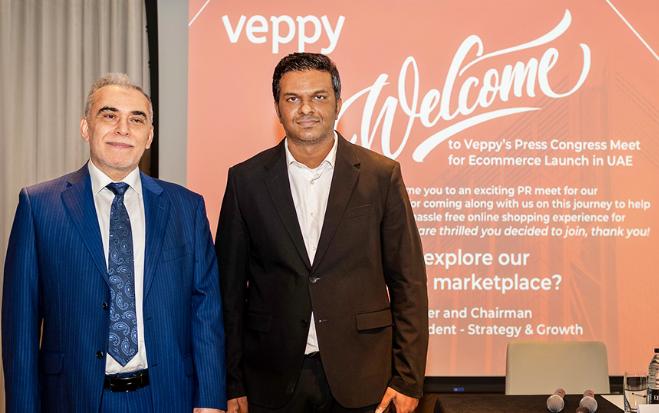
According to the top brass, founder-chairman Moustafa Banbouk and vice president Praveen Kumar, a large part of SMEs are “not yet on the digital platforms” for sales. And small and medium enterprises constitute more than 80 percent of UAE’s economy.

With Veppy, which takes its name from the company motto “very happy”, sellers can look forward to connecting with buyers over 14 categories to start with. Most of the focus will be on products, which are gift ideas mostly.

“Imagine we have an occasion we forgot and need to buy a gift – flowers, cakes, any tech product – urgently and we are at work … with Veppy we can address that,” Mr Banbouk told Headline at a hotel in Dubai.

His deputy Mr Kumar, who has built a career out of focusing on digital transformation for his clients, explained that the company will not be investing in warehouses and will directly connect the buyer with the seller to ensure the quickness of product delivery.

“There will be no fees for registering for the seller, and we will offer a consultative process during the onboarding of the seller. However, there will be a fee with each transaction involved for the seller,” Mr Kumar said.

___________________

ALSO READ: It is Prime time for Amazon faithful among UAE shoppers!
___________________

Mr Banbouk, a property developer in a family business in Lebanon, is excited about succeeding with his q-commerce model in UAE, the land of opportunities and where digital growth is the best in the region.

Q-Commerce – sometimes used interchangeably with ‘on-demand delivery’ and ‘e-grocery’ – is e-commerce in a new, faster form. It combines the merits of traditional e-commerce with innovations in last-mile delivery.

It is one of the fastest-growing businesses in the world. Driven by the changing consumer behavior dominated by last-minute shopping trends, the Q-Commerce market in the Middle East and North Africa (MENA) region is expected to grow from US$9 billion in 2020 to US$20 billion by 2024, according to Statista.com, a global market intelligence provider. Globally, the Q-Commerce market for food and grocery delivery is expected to grow to $72 billion by 2025, according to a report by Forbes magazine.

An analysis by the Dubai Chamber of Commerce and Industry revealed during the Gulfood Breakfast Briefing event at Gulfood 2021 that as per Euromonitor’s data, online sales within the UAE’s food and beverage market surged 255% year-over-year in 2020 to reach $412 million.

The analysis predicted the value of online food and beverage sales in the country to reach $619 million by 2025 and record a compound annual growth (CAGR) of 8.5% over the 2020-2025 period.

The latest estimates from Visa Middle East have forecasted the total MENA E-Commerce market size, including all categories, to be worth US$48.6 billion in 2022.


Announcements

UAE to crack down on businesses not complying with electronic invoicing rules

Published

on

Spread the love

The UAE Ministry of Finance has introduced a Cabinet Resolution imposing administrative fines on businesses that fail to comply with the country’s Electronic Invoicing System (EIS), reinforcing the nation’s drive for digital transformation and stronger tax compliance.

The rules apply to all entities required to adopt EIS under Ministerial Decision No. (243) of 2025. Companies using the system voluntarily are exempt from penalties until compliance becomes mandatory.

Fines include:

  • Dh5,000 per month for failing to implement EIS or appoint an approved service provider on time.
  • Dh100 per electronic invoice not issued or sent on time, capped at Dh5,000 per month.
  • Dh100 per electronic credit note not issued or sent on time, capped at Dh5,000 per month.
  • Dh1,000 per day for not notifying the Federal Tax Authority of system malfunctions.
  • Dh1,000 per day for delays in updating approved service providers on registered data changes.

Officials stressed that the resolution underlines the UAE government’s commitment to international best practices and the development of a fully integrated digital economy.

Continue Reading

Announcements

UAE VAT rules are changing in 2026: Here’s what businesses need to know

Published

on

Spread the love

The UAE’s Ministry of Finance has announced a new set of amendments to the country’s VAT law, with the revised rules taking effect on January 1, 2026. The changes are designed to make the tax system easier to use and more aligned with international best practices.

In a statement, the Ministry said the move supports the UAE’s ongoing efforts to streamline its tax framework and improve administrative efficiency. The updates are also designed to provide businesses with greater clarity and reduce unnecessary paperwork.

Simpler filing, fewer steps

One of the biggest changes removes the requirement for businesses to issue self-invoices when using the reverse charge mechanism. Instead, companies will simply need to keep the usual documents that support their transactions, such as invoices, contracts and records, which the Federal Tax Authority (FTA) can review when checking compliance.

According to the Ministry, this adjustment “enhances administrative efficiency” and provides clear audit evidence without placing extra paperwork burdens on businesses.

Five-year window for VAT refunds

The updated law also introduces a five-year limit for claiming back refundable VAT after accounts have been reconciled. Once this period ends, businesses lose the right to submit a claim. Officials say this helps prevent long-delayed refund requests and gives taxpayers more certainty about their financial position.

Tighter rules on tax evasion

To protect the system from misuse, the FTA will now have the authority to deny input tax deductions if a transaction is found to be linked to a tax-evasion arrangement. This means businesses must ensure the supplies they receive are legitimate before claiming input VAT.

Taxpayers are expected to verify the “legitimacy and integrity” of supplies as part of these strengthened safeguards.

Supporting a competitive economy

The Ministry said the amendments will boost transparency, ensure fairness across the tax system and support better management of public revenue. The updated rules also aim to maintain the UAE’s competitive edge while supporting long-term economic sustainability.


Continue Reading

Business

Dubai unveils world’s largest silver bar, and It’s going digital

Published

on

Spread the love

Dubai has added yet another glittering record to its name. DMCC has officially unveiled the world’s largest silver bar, a jaw-dropping 1,971kg giant that now holds a Guinness World Records title.

The reveal took place at the Dubai Precious Metals Conference (DPMC), and the weight isn’t random; the 1,971kg mark pays tribute to the UAE’s founding year, a nod to the nation’s ambition, craftsmanship and forward-thinking spirit.

But here’s the twist: This record-breaking bar isn’t just for show. It’s about to make history again by becoming the first-ever Guinness World Record precious metal bar to be tokenised under a regulated framework. Yes, Dubai is taking silver straight into the digital future.

The project is a collaboration of heavyweights:

  • Sam Precious Metals crafted the bar
  • Tokinvest, regulated by VARA, will lead the digital tokenisation and issuance
  • Brink’s will handle secure storage and logistics

Calling it a milestone moment, Ahmed Bin Sulayem, Executive Chairman and CEO of DMCC, said the bar’s unveiling represents “the UAE’s ambition and craftsmanship,” adding that it reflects DMCC’s mission to bridge trade, commodities, finance and technology.

The tokenisation of the record-breaking silver bar isn’t just a headline moment; it’s a flagship milestone that strengthens Dubai’s push to become the world’s leading hub for trusted, regulated real-world-asset tokenisation.

DMCC’s new strategic partnership with the Dubai Virtual Assets Regulatory Authority (VARA), aimed at accelerating the creation of secure, transparent and scalable frameworks for tokenised real-world assets. Through the collaboration, the two entities are rolling out pilot projects across gold, diamonds and other physical commodities, while also boosting investor awareness and sharing key data insights to help shape future regulation.

With a precious metals ecosystem of more than 1,500 companies, and over 700 Web3 and blockchain innovators at its Crypto Centre, DMCC is in a prime position to drive the next era of asset-backed digital instruments.

Continue Reading

Popular

© Copyright 2025 HEADLINE. All rights reserved

https://headline.ae/