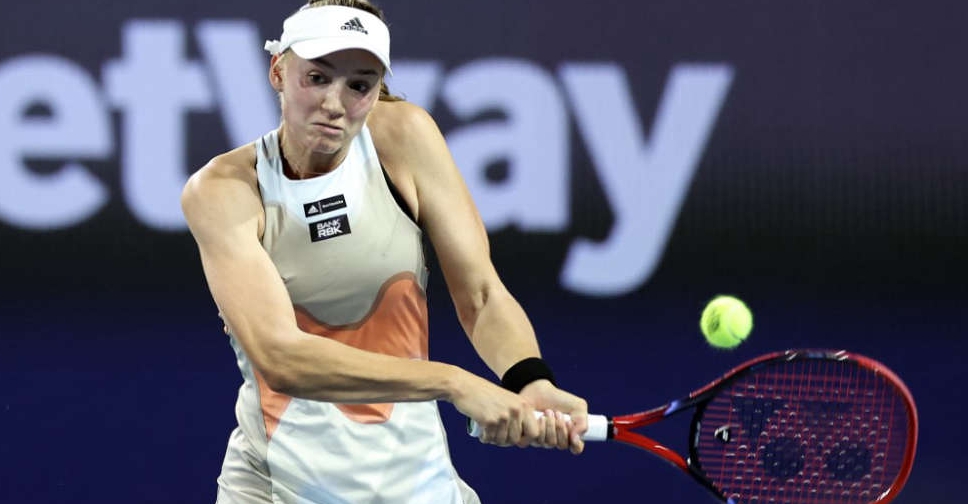
Elena Rybakina kept her “Sunshine Double” hopes alive as she battled from the brink to beat Paul Badosa in the Miami Open third round on Saturday, while Russian Anastasia Potapova upset Coco Gauff in three sets.
Wimbledon champion Rybakina, fresh off her Indian Wells triumph last week, calmly saved a match point on serve in the second set and fired 60 winners, including a dozen aces, as she earned a gutsy 3-6 7-5 6-3 win.
Rybakina, who also had to go the distance in her opening match against Anna Kalinskaya, struggled to find her rhythm on serve in the opening set but wrestled back momentum in the second.
After being broken four times in the first set, Rybakina held her serve in all but one game in the remainder of the contest and confidently closed out victory in two hours and 31 minutes.
“It didn’t start well in the first set but in the end I just found some energy,” Rybakina said. “I was trying to push more on the serve and started to move better on the court. It was a really tough battle.
“I was trying to focus on every point because the first set didn’t go my way. But it was just a few mistakes here and there. Overall, I played well. Paula was serving well. Just happy that I was able to manage in three sets.”
Russian 27th seed Potapova produced some of her best tennis to see off world number six Gauff in a 6-7(8) 7-5 6-2 win and set up a meeting with China’s Zheng Qinwen.
Potapova mounted a stout defense to fend off 10 of 13 break points and grinned widely as she fired down an unreturnable serve to secure the win.
Up 5-2 in the first set, it looked as though it might be an easy day for Potapova. But Gauff turned the tables when she converted break point chances in the ninth and 11th games and closed the tiebreak with a lethal backhand.
Potapova regained her composure in the second set and pummeled her opponent with her mighty forehand as she broke serve in the penultimate game and dropped only one first-serve point as she won the final five games.
On the men’s side, Indian Wells runner-up Daniil Medvedev breezed past Spain’s Roberto Carballes Baena 6-1 6-2 in just over an hour to reach the third round, where he will face Alex Molcan of Slovakia.
In his first match since Carlos Alcaraz snapped his 19-match winning run, Medvedev barely broke a sweat as he hit 18 winners to Carballes Baena’s five in a dominant victory.
Canadian fifth seed Felix Auger-Aliassime unleashed a dozen aces to edge out Brazilian Thiago Monteiro 7-6(5) 7-6(8) and set up a third-round meeting with last year’s semi-finalist Francisco Cerundolo of Argentina.
“That’s the longest I’ve ever played two sets, definitely,” Auger-Aliassime said after the two hour, 40 minute match. “He made me work for it.”
Greek second seed Stefanos Tsitsipas, runner-up at this year’s Australian Open, reached the third round after opponent Richard Gasquet of France withdrew with an ankle injury. Tsitsipas will next face Chile’s Christian Garin.
World number three Jessica Pegula made quick work of her fellow American Danielle Collins 6-1 7-6(0). She will meet Polish 20th seed Magda Linette for a place in the quarter-finals.
Earlier, the home fans leapt to their feet as 55th-ranked American Mackenzie McDonald survived a barrage of aces to upset Italian 19th seed Matteo Berrettini 7-6(8) 7-6(5). He will next face France’s Quentin Halys.

UAE fast bowler Khuzaima Tanveer has credited the DP World ILT20 with accelerating his rise to international cricket, saying the league gave him the confidence and experience needed to represent the UAE on the global stage.
The 26-year-old, who made his international debut earlier this year, believes competing alongside some of the world’s top cricketers helped prepare him for the demands of international cricket.
“Representing the UAE was a proud moment for me and it’s something every young cricketer dreams about. The DP World ILT20 helped prepare me because you’re constantly competing against high-quality players. It gives you confidence that you belong on the international stage,” he said.
Breakthrough performances
Khuzaima announced himself during DP World ILT20 Season 3 with impressive figures of 4/22 against Sharjah Warriorz.
Since joining the Desert Vipers, he has claimed 24 wickets in 18 matches across two seasons. During the Vipers’ title-winning campaign, he finished with 17 wickets, making him the second-highest UAE wicket-taker in the tournament and third overall. He was also shortlisted for the Blue Belt, awarded to the competition’s best UAE player.
Learning from the world’s best
Khuzaima said one of the league’s biggest advantages is the opportunity to learn from elite players and coaches.
“A lot of the learning happens during training sessions, team meetings and conversations. I was fortunate to share the dressing room with Sam Curran, Naseem Shah and Lockie Ferguson. Even small pieces of advice from players like them help you become a better cricketer.”
He also described interacting with legendary fast bowlers Waqar Younis and Wasim Akram as one of the highlights of his career.
Inspired, not compared
While fans have compared his bowling action to Pakistan legend Waqar Younis, Khuzaima insists he is focused on building his own identity.
“Waqar Younis is a legend of the game. If people see similarities, I take it as a compliment, but my focus is on becoming the best version of myself.”
Eyes on future
Now a UAE international, Khuzaima says wearing the national jersey comes with greater responsibility.
“Once you represent the UAE, people expect more from you and you expect more from yourself. My aim is to keep improving, perform consistently and contribute whenever I get the opportunity.”
He also praised UAE captain Muhammad Waseem for setting an example for local players, saying his performances in the DP World ILT20 have shown that Emirati cricketers can compete with the world’s best.
Looking ahead to DP World ILT20 Season 5, Khuzaima hopes to continue developing his game and make the most of every opportunity.
“Every season brings new challenges and new opportunities to learn. My goal is to keep improving, contribute to my team and continue making the most of the opportunities the DP World ILT20 provides.”
Football fans travelling with Emirates this summer won’t have to worry about missing any FIFA World Cup 2026 action. Dubai’s flagship airline Emirates, has announced that it will broadcast every match of the tournament live onboard its flights through Sport24, its dedicated live sports channel available on the award-winning ice entertainment system.
Passengers will be able to follow every moment of the world’s biggest football tournament while flying at 40,000 feet. The move ensures customers can stay connected to the action no matter where they are travelling, with live coverage available throughout the competition.
Emirates said the complete FIFA World Cup 2026 broadcast schedule is featured its ice magazine, allowing passengers to plan their journeys around key fixtures and follow their favourite teams during the tournament.
The live coverage will be available on most Emirates aircraft equipped with Sport24 and Sport24 Extra, although availability may vary depending on aircraft type and route. Selected FIFA World Cup matches will also be shown in Emirates Lounges across Dubai, giving travellers additional opportunities to catch the action before departure.
Mexico City’s iconic Estadio Azteca was transformed into a global stage on Thursday Night as the FIFA World Cup 2026 officially got underway, marking the beginning of the biggest edition in the tournament’s history.
A vibrant opening ceremony showcased a blend of Mexican culture, music and modern spectacle, with performances from international stars including Shakira and Burna Boy. The ceremony was designed to reflect both the heritage of the host nation and the global nature of the tournament, which for the first time will be staged across three countries — Mexico, the United States and Canada.
Before the first whistle of the competition, the atmosphere inside the historic stadium reached a crescendo as thousands of fans filled the stands, waving flags and lighting up the arena in a sea of colour. The Estadio Azteca, already steeped in football history, has now become the first venue in the world to host matches across three separate FIFA World Cups, having previously staged the 1970 and 1986 finals.
In a further highlight of the ceremony, Italian tenor Andrea Bocelli performed the tournament’s official anthem, adding a classical flourish to an evening otherwise defined by high-energy performances and large-scale choreography.
FIFA officials described the opening event as a “symbolic bridge between continents”, underlining the expanded format of the 2026 tournament. For the first time, the World Cup will feature 48 teams — up from 32 — and a total of 104 matches, spread across 16 host cities across North America. The expansion is intended to increase global participation and bring the tournament to a wider range of supporters.
Immediately after the ceremony, hosts Mexico faced South Africa in the tournament’s opening match, kicking off what is expected to be a month-long football spectacle. The match began under heavy security and heightened global attention, with millions watching around the world.
The expanded format has also brought logistical challenges, with teams required to travel across vast distances between venues in multiple countries. Organisers have emphasised investments in transport infrastructure, stadium upgrades and sustainability measures aimed at reducing the environmental footprint of the tournament.
The 2026 edition also arrives at a time when football’s global profile continues to grow rapidly, with record broadcast deals, increased digital streaming access and heightened commercial interest from sponsors. Analysts expect the tournament to break previous viewership records, particularly given its tri-nation hosting model and expanded team lineup.
Estadio Azteca itself remains one of football’s most storied venues. It famously hosted Brazil’s Pelé lifting the trophy in 1970 and Diego Maradona’s “Hand of God” and “Goal of the Century” performances in 1986. Its role in opening the 2026 tournament has been widely seen as a nod to football’s rich history in Mexico, while also signalling a new era for the sport.
As fireworks lit up the Mexico City skyline following the ceremony, attention now turns to the next phase of the tournament’s opening schedule, with matches set to continue across North America in what promises to be the most geographically expansive World Cup ever staged.
For fans, players and organisers alike, the message from Mexico City was clear: the world’s biggest sporting event has begun, and it is set to be bigger, broader and more ambitious than ever before.