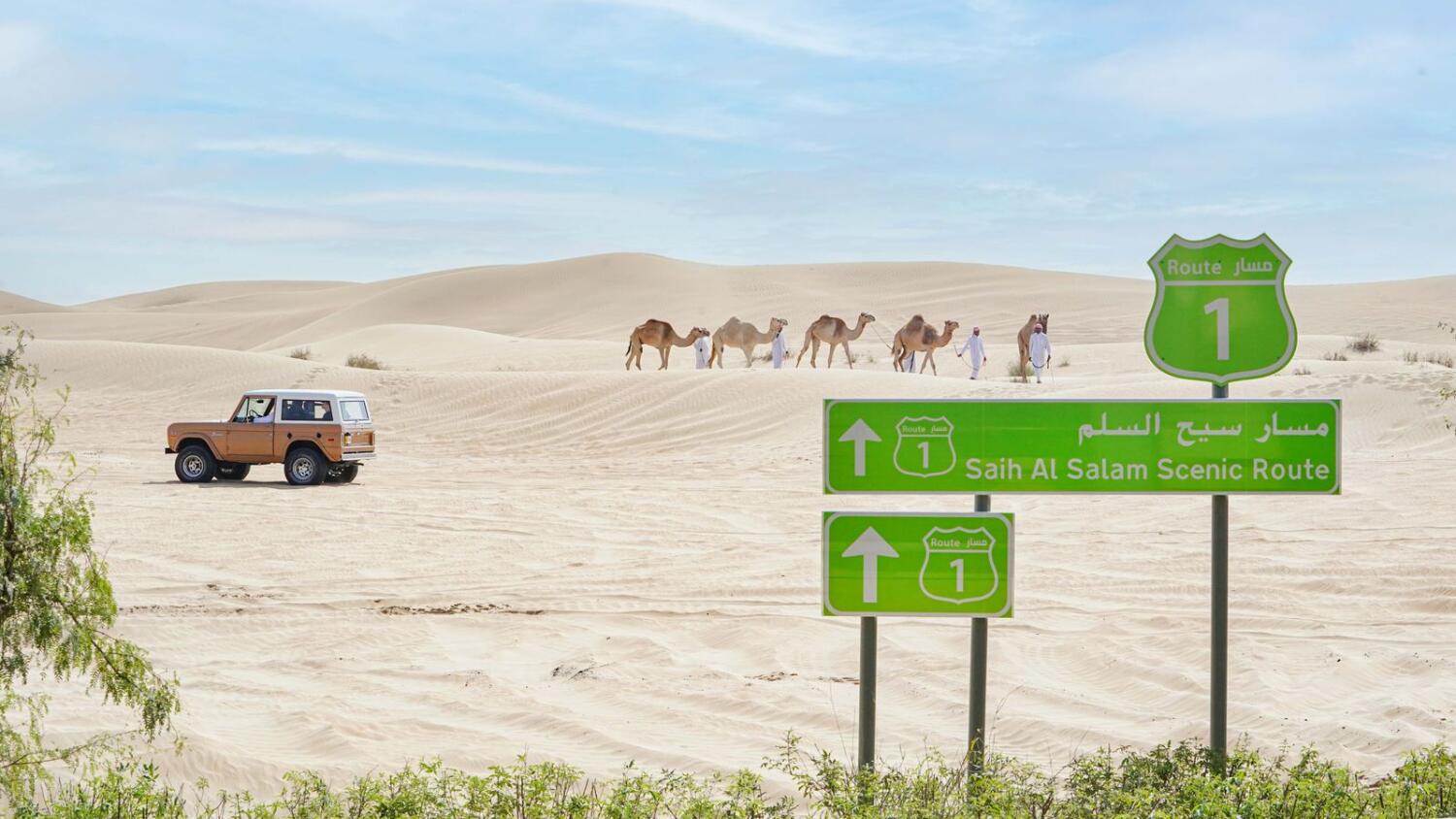
The master plan for Saih Al Salam Scenic Route, featuring new facilities, activities, events, and services was approved by Sheikh Hamdan bin Mohammed bin Rashid Al Maktoum, Crown Prince of Dubai, and Deputy Prime Minister and Minister of Defence of the UAE.
In a post on X, Sheikh Hamdan said: “These aim to provide high-quality services and advanced facilities to meet the needs of residents and visitors.”
The Master plan for the Saih Al Salam Scenic Route involves developing five tourist stations and building of 97.86 kilometres of cycling tracks, bringing the total track length in the area to 156.61 kilometres. The plan also includes expanding facilities and organising activities and events to attract more tourists and offer a complete tourism experience for both residents and visitors.
Thirty-seven projects and initiatives to develop Dubai’s countryside and rural areas from 2024 until 2028 were also approved. The series of development projects and initiatives is estimated to cost around Dh390 million.
Sheikh Hamdan said: “The master plan for the Saih Al Salam Scenic Route and Dubai Countryside & Rural Areas Development Projects reflects the vision and directives of His Highness Sheikh Mohammed bin Rashid Al Maktoum, aiming to transform Dubai’s rural areas and countryside to be among the best, most beautiful, and enjoyable for all. This contributes to solidifying the emirate’s position as an ideal destination to live and work, as well as a preferred attraction for visitors from around the world.”
Five recreational stations
The master plan outlines these five tourist stations:
–Main Hub Station near Al Qudra Lakes. A traditional market will be established in this station, featuring several shops selling local products typical of the rural areas, alongside an open-air cinema near the Last Exit, offering a unique movie experience in a natural setting. Visitors can also camp in luxury marquees near the activity sites along Al Qudra Lakes. Public facilities will also be added to support the expected large number of visitors.
–Wildlife Station. This station, located near Flamingo Lake, will feature various facilities and activities, including hot air balloon rides for stunning views of wildlife and the Love Lakes, luxury camping options, and elevated walking connecting Love, Qudra, and Flamingo Lakes. Kayak tours will also be available across the three lakes.
–Adventure Station. In this station located near Expo 2020 Lake, an adventure park will be built near the Oryx platform, as well as walking and fitness trails. A sandy trail for cycling and walking will be added around Expo Lake, along with budget camps and restaurants.
–Cultural Experience Station. This station, located near the camel farm in Al Marmoom, will provide a traditional majlis and an entertainment theatre at the camel farm. Visitors can enjoy camel rides, explore the desert, and enjoy traditional meals.
–At the Desert Adventure Station, a fully equipped area for adventure and desert sports will be developed . This will allow visitors to enjoy various outdoor fun activities, such as dune bashing, desert cycling, dune climbing, sandboarding, and desert safari tours, among others.
He also added, “We continue to launch unique projects to consolidate Dubai’s status as one of the world’s best cities for quality of life and ensure our citizens, residents and visitors enjoy the highest levels of well-being.”
Meanwhile, the first phase of the rural and countryside plan includes the provision of 18 new services for residents of these areas. These services involve establishing three nurseries, seven parks and open spaces, and three healthcare facilities (a hospital, a health centre, and an ambulance station). Additionally, civil defence and ambulance services will be available in the area, along with three social facilities catering to residents and visitors across the majlis, halls, and a community centre.
The Higher Committee for Urban Planning in Dubai is also managing the implementation of 37 projects and initiatives as part of the comprehensive plan for the development of rural and countryside areas, which span 2,216 square kilometres.
A rural service centre and a socio-cultural centre are being constructed at Lahbab, including a majlis, a public library, an art exhibition hall, centres for teaching traditional arts, and centres for teaching Bedouin crafts. A majlis is also being built in Al Awir, and healthcare facilities are being established in Lahbab 2 and Al Lisaili, along with an ambulance station in Margham and a civil defence centre in Lahbab 1. Additionally, three nurseries are being built in Al Awir 2, Lahbab, and Al Lisaili, and seven neighbourhood parks are being developed in Margham, Al Lisaili, Nizwa, Lahbab 1 and 2, and Al Awir 2. Furthermore, internal roads are being constructed in Margham, Lahbab, and Al Lisaili.
The plan also includes shared and mass transportation solutions to serve all rural areas, as well as traffic improvements in Lahbab, Al Awir, and Al Lisaili. The development of the Saih Al Salam Scenic Route, which is the first recreational tourist route, is also underway, along with the relocation of waste transfer stations in Lahbab 1, the relocation of the truck rest-stop, and a sewage project in Al Lisaili, Nizwa, Margham, and Lahbab 1 and 2. Landscaping works are being carried out in Al Faqa, Nizwa, and Al Lisaili, and a farmers’ support programme is being implemented. Relevant entities are organising events and activities such as the Al Marmoom Festival, camel races, cycling races, and the Fazza Yola Championship.
Businesses across the UAE that play music for commercial purposes will face a new licensing system from December 2026, under rules announced by the Ministry of Economy and Tourism.
The new framework introduces licensing fees for a wide range of businesses and organisations that use music commercially, including restaurants, cafes, hotels, shopping malls, gyms and airlines.
Radio and television broadcasters, as well as concert organisers, will also fall under the new system.
The changes are outlined in the ministry’s new Collective Management in Music Guide, which sets out how music copyright and related rights will be managed across the UAE.
Which businesses will have to pay?
The new licensing requirements will apply to venues and businesses that commercially use music.
This includes:
Restaurants Cafes Hotels Shopping malls Gyms Airlines Radio stations Television channels Concerts and other commercial music events
The amount businesses pay will not be the same across the board. Instead, fees will be calculated using a sliding-scale system, taking into account factors such as the type of music use and the size or nature of the business.
When do the new UAE music fees start?
The new licensing fees are scheduled to come into effect in December 2026.
Businesses that require a licence will receive a renewable one-year licence. The fees will be collected through the organisations responsible for managing music rights, including the Emirates Music Rights Association and Music Nation.
These organisations represent rights holders across the music industry, including composers, songwriters, singers, instrumentalists, record producers and music publishers.
Why is the UAE introducing the new system?
The government says the new framework is designed to create a more structured system for managing copyright and related rights in the UAE.
According to the Ministry of Economy and Tourism, standardising licensing requirements and fees should help reduce copyright violations while bringing the UAE’s approach more closely in line with international practices.
For businesses, that means music used as part of the customer experience, whether in a restaurant, hotel, gym or another commercial setting, will be subject to clearer licensing requirements.
Who is exempt from the music licensing fees?
Not every organisation or event will be covered by the new commercial licensing requirements.
The guide identifies exemptions that include: Schools and academic institutions Non-commercial celebrations National events
This means the new fees are primarily focused on the commercial use of music rather than private or educational settings.
New fund will support UAE music talent
The new framework also includes a support mechanism for the country’s music industry.
A Cultural Support Fund in the Field of Music will be established to provide financial assistance and technical support to artists, performers and producers.
Under the new system, 10 per cent of the fees collected will be directed towards the fund.
The money will be used to support emerging musical talent and help promote Emirati music internationally.
What does this mean for UAE businesses?
For businesses that regularly play music for customers, the biggest change will be the introduction of a formal licensing requirement and associated annual fees.
The exact amount will depend on how the music is being used and the characteristics of the business, rather than being a single flat charge for every venue.
Businesses that rely on music as part of their atmosphere or entertainment offering will therefore need to factor the new licensing requirements into their operations from December 2026.
At the same time, the government says the system is intended to ensure creators and other rights holders receive appropriate recognition and compensation when their work is used commercially.
Music licensing rules:
Start date: December 2026 Licence period: One year, renewable Applies to: Commercial users of music Examples: Restaurants, cafes, hotels, malls, gyms and airlines Also covered: Radio, television and concerts Fee structure: Sliding scale based on use and business characteristics Exemptions: Schools, academic institutions, non-commercial celebrations and national events Music support fund: 10% of collected fees
For UAE businesses, the new rules mark a significant change in how commercial music use will be licensed, while the accompanying support fund is designed to put part of those revenues back into the country’s developing music sector.
Indian travellers planning a holiday in Abu Dhabi can now have the cost of their UAE entry visa covered under a new tourism initiative.
The Department of Culture and Tourism – Abu Dhabi (DCT Abu Dhabi) has launched a limited-time programme for eligible Indian passport holders who book qualifying Abu Dhabi holiday packages through participating travel companies and online travel agencies.
The offer is available until October 31, 2026, during an initial pilot that will support up to 20,000 visas.
However, the offer comes with specific booking requirements. Travellers must book a package that includes both a return flight from India and at least three consecutive nights at an Abu Dhabi hotel.
Who is eligible for the free UAE visa offer?
The programme is aimed at Indian passport holders travelling from India to Abu Dhabi.
To qualify, travellers must book through a participating travel partner or online travel agency. The holiday package must include:
A minimum three-night stay at an Abu Dhabi hotel
A return flight from India
Booking through an eligible participating travel partner or OTA
The visa benefit cannot be claimed through an independent application. It is tied to qualifying holiday bookings made through the programme’s participating partners.
When is the Abu Dhabi free visa offer available?
The initiative runs from:
August 1 to October 31, 2026
DCT Abu Dhabi says the pilot programme will initially support up to 20,000 visas.
For eligible bookings, the tourism authority will cover the full cost of the UAE entry visa, potentially reducing the upfront expense for Indian visitors planning a trip to the emirate.
How does the visa fee waiver work?
Travel partners participating in the scheme have two ways to process the visa arrangements.
One option is to work with a DCT-appointed destination management company (DMC). In this case, DCT Abu Dhabi will pay the visa costs directly.
Travel companies can also use their existing DMC partners. Under this arrangement, DCT Abu Dhabi will reimburse Dh285 for each visa issued under the programme.
For travellers, the key point is that the benefit is handled through the participating travel partner rather than by applying for reimbursement independently.
Why is Abu Dhabi targeting Indian travellers?
India continues to be an important international source market for Abu Dhabi’s tourism sector.
According to DCT Abu Dhabi, the new programme is part of wider efforts to make the destination more accessible to Indian visitors while strengthening relationships with travel companies and improving connectivity between India and Abu Dhabi.
The initiative also aims to encourage visitors to spend more time in the emirate exploring its hotels, cultural attractions, entertainment options and natural landscapes.
Is the UAE visa completely free for all Indian tourists?
No.
The offer does not mean that every Indian passport holder automatically receives a free UAE tourist visa.
The visa fee is covered only when travellers meet the programme’s conditions and book through a participating travel partner or online travel agency.
The booking must include at least three consecutive hotel nights in Abu Dhabi and a return flight from India.
Travellers should therefore check with their chosen travel provider before booking to confirm that the package and visa arrangement qualify for the offer.
Abu Dhabi holiday offer:
Who: Eligible Indian passport holders travelling from India Destination: Abu Dhabi, UAE Offer period: August 1–October 31, 2026 Hotel requirement: Minimum three consecutive nights Flight requirement: Return flight from India Booking requirement: Participating travel partner or OTA Visa cost: Covered by DCT Abu Dhabi for eligible bookings Pilot capacity: Up to 20,000 visas Independent applications: Not eligible for the programme
For Indian travellers already considering an Abu Dhabi getaway, the initiative could make an eligible holiday package more affordable, but checking the participating travel provider and meeting all the booking conditions will be essential.
Small businesses in the UAE with annual revenues of up to Dh3 million will continue to be eligible for Small Business Relief under the corporate tax regime until the end of 2029.
The Ministry of Finance said on Friday that Ministerial Decision No. 131 extends the period during which eligible businesses can benefit from Small Business Relief to cover tax periods ending on or before December 31, 2029.
The relief was introduced to help reduce the corporate tax compliance burden for smaller businesses and start-ups that meet the eligibility requirements.
Dh3 million threshold remains unchanged
The existing annual revenue threshold of Dh3 million, set under Ministerial Decision No. 73 of 2023, will continue to apply.
The relief applies to tax periods beginning on or after June 1, 2023 and, following the latest amendment, will remain available for subsequent tax periods ending on or before December 31, 2029.
Eligible taxable persons with annual revenue of up to Dh3 million can claim Small Business Relief, subject to meeting the conditions and requirements outlined in the corporate tax legislation.
The relief enables qualifying businesses to benefit from simplified corporate tax compliance requirements.
More time for small businesses
The extension provides eligible small businesses and start-ups with additional tax periods to benefit from the relief while continuing to meet the Dh3 million revenue threshold.
The Ministry said the decision is part of its efforts to support smaller companies and entrepreneurs, strengthen the business environment, and encourage sustainable growth and expansion.