Connect with us

Education

UAE shines at the Olympics of Robotics, clinching top global honours among 193 nations

Published

on

Spread the love

The UAE is celebrating a landmark achievement after its national robotics team clinched the coveted Gold Medal at the 2025 First Global Challenge, an event often hailed as the Olympics of Robotics. The competition, held in Panama City from October 28 to November 1, brought together young innovators from 193 countries, making Team UAE’s victory even more remarkable.

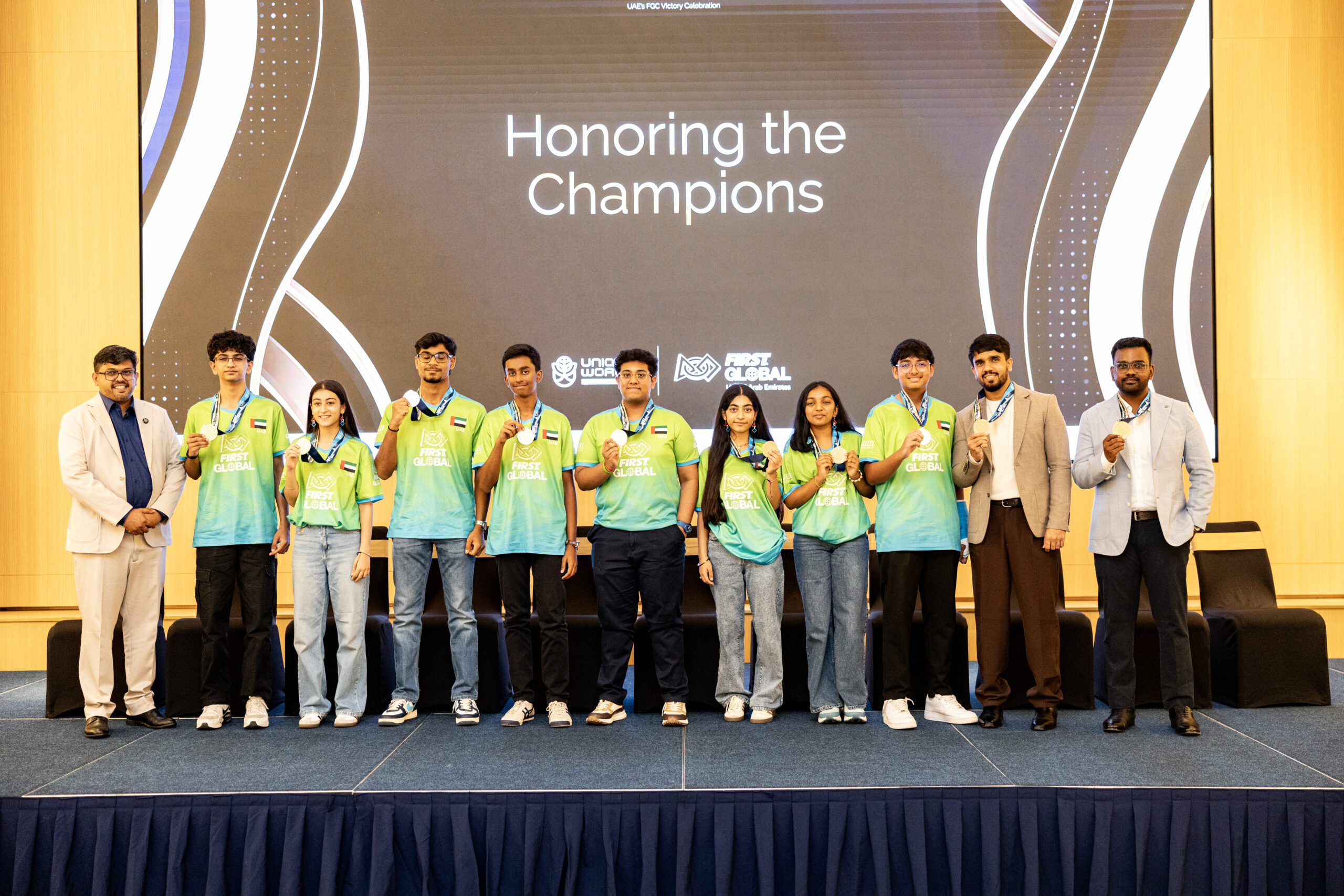
In a special ceremony held in Dubai on Saturday, the team was honoured for their outstanding performance, showcasing the UAE’s growing strength in STEM education, youth innovation, and global scientific excellence.

The eight-member team –  Riya Mehra (Dubai College), Aarya Parekh (Delhi Private School Sharjah), Aarush Pancholi (GEMS Modern Academy), Aditya Anand (New Millennium School Al Khail), Krithin Satya (Dubai College), Simran Mehra (Dubai College), Sreya Binoy Nair (GEMS Modern Academy), and Aryan Goyal (DIA Emirates Hill) — spent more than 300 hours preparing for the global challenge.

Their training was powered by Unique World Robotics, Team UAE’s official training partner, which supported the students through mechanical design, programming, and strategic problem-solving to compete on the world stage.

“This victory is a testament to the extraordinary dedication and ingenuity of our young innovators,” said coach Muhammed Mukhtar. 

“They have made the nation proud and shown that UAE students can compete at the highest global level.”

A groundbreaking project with global potential

The winning project, STASH, is an innovative bio preservation system that protects endangered plant species, including the UAE’s iconic Ghaf tree, without the need for electricity or freezing. Instead, it uses sodium alginate hydrogels to encase living cells in small, portable beads that remain viable for up to five days.

The system is paired with a 3D-printed field kit and AI-powered viability analysis, creating a low-cost, eco-friendly solution that can be deployed anywhere in the world, especially in remote regions.

The project impressed a distinguished panel of judges that included experts from MIT and scientists from Lam Research, who commended the team for its creativity, sustainability, and global applicability.

Team Captain Aarush Pancholi reflected on the accomplishment: “Winning Gold was the result of countless hours of collaboration and experimentation. We’re proud not just of the medal, but of building something that can make a real difference for biodiversity and communities worldwide.”

A milestone for the UAE’s innovation journey

National Organiser Bansan Thomas George praised the team’s achievement, noting that Team UAE’s success reflects the country’s long-standing commitment to STEM education and youth empowerment.

“Their work on STASH demonstrates not only technical brilliance but also a vision for sustainable solutions that benefit the world,” he said.

With this victory, Team UAE continues to inspire the next generation of scientists, engineers, and problem-solvers, reinforcing the nation’s strategy of investing in future-ready talent.


With over 35 years of experience in journalism, copywriting, and PR, Michael Gomes is a seasoned media professional deeply rooted in the UAE’s print and digital landscape.

Education

Dubai private  schools to end classes by 11.30am every Friday from January 9

Published

on

Spread the love

Parents in Dubai will need to reshuffle their Friday routines, as private schools across the emirate will begin closing earlier each week starting January 9, 2026.

The Knowledge and Human Development Authority (KHDA) has confirmed that all private schools and early childhood centres operating within private schools must finish the school day no later than 11.30am on Fridays. The move aligns with the UAE-wide adjustment to Friday prayer timings, which have been brought forward to 12.45pm.

Previously, Fridays were already half-days for most schools, with classes ending around noon. The latest update shortens the school day by a further 30 minutes, ensuring students and staff have sufficient time to return home before congregational prayers begin.

According to KHDA, the change prioritises student wellbeing while maintaining curriculum requirements. Schools will be allowed flexibility in how they manage dismissals, including staggered or phased exits, to reduce congestion and minimise disruption to learning.

In a post on social media platform X, KHDA said:
“In line with the adjustment of the Friday prayer time across the country to 12.45pm, and following consultations with educational institutions, effective Friday, January 9, 2026, all private schools and early childhood centres operating within private schools in Dubai will finish the school day no later than 11.30am on Fridays.”

The authority added that schools may introduce flexible arrangements to address logistical and operational challenges, while ensuring teaching time is not significantly affected.

Online learning option for older students

For students in Grade 6 (Year 7) and above, schools may apply to offer online learning on Fridays, subject to parental consultation and approval from KHDA. This option is intended to provide additional flexibility for families, particularly those balancing work and childcare commitments.

The UAE Government has echoed the directive, urging private schools nationwide to adhere to the 11.30am finish on Fridays.

Public school Friday timings also updated

The announcement follows the release of revised Friday schedules for public schools across the UAE, which will also reflect the earlier prayer time:

  • Kindergarten: 8am – 11.30am
  • Cycle One:
    • 7.10am – 10.30am or
    • 8am – 11.30am
  • Cycles Two and Three:
    • Boys: 7.10am – 10.30am
    • Girls: 8am – 11.30am

With the changes coming into effect from early January, parents are being advised to plan ahead for earlier pick-ups and revised Friday routines.

Continue Reading

Education

New UAE law explains who controls school curriculum, and how changes will happen

Published

on

Spread the love

The UAE has issued a landmark Federal Decree Law to regulate the national educational curriculum, creating a clear, unified framework for how school education is designed, approved and updated across the country.

For the first time, the law formally governs the entire curriculum lifecycle, from development and approval to implementation, evaluation and review across both public and private schools. It applies from kindergarten to Grade 12, including private schools that follow international curricula but teach approved compulsory subjects.

Clear roles, shared responsibility

The decree clearly defines the responsibilities of federal and local authorities, ensuring better coordination, transparency and community participation in shaping education policy.

Under the framework:

  • The Ministry of Education leads curriculum development, learning resources, assessment tools and teacher readiness.
  • Schools are responsible for implementing the curriculum and providing feedback from the classroom.
  • Local education authorities monitor compliance in private schools.
  • The National Centre for Education Quality evaluates outcomes and publishes performance reports.

This structure aims to ensure consistency in education quality, while allowing flexibility to respond to future needs.

What the curriculum includes

The law also clearly outlines what makes up the curriculum, including:

  • Learning standards and outcomes
  • Teaching and assessment methods
  • Educational pathways aligned with students’ abilities and aspirations

The focus is on strengthening learning quality and preparing students for global competitiveness and the future workforce.

How curriculum changes will work

To prevent disruption while allowing progress, the law introduces four categories of curriculum changes, each with its own approval process:

  • Major changes require approval from the Council of Ministers
  • Partial and technical changes are reviewed by education authorities
  • Urgent changes can be fast-tracked when necessary

Decisions involve the Ministry of Education, the Education, Human Resources and Community Development Council, and other relevant bodies, depending on the scale of the change.

Importantly, government entities, private institutions and stakeholders can propose curriculum updates, provided they align with national values, development goals and labour market needs.

Why it matters

Officials say the decree strengthens the UAE’s long-term education vision by creating a stable yet flexible system that puts human capital at its core. By clarifying governance and encouraging innovation within a regulated framework, the law ensures schools can evolve without compromising quality or national priorities.

In short, it’s a big step toward a future-ready education system built for consistency, adaptability and excellence.


Continue Reading

Education

New UAE higher education law explained: What it means for universities, students and online learning

Published

on

Spread the love

The UAE has introduced a new federal decree law on higher education and scientific research, marking a major reset for how universities, colleges and vocational institutes are regulated across the country.

The law applies to all higher education institutions, as well as technical and vocational education and training (TVET) providers, creating a unified national framework aimed at improving quality, transparency and global competitiveness, while ensuring graduates are better aligned with the needs of the labour market.

One national system, clearer rules

At the heart of the decree is a standardised governance model. It introduces clear national systems for institutional licensing, programme accreditation, and the implementation of the National Qualifications Framework. Universities will also be periodically classified and evaluated, with results made public to promote accountability and continuous improvement.

In simple terms: no more grey areas when it comes to quality, standards or oversight.

Licensing is now mandatory

Under the new law, no higher education institution can operate, promote or offer programmes without official licensure from the ministry. This rule applies equally to institutions operating in free zones, which must now secure both federal approval and local permits, with clearly defined coordination between authorities.

Academic programmes must meet ministry-approved accreditation standards, and institutions are required to demonstrate strong governance and effective management before being approved.

Digital and blended learning gets regulated

With online education becoming the norm, the decree also introduces clear rules for electronic, digital and blended learning. Academic and professional programmes delivered online must meet accreditation standards, while institutions are required to safeguard student data, privacy and intellectual property rights.

Transparency through public evaluations

Another key change is the requirement for regular classification and performance evaluations of higher education institutions, with outcomes published publicly. This move is designed to encourage competition, drive improvement and help students make more informed choices.

Why this matters

The new law positions higher education as a strategic pillar of national development. By tightening oversight, improving quality assurance and aligning education with workforce needs, the UAE is laying the groundwork for a more future-ready, globally competitive education system, one that supports lifelong learning and innovation.

In short, this decree brings structure, clarity and accountability to every corner of the UAE’s higher education landscape.


Continue Reading

Popular

© Copyright 2025 HEADLINE. All rights reserved

https://headline.ae/