Connect with us

Announcements

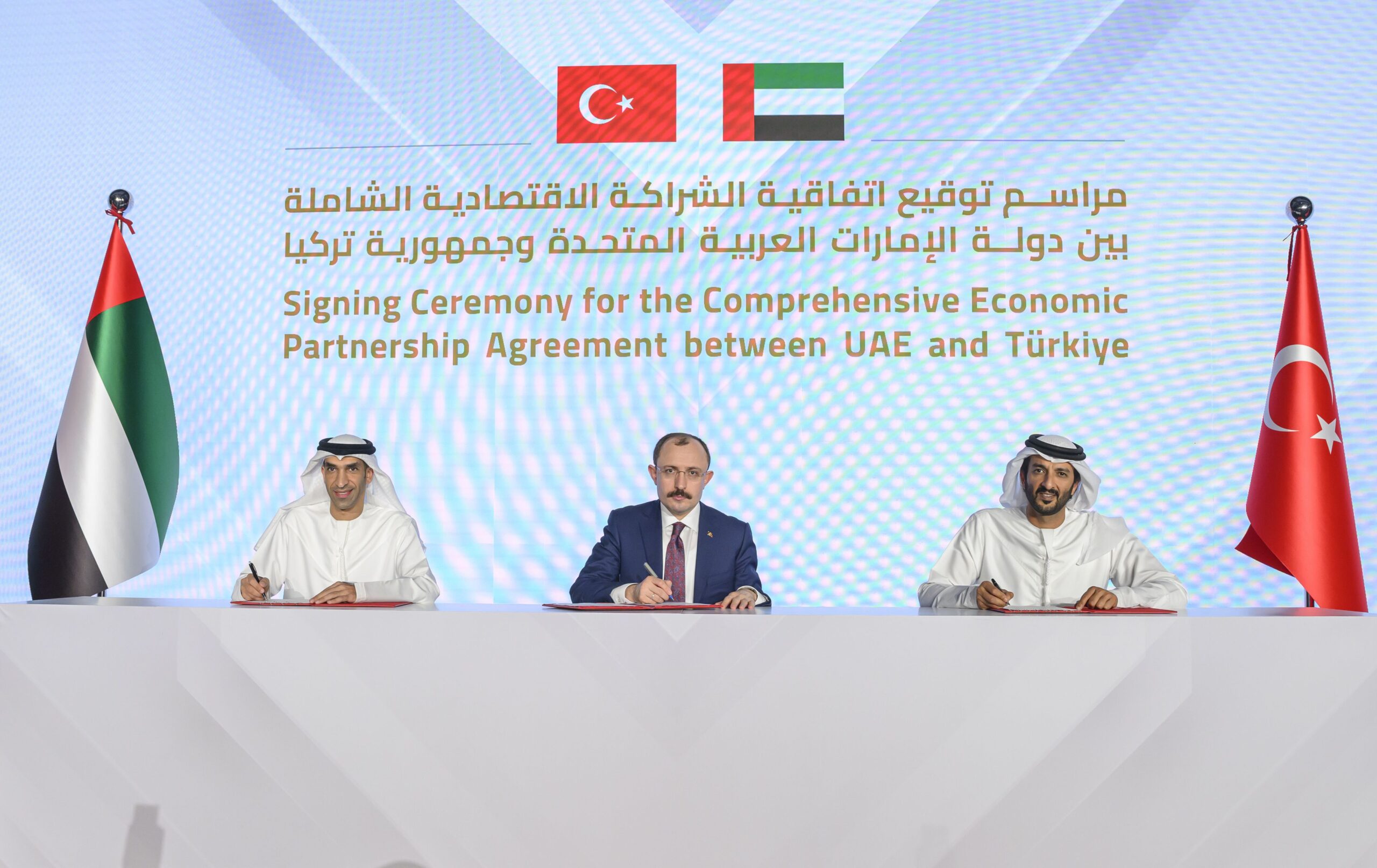
UAE’s economic agreements with Turkey and Indonesia spring into action

Published

on

Spread the love

The United Arab Emirates (UAE) is entering a new era of economic collaboration with two rapidly growing global players as it activates two of its Comprehensive Economic Partnership Agreements (CEPAs). The UAE-Türkiye CEPA and the UAE-Indonesia CEPA have officially come into force, setting the stage for enhanced trade and investment cooperation.

The primary goal of these CEPAs is to foster economic ties by doubling non-oil trade. The UAE-Türkiye CEPA aims to elevate bilateral non-oil trade to an impressive $40 billion within five years, while the UAE’s CEPA with Indonesia seeks to push non-oil trade beyond $10 billion within the same timeframe. These agreements also aim to facilitate investment projects valued at $10 billion in various sectors.

In the words of HE Al-Zeyoudi, “The implementation of our CEPAs with Türkiye and Indonesia marks a significant step forward in our foreign trade program. Both agreements will unlock significant opportunities for our private sector in two of the world’s most dynamic centers of growth.”

These CEPAs are the third and fourth of their kind to come into force for the UAE, following successful agreements with India in May 2022 and Israel in April 2023. They are a testament to the UAE’s foreign trade agenda, strategically forging robust economic connections with nations of global importance. Both CEPAs promise to reduce or remove tariffs on a wide range of goods, eliminate trade barriers, and create pathways for investments in vital sectors like logistics, energy, food production, fintech, e-commerce, and travel and tourism.

The UAE-Indonesia CEPA, inked in Abu Dhabi in July 2022, aims to significantly boost bilateral non-oil trade from $4.08 billion to over $10 billion within five years. Additionally, the agreement targets a combined trade in services worth $630 million by 2030. Notably, over 80 percent of UAE exports to Indonesia will now be exempt from customs duties under this pact. This partnership also has an eye on nurturing the rapidly expanding Islamic economy, projected to reach $3.2 trillion by 2024. It will accelerate investment projects worth $10 billion across sectors like agriculture, energy, infrastructure, and logistics. The UAE-Türkiye CEPA is equally impactful, having eliminated or reduced customs duties on 82 percent of product lines, accounting for more than 93 percent of bilateral non-oil trade. Türkiye was the UAE’s fastest-growing top ten trading partner in 2022, witnessing a 40 percent increase in non-oil trade to $18.9 billion. The newly liberalized trade environment is set to drive this figure to an impressive $40 billion within the next five years.

HE Al Zeyoudi also stressed that the Comprehensive Economic Partnership Agreements play a vital role in attaining the nation’s objectives, in particular the vision laid out in “We The UAE 2031”, which seeks to double the UAE’s non-oil foreign trade to AED4 trillion and elevate national exports to AED800 billion. The recently published statistics from H1, 2023, which show a record non-oil foreign trade value of AED1.239 trillion for the first six months of the year, demonstrate that the UAE is firmly on track – and that the CEPA program will help maintain this upward trajectory.

Announcements

UAE’s Jaywan card can now be used for online shopping on thousands of websites

Published

on

Spread the love

Online shopping with the UAE’s Jaywan card just got a major upgrade.

Network International has announced that Jaywan cardholders can now use their cards to pay on thousands of online stores connected to its payment gateway, expanding the domestic payment scheme beyond in-store purchases.

The move is expected to make online payments faster and more convenient while supporting the UAE’s push towards a cashless economy.

What is Jaywan?

Launched by Al Etihad Payments, a subsidiary of the Central Bank of the UAE, Jaywan is the country’s domestic payment card scheme.

It was introduced to provide a secure local payment option, reduce transaction costs and strengthen the UAE’s digital payments ecosystem.

Until now, Jaywan cards were mainly accepted for in-store purchases. With the latest expansion, cardholders can also use them for online shopping across thousands of merchants powered by Network International.

What this means for shoppers

For UAE residents, the update means more flexibility when shopping online.

Whether you’re ordering groceries, booking services or buying products online, you’ll be able to use your Jaywan card anywhere that supports Network International’s payment gateway.

The company says the integration offers secure, fast and seamless online payments, while merchants won’t face additional charges for Jaywan transactions processed through its platform.

A step towards a cashless UAE

The expansion is part of the UAE’s broader strategy to accelerate digital payments and reduce reliance on cash.

By making Jaywan available both in stores and online, payment providers are helping create a more connected digital payment ecosystem for businesses and consumers alike.

As more banks, merchants and payment providers adopt the scheme, residents can expect to see Jaywan accepted across even more everyday payment services in the future.

Continue Reading

Announcements

Dubai Chambers launches one-stop digital platform to help businesses start, grow and expand

Published

on

Spread the love

Starting and growing a business in Dubai is set to become easier with the launch of Business in Dubai, a new digital platform by Dubai Chambers that brings together essential corporate services in one place.

Designed as a single gateway for companies, the platform connects businesses with trusted service providers, helping them access everything from financial solutions to technology, marketing and certification services without having to navigate multiple channels.

The initiative aims to simplify business operations while strengthening Dubai’s position as one of the world’s most competitive destinations for investment and entrepreneurship.

What does the platform offer?

The Business in Dubai platform currently provides 65 corporate services through seven accredited partners, offering companies a wide range of support as they establish or expand their operations in the emirate.

The services are grouped into four key categories:

  • Financial services
  • Marketing and business growth services
  • Technology services
  • Testing, inspection and certification services

The current network of partners includes ZENDATA Cybersecurity, FAST Ventures, Mamo, OCTA, SGS Gulf Limited, Vault, and Pemo.

Helping businesses grow

Dubai Chambers said the platform has been designed to save companies time and resources by bringing multiple business services under one digital roof.

Khalid AlJarwan, Executive Vice President of Commercial and Corporate Services at Dubai Chambers, said the initiative reflects the organisation’s commitment to creating an environment that supports business growth both locally and internationally.

He said the platform will strengthen Dubai’s investment ecosystem by making it easier for companies to access the services they need to scale their operations and contribute to the emirate’s long-term economic development.

Boost for the digital economy

Saeed Al Gergawi, Vice President of Dubai Chamber of Digital Economy, said the platform will particularly benefit businesses operating in the digital economy by simplifying access to trusted service providers.

He added that the initiative creates a more flexible and efficient business environment, enabling entrepreneurs and companies across different sectors to focus on growth rather than administrative processes.

A single digital gateway

By consolidating key business services onto one platform, Dubai Chambers aims to reduce the time and effort companies spend searching for service providers, allowing them to concentrate on innovation, expansion and day-to-day operations.

The launch forms part of Dubai’s wider efforts to strengthen its business ecosystem and reinforce its position as a leading global hub for trade, investment and entrepreneurship.

Continue Reading

Announcements

What the new DIFC investment fund proposals mean for investors

Published

on

Spread the love

Dubai’s financial regulator is planning the biggest update to the Dubai International Financial Centre (DIFC) investment fund rules in more than a decade.

The Dubai Financial Services Authority (DFSA) has launched a public consultation on a wide-ranging package of reforms designed to modernise the DIFC’s investment fund framework, simplify regulations for fund managers and strengthen investor protection.

Here’s what you need to know.

Why is the DFSA changing the rules?

The DFSA says the investment fund industry has evolved significantly since the current framework was introduced in 2006.

The proposed reforms aim to:

  • Modernise regulations to reflect today’s investment market.
  • Reduce unnecessary compliance requirements.
  • Make it easier for fund managers to operate.
  • Maintain strong investor protection.
  • Align DIFC regulations with international best practices.

What are the proposed changes?

The consultation includes several key proposals:

More flexible rules for private investment funds

The DFSA plans to replace rigid classifications for specialist private funds with a more flexible framework that can better accommodate modern investment strategies.

Simpler licensing for fund managers

Investment managers may no longer need separate licences for certain activities, such as arranging investments or dealing on behalf of clients, as these would be covered under an existing asset management licence.

Updated rules for master-feeder funds

The regulator also wants to modernise regulations governing “master-feeder” fund structures to reflect current market practices better.

Removal of the external fund manager regime

The DFSA proposes removing the external fund manager framework as more firms are now seeking direct authorisation from the regulator.

More investment opportunities for employees

Employees could be given greater flexibility to invest in private funds managed by their own employers, either directly or through dedicated investment vehicles.

Technical improvements

The consultation also proposes several technical amendments to improve clarity and consistency within the Collective Investment Law.

Could tokenised investment funds become a reality?

The consultation also seeks industry feedback on regulating tokenised investment funds.

Tokenisation uses blockchain technology to represent ownership units digitally, potentially making investment funds more efficient and accessible.

At this stage, the DFSA is only gathering feedback and has not proposed formal regulations.

Will retail investors get access to more investment opportunities?

Another topic under discussion is the possible introduction of a long-term investment fund regime.

If developed in the future, it could allow retail investors to access certain long-term assets—such as infrastructure projects or private market investments- that are currently limited to professional investors.

No regulatory changes have been proposed yet; the regulator is first seeking industry views.

Who can provide feedback?

The consultation is open until September 7, 2026.

The DFSA is inviting comments from:

  • Fund managers
  • Asset managers
  • Fund administrators
  • Legal advisers
  • Auditors
  • Compliance professionals
  • Other participants in the DIFC investment funds industry

The proposals form part of Dubai’s wider efforts to strengthen its position as a leading regional hub for wealth and asset management while ensuring regulations remain modern, proportionate and investor-focused.

Continue Reading

Popular

© Copyright 2025 HEADLINE. All rights reserved

https://headline.ae/