Connect with us

News

Health hazard warning as dusty weather to continue in UAE

Published

on

dubai-sand-storm
Spread the love

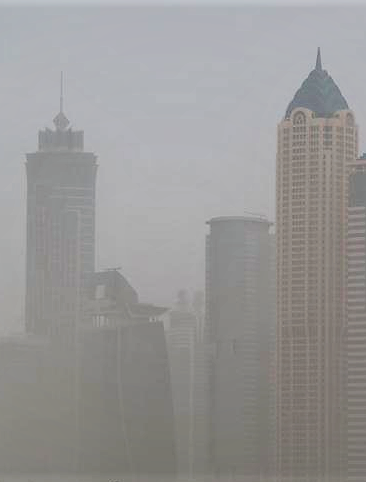
The world’s tallest building disappeared behind a grey layer of dust on Thursday as sandstorms that have swept the Middle East hit the United Arab Emirates, prompting weather and traffic warnings.
The 828-metre tall Burj Khalifa, which towers over Dubai and is usually visible across the busy financial hub, retreated behind a curtain of airborne dirt that shrouded much of the country.
The UAE is just the latest country in the path of sandstorms that have smothered Iraq, Kuwait, Saudi Arabia, Iran and others in recent days, closing airports and schools and sending thousands to hospital with breathing problems.
Capital city Abu Dhabi’s air quality index soared into the “hazardous” zone overnight, according to waqi.info and the Plume pollution app.
The Middle East’s sandstorms are becoming more frequent and intense, a trend associated with overgrazing and deforestation, overuse of river water and more dams.
Experts say the phenomenon could worsen as climate change warps regional weather patterns and drives desertification.
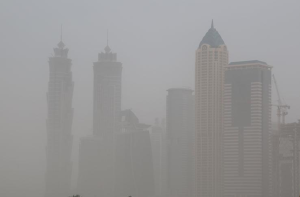
duba-dust-weather

File picture of the buildings on the Sheikh Zayed Road in Dubai.

Emirati authorities issued a nationwide warning urging residents to remain vigilant.
“Abu Dhabi Police urges drivers to be cautious due to low visibility during high winds and dust,” the police force tweeted, as residents took to social media to publish photos and videos.
“Please do not be distracted by taking any videos or using your phone,” it added.
A National Center for Meteorology graphic showed nearly all the country covered by the storm, with the warning: “Be on the alert: hazardous weather events are expected.”
Winds with speeds up to 40 kilometres per hour are blowing the dust, it said, reducing visibility in some areas to less than 2,000 metres.
However, a Dubai airports spokesman said there was no impact on air traffic. Weather conditions were expected to remain the same for the next few days.
In neighbouring Saudi Arabia, badly hit on Tuesday, conditions eased in the capital Riyadh on Wednesday but continued to restrict visibility in the city centre.
Emergency rooms in Riyadh hospitals received some 1,285 people suffering from respiratory problems over 24 hours from the sandstorm, the state-run Al-Ekhbariya channel reported late on Tuesday.
The Saudi national weather centre reported that dust was also affecting visibility in the west and south, specifically in Assir, Najran, Hael and Medina provinces. Medina is home to Medina city, the second-holiest city in Islam.
The centre predicted another sandstorm would arrive in the kingdom by Sunday.

Agence France-Presse

News

UAE motorists to see new parking charges in Abu Dhabi neighbourhood

Published

on

Spread the love

Motorists in Abu Dhabi’s Mohamed Bin Zayed City will soon need to factor in parking fees, as paid parking is set to roll out in additional commercial sectors starting May 6.

Under the new system, drivers will pay Dh2 per hour for standard parking in sectors ME9 and ME12, as part of ongoing efforts to improve traffic flow and accessibility in busy neighbourhood hubs.

The initiative is being implemented by Q Mobility under the supervision of the Integrated Transport Centre (ITC), reflecting a broader push to modernise urban mobility across the capital.

For many UAE residents and expats living in the area, the change marks a shift from previously free parking to a more structured system designed to reduce congestion and limit random parking, particularly around commercial and service outlets.

The rollout will cover more than 10,000 parking spaces, including 3,219 spaces in ME9 and 6,986 spaces in ME12, along with designated spots for People of Determination.

To make the transition easier, motorists can pay through multiple digital channels, including apps like Darb and TAMM, as well as SMS and on-site payment machines, offering flexibility for residents who rely on different payment methods.

Authorities say the system is designed to support local businesses by improving access to shops and services, making it easier for customers to find available spaces.

Continue Reading

News

UAE mandates better housing, healthcare, and safety for workers

Published

on

Spread the love

The UAE is stepping up efforts to improve worker welfare, as the Ministry of Human Resources and Emiratisation (MOHRE) rolls out a comprehensive set of regulations governing labour accommodation across the country.

The new guidelines aim to raise living standards for workers, many of whom are part of the UAE’s diverse expat community, by introducing enhanced health, safety, and well-being measures, including mandatory free internet access in accommodation facilities.

Under the updated rules, employers are required to provide licensed and adequate housing or offer a housing allowance. Larger accommodations housing 1,000 workers or more must now include 24-hour medical clinics, along with recreational spaces and access to financial services.

The changes also place a stronger emphasis on mental well-being. Accommodation managers are expected to organise social and recreational activities during official holidays, helping workers stay connected and engaged outside of work.

Location planning is another key focus. Labour accommodations must be situated near industrial zones and transport networks, while maintaining safe distances from residential neighbourhoods and environmental risks.

In terms of daily living standards, the regulations outline clear requirements for cleanliness, proper lighting, sanitation, food preparation areas, and access to safe drinking water, as well as pest control and secure gas systems.

Emergency preparedness has also been reinforced. Employers must provide first aid rooms, isolation areas, and emergency response plans, while larger facilities are required to have on-site doctors, nurses, and ambulance services.

To ensure accessibility and transparency, workers must be given written guidance in multiple languages, explaining their rights, health and safety procedures, and how to contact authorities for support or to file complaints. This is complemented by clear emergency signage, evacuation plans, fire safety measures, and regular drills.

The ministry says these updates are part of a broader push to strengthen worker protection, ensure compliance, and enhance quality of life.

Continue Reading

News

Sharjah begins demolition in Khorfakkan for new university tower

Published

on

Spread the love

Urban transformation is underway in Khorfakkan, as the Sharjah Roads and Transport Authority (SRTA) has begun demolition work on the southern entrance bridge to the city, marking the first step in a wider redevelopment plan.

The move comes as part of preparations for the upcoming Khorfakkan University Tower, a project expected to become a new architectural landmark and a defining feature of the city’s skyline.

For residents and expats living in Sharjah’s east coast hub, the development signals a shift towards a more modern and visually striking urban environment, while still maintaining the coastal charm that makes Khorfakkan a popular weekend escape.

According to authorities, the tower is one of several ongoing projects aimed at enhancing the quality of life, improving infrastructure, and elevating the overall visitor experience. The redevelopment aligns with Sharjah’s long-term vision of creating sustainable, well-connected urban spaces across the emirate.

Khorfakkan, known for its scenic beaches and mountainous backdrop, has increasingly become a focal point for development in recent years. Projects like the University Tower are expected to further position the city as both a lifestyle destination and a growing residential hub for UAE residents seeking a quieter alternative to larger cities.

While the demolition may temporarily affect traffic flow in the area, it also marks the beginning of a new chapter for the city.

Continue Reading

Popular

© Copyright 2025 HEADLINE. All rights reserved

https://headline.ae/