Connect with us

Technology

DFS Dialogue: FinTechs and banks joining forces in welcome trend

Published

on

Spread the love

Collaboration and not collision of interests is the emerging pathway for FinTech companies and banks to build a better economic system in the UAE and the world. This is the message coming out of Dubai International Financial Centre where 10 head honchos came together for the second of Dubai FinTech Summit (DFS) Dialogues, a precursor series to the main event on May 8 and 9.

Mohammad AlBlooshi

The 10 speakers deliberated the challenges which face the financial sector, and how the industry can de-risk while building sustainable institutions. Host Mohammad AlBlooshi, Head of DIFC Innovation Hub and FinTech Hive, said: “As an industry predicated on confidence and trust, we are currently seeing the banking sector experience a time of disruption. Given global headwinds, we have an opportunity to build more resilient institutions through collaboration between banks and FinTechs.”

According to recent research by Report Ocean, the global FinTech lending market was valued at approximately US$ 573 billion in 2021. It’s expected to grow at a healthy cumulative growth rate of more than 27.4% over the forecast period of 2022-2029.

Banks v FinTechs is history

The FinTech sector, widely recognised as a major competitor to banks, is expected to double in size from $135.9bn in 2021 to $266.9bn in 2027, according to a 2022 report by DIFC FinTech Hive. Additionally, with approximately 50 per cent of the MENA region currently unbanked or underbanked, FinTechs have been playing a crucial role in promoting inclusive economic growth in the region.
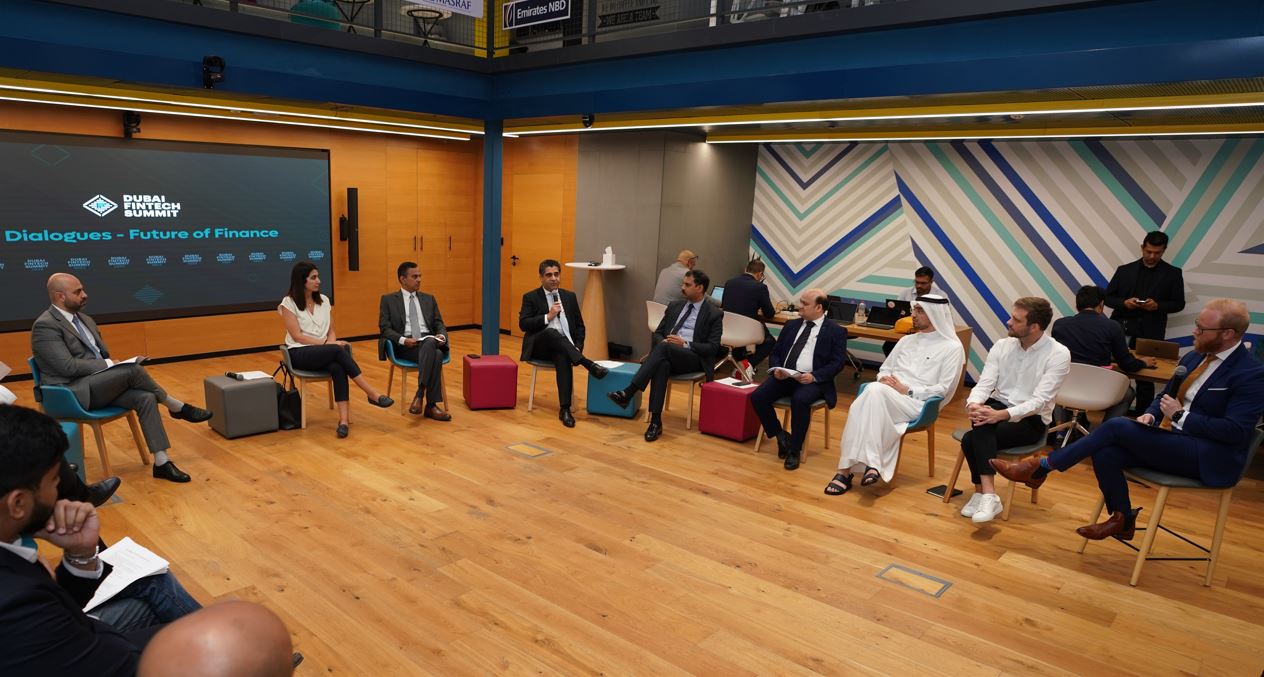
Ten head honchos from banks and FinTechs came together to discuss disruption in the industry. Trescon Global

However, a unanimous takeaway from all banks at the DFS Dialogue captured how both entities are in fact symbiotic. Sanjay Sethi, Senior Managing Director, Head of Global Transaction Banking at First Abu Dhabi Bank, said, “this is an age of collaboration and co-creation where leading financial institutions and pioneering FinTechs can embark on a journey of innovative discovery together. This is especially true when we look at opportunities to expand into new geographies, improve product capabilities, grow revenues, or scale or optimise our business faster and more efficiently. Alongside this, FinTech solutions in transaction banking are growing in agility every day.”

Earlier this year, the UAE Central Bank announced the implementation of its Digital Dirham currency strategy, which promises to be a critical step in the country’s payments industry. “As such, the synergy between banks and FinTechs proves to be unavoidable as the industry inches towards a cashless economy,” added AlBlooshi.

Enhancing trust

A report by Economist Impact and supported by Google has predicted that the financial services and banking industry will emerge as the primary spender for AI technology in the MENA. The industry will make up nearly 25 per cent of all AI investments in the region, with banking tech alone expected to contribute 13.6 per cent to the region’s gross domestic product by 2030.

Mehdi Tazi, Chief Operating Officer, Lean Technologies, stated, “I believe customers still trust banks more than FinTechs – they are larger more established institutions. However, something FinTechs do very well is streamlining processes when helping onboard customers into these larger banks. As a result, we are seeing a marriage between FinTech and banking that enhances the customer’s journey, ultimately building trust.”


The onset of Web 3.0 ushers in a transformative moment for financial services, capital markets and banking, shifting customer expectations and revolutionising the sector. The total transaction value of embedded finance is estimated to reach $7 trillion in 2026, as per Rakesh Reddy, CEO, Cloud4u, “This is particularly useful for Platform as a Service (PaaS) providers who will strongly benefit from this growth, undeniably becoming a key industry disruptor.”

Nilay Singh, Chief Executive Officer, State Bank of India, DIFC, pointed out, “We cannot ignore AI. It has to be adopted but cleverly and effectively, and this is where we need to understand what to outsource and when to collaborate.”

With a unified goal to enhance inclusive banking solutions for the region, traditional financial establishments are optimistic in growing partnerships with FinTech companies to bridge gaps and stay ahead of the curve strategically.

More such conversation starters will be on show at the Dubai FinTech Summit, to be held at Madinat Jumeirah on May 8-9. Visitors can purchase tickets with early bird prices available until 15 April 2023.

HEADLINE READERS GET DISCOUNTED TICKETS: As media partners, Headline UAE can get you 10% off on the big ticket to the most high-profile event in town. All you have to do is hit a like on the Instagram post to this story on our page and DM us. We will send you a code to use in the booking, so hurry!   
Crime

Dubai Police issue urgent warning: Secure your devices now

Published

on

Spread the love

Dubai Police have issued a fresh reminder to residents to strengthen the security of home surveillance systems and internet-connected devices, warning that weak settings can leave users vulnerable to hacking, privacy breaches, and even cyber extortion.

The alert comes as part of ongoing awareness campaigns led by the General Department of Criminal Investigation, represented by the Cybercrime and Electronic Crime Department. Authorities noted that many cyberattacks exploit devices with default or weak configurations, making them easy targets.

Residents are advised to take simple but vital steps:

  • •Change default passwords immediately after activating any device.
  • •Use strong, complex passwords with letters, numbers, and symbols.
  • •Regularly update operating systems and apps to patch security gaps.
  • •Avoid sharing personal details or passwords with unverified sources.
  • •Switch off surveillance systems when not in use, especially in private spaces.
  • •Stay alert to suspicious links or apps from unreliable platforms.

Dubai Police emphasised that awareness remains the first line of defence against cybercrime. To support the public, residents can access advice through the e-Crime Hub and report incidents via official channels or by calling 901 for non-emergency cases.

Authorities reiterated that community cooperation is key to reducing cybercrime and protecting individuals, families, and property in the digital age.

Continue Reading

Business

AI Is taking over half of UAE government services: What you need to know

Published

on

Spread the love

half of

The UAE will transition 50 per cent of its government services, operations and sectors to autonomous artificial intelligence systems within the next two years, under directives issued by President Sheikh Mohamed bin Zayed Al Nahyan.

The major shift was announced on Thursday by Sheikh Mohammed bin Rashid Al Maktoum, Vice President and Prime Minister of the UAE and Ruler of Dubai, who said the country would move half of its government services to AI-driven systems as part of a new governance model.

Describing the initiative as a next-generation government system, Sheikh Mohammed said the UAE aims to become the first country in the world to adopt ‘agentic AI’ models capable of independently executing tasks, managing processes and supporting decision-making without direct human intervention.

He noted that advanced AI technologies are now able to monitor changes, analyse data, provide recommendations and carry out sequences of actions autonomously, adding that such systems would function as an executive partner to government entities. The move is expected to enhance efficiency, improve service delivery and enable real-time evaluation and optimisation across public sector operations.

Sheikh Mohammed also said that ministers, directors-general and federal entities would be assessed over the next two years based on how effectively they keep pace with the transformation, including the speed at which they adopt AI tools and implement new operational standards.

As part of the initiative, all federal government employees will undergo specialised training in artificial intelligence to build the capabilities required to support what has been described as one of the largest government transformation projects globally.

How AI shift could affect daily life

  • Applications, approvals, and renewals could be processed much quicker.
  • Expect fewer in-person visits and more services handled online.
  • AI systems don’t sleep, some services may become available 24/7.
  • Real-time tracking and instant status updates on requests.
  • Policies and services may improve based on data-driven insights.
  • Basic processes (like renewals or payments) could be fully automated.
  • Problems or delays in services may be identified and fixed sooner.
  • Increased reliance on digital systems may bring stronger data controls, but also higher awareness around privacy.

Continue Reading

Announcements

DIFC to become world’s first AI-native financial centre in Dubai

Published

on

Spread the love

Dubai International Financial Centre (DIFC) has announced plans to transform into the world’s first AI-native financial centre, embedding artificial intelligence across every layer of its operations as part of Dubai’s broader push to lead in advanced technologies.

The initiative will integrate AI into legal and regulatory systems, business operations, talent development, and even physical infrastructure, marking a shift from limited pilot projects to a fully AI-driven ecosystem.

AI at the core of DIFC’s strategy

While many global financial hubs are experimenting with AI, DIFC said its approach is different, placing AI at the core of how the centre functions, rather than using it selectively.

The groundwork for this transformation was laid in 2023 with the launch of a five-year AI strategy, alongside new data governance policies and regulations that formally incorporate AI into its legal framework.

Economic growth and job creation

Officials estimate the initiative could generate up to $3.5 billion (Dh12.9 billion) in economic benefits and create around 25,000 jobs, further strengthening Dubai’s position as a global financial and technology hub.

Building an AI-powered ecosystem

DIFC plans to provide companies with access to advanced AI tools, while also exporting governance models and trained talent to emerging markets.

By 2030, the centre aims to develop a fully integrated AI ecosystem, including robotics, autonomous mobility, and digital infrastructure, effectively creating a smart, AI-powered city within a city.

Supporting Dubai’s AI vision

The move aligns with Dubai’s wider economic agenda to lead in artificial intelligence and innovation.

The vision will also be highlighted during the Dubai AI Festival, taking place at Dubai World Trade Centre on October 26–27, where more than 20,000 participants from over 100 countries are expected to attend.

Continue Reading

Popular

© Copyright 2025 HEADLINE. All rights reserved

https://headline.ae/