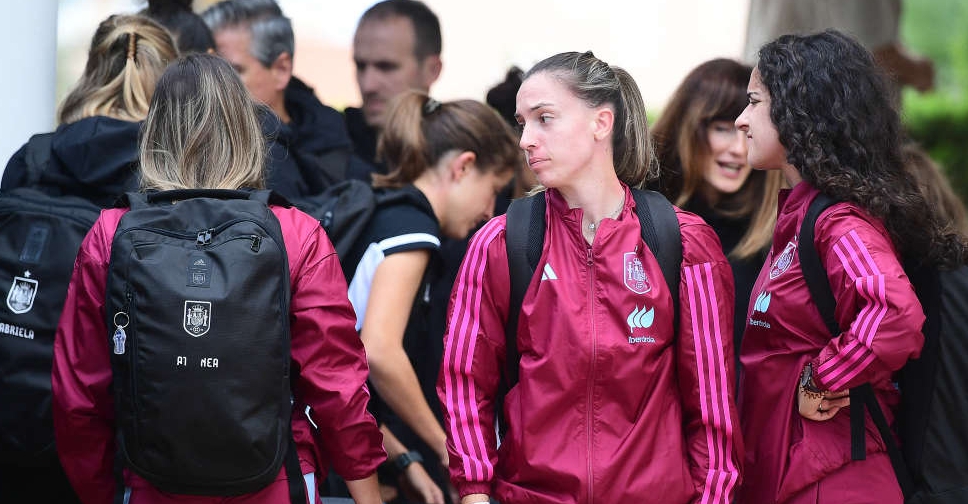
Spain’s forward Eva Navarro (C), defender Ohiane Hernandez and teammates at Valencia (AFP)
Spain’s World Cup winning squad agreed to end their boycott of the national team early on Wednesday after the country’s football federation (RFEF) said it would make “immediate and profound changes” to its structure.
The decision was reached around 5:00 am (0300 GMT) after more than seven hours of meetings at a hotel in Oliva, an hour from Valencia, involving the players, RFEF officials, the National Sports Council (CSD) and the women’s players’ union FUTPRO.
The players had said they would not represent Spain until there were further changes at the federation, deepening a crisis that started after former (RFEF) boss Luis Rubiales kissed Jenni Hermoso during the World Cup presentation ceremony.
“A joint commission will be created between RFEF, CSD and players to follow up on the agreements, which will be signed tomorrow,” CSD President Victor Francos told reporters.
“The players have expressed their concern about the need for profound changes in the RFEF, which has committed to making these changes immediately.”
Neither Francos nor Rafael del Amo, president of the RFEF committee for women’s football, would elaborate on the changes to be made, only saying they would be announced “soon”.
“The players see it as a rapprochement of positions. It is the beginning of a long road ahead of us,” FUTPRO president Amanda Gutierrez told reporters.
“Once again, they have shown themselves to be coherent and the vast majority have decided to stay for the sake of this agreement.”
After most of the Women’s World Cup winners were selected for upcoming games, the players said in a joint statement they would take the “best decision” for their future and health after they studied the legal implications of being included in a squad list they had asked to be left out.
They argued the federation cannot require their presence because they alleged the call-up was not issued within the world’s football governing body FIFA parameters in terms of timings and procedure.
The players could have faced sanctions including fines of up 30,000 euros ($32,000) and the suspension of their federation licence for two to 15 years according to Spain’s Sports Act if they had refused the call-up.
Twenty players who said they were boycotting the team were called up by new coach Montse Tome, and while all of them reported for training on Tuesday two decided to leave the squad for “personal reasons”.
Neither of the players would be sanctioned and it was agreed their identities would remain anonymous.
“The first thing they have been told here has been: whoever is not at ease, does not feel strong enough, should know that neither the federation nor the CSD was going to apply a sanctioning process,” Francos said.
The revolt by the players was triggered after former RFEF chief Rubiales kissed forward Hermoso following Spain’s World Cup victory.
She disputed his insistence the kiss was consensual, sparking a national debate about macho culture in sport and eventually led to Rubiales’s resignation.
Hermoso was not in the squad list announced on Monday and accused the RFEF of trying to divide and manipulate the players.
Spain are set to make their debut in the Women’s Nations League against Sweden in Gothenburg on Friday before playing against Switzerland in Cordoba on September 26.
The Nations League will determine which teams from Europe qualify for the 2024 Paris Olympic Games.
The RFEF said the players would have a late breakfast after resting and will hold their first practice on Wednesday afternoon before travelling to Gothenburg on Thursday morning.

Football fans travelling with Emirates this summer won’t have to worry about missing any FIFA World Cup 2026 action. Dubai’s flagship airline Emirates, has announced that it will broadcast every match of the tournament live onboard its flights through Sport24, its dedicated live sports channel available on the award-winning ice entertainment system.
Passengers will be able to follow every moment of the world’s biggest football tournament while flying at 40,000 feet. The move ensures customers can stay connected to the action no matter where they are travelling, with live coverage available throughout the competition.
Emirates said the complete FIFA World Cup 2026 broadcast schedule is featured its ice magazine, allowing passengers to plan their journeys around key fixtures and follow their favourite teams during the tournament.
The live coverage will be available on most Emirates aircraft equipped with Sport24 and Sport24 Extra, although availability may vary depending on aircraft type and route. Selected FIFA World Cup matches will also be shown in Emirates Lounges across Dubai, giving travellers additional opportunities to catch the action before departure.
Mexico City’s iconic Estadio Azteca was transformed into a global stage on Thursday Night as the FIFA World Cup 2026 officially got underway, marking the beginning of the biggest edition in the tournament’s history.
A vibrant opening ceremony showcased a blend of Mexican culture, music and modern spectacle, with performances from international stars including Shakira and Burna Boy. The ceremony was designed to reflect both the heritage of the host nation and the global nature of the tournament, which for the first time will be staged across three countries — Mexico, the United States and Canada.
Before the first whistle of the competition, the atmosphere inside the historic stadium reached a crescendo as thousands of fans filled the stands, waving flags and lighting up the arena in a sea of colour. The Estadio Azteca, already steeped in football history, has now become the first venue in the world to host matches across three separate FIFA World Cups, having previously staged the 1970 and 1986 finals.
In a further highlight of the ceremony, Italian tenor Andrea Bocelli performed the tournament’s official anthem, adding a classical flourish to an evening otherwise defined by high-energy performances and large-scale choreography.
FIFA officials described the opening event as a “symbolic bridge between continents”, underlining the expanded format of the 2026 tournament. For the first time, the World Cup will feature 48 teams — up from 32 — and a total of 104 matches, spread across 16 host cities across North America. The expansion is intended to increase global participation and bring the tournament to a wider range of supporters.
Immediately after the ceremony, hosts Mexico faced South Africa in the tournament’s opening match, kicking off what is expected to be a month-long football spectacle. The match began under heavy security and heightened global attention, with millions watching around the world.
The expanded format has also brought logistical challenges, with teams required to travel across vast distances between venues in multiple countries. Organisers have emphasised investments in transport infrastructure, stadium upgrades and sustainability measures aimed at reducing the environmental footprint of the tournament.
The 2026 edition also arrives at a time when football’s global profile continues to grow rapidly, with record broadcast deals, increased digital streaming access and heightened commercial interest from sponsors. Analysts expect the tournament to break previous viewership records, particularly given its tri-nation hosting model and expanded team lineup.
Estadio Azteca itself remains one of football’s most storied venues. It famously hosted Brazil’s Pelé lifting the trophy in 1970 and Diego Maradona’s “Hand of God” and “Goal of the Century” performances in 1986. Its role in opening the 2026 tournament has been widely seen as a nod to football’s rich history in Mexico, while also signalling a new era for the sport.
As fireworks lit up the Mexico City skyline following the ceremony, attention now turns to the next phase of the tournament’s opening schedule, with matches set to continue across North America in what promises to be the most geographically expansive World Cup ever staged.
For fans, players and organisers alike, the message from Mexico City was clear: the world’s biggest sporting event has begun, and it is set to be bigger, broader and more ambitious than ever before.
Emirati International Arbiter Abdullah Murad Al Mazmi has been appointed to the officiating panel for the 2026 FIDE World Rapid and Blitz Team Championships, one of the biggest events on the global chess calendar.
The championship will take place in Hong Kong from June 16 to 22 and is expected to feature many of the world’s leading grandmasters, including world number one Magnus Carlsen.
Al Mazmi’s selection highlights the growing international recognition of Emirati chess officials. He currently serves as Chairman of the Arab Chess Federation’s Arbiters Committee and Tournament Director of the prestigious Sharjah Masters International Chess Championship.
Speaking about the appointment, Al Mazmi said he was proud to represent the UAE at one of chess’s most prestigious global events. He described the selection as a reflection of FIDE’s confidence in Emirati arbiters and their ability to officiate at the highest international level.
He added that the role carries significant responsibility and offers a valuable opportunity to exchange expertise with some of the world’s top chess officials while showcasing the progress of UAE chess on the global stage.
The appointment marks another milestone for Emirati representation in international sports administration and reinforces the UAE’s growing presence in the world of chess.