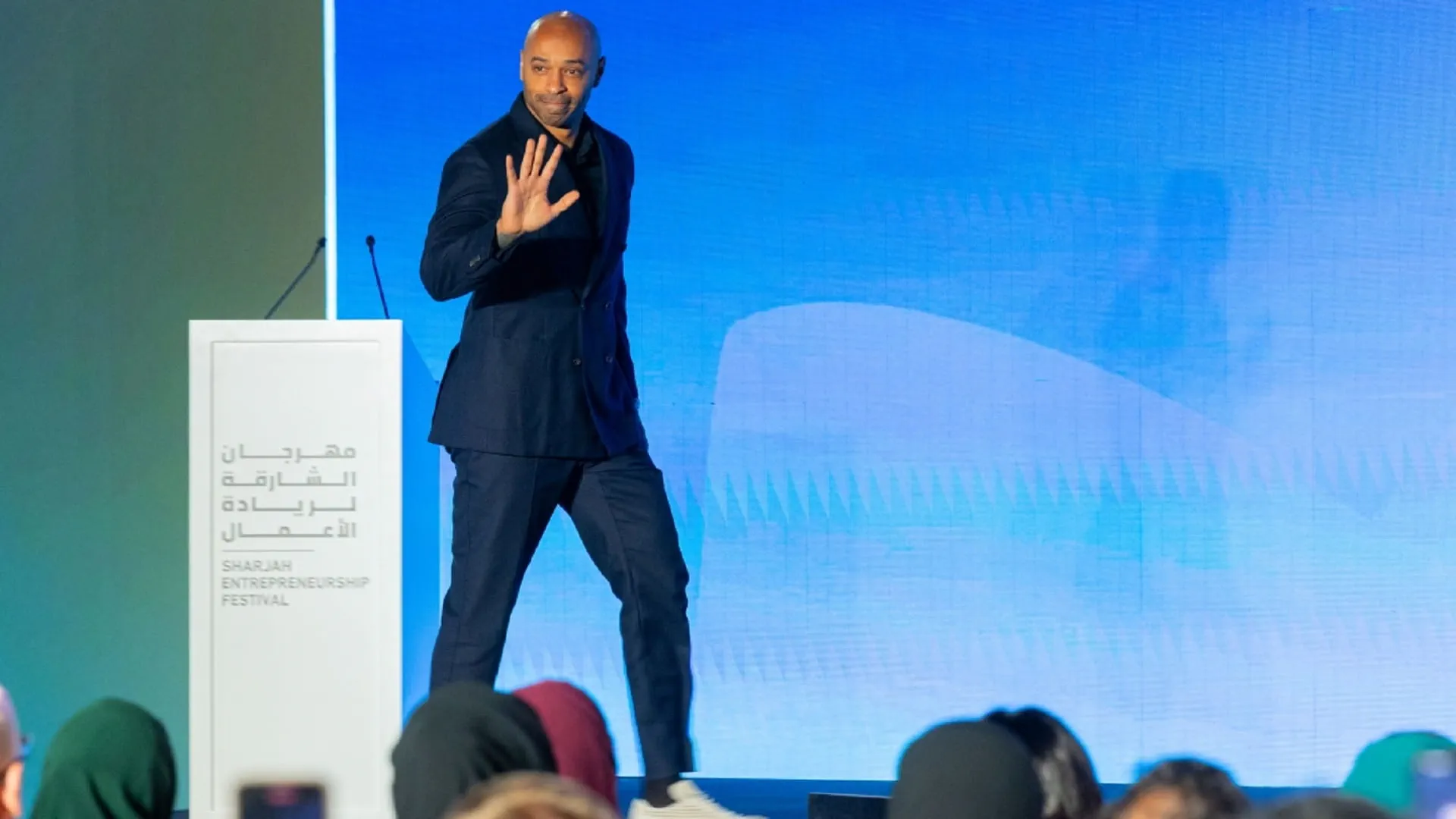
At the region’s largest entrepreneurial festival, former Arsenal and Barcelona star draw parallels between football and business, encouraging youth to push beyond their limits.
“Invest in yourself—whether it’s in your free time, happiness, or beliefs.” These were the words of French World Cup-winning football icon Thierry Henry as he delivered an impassioned keynote at the Sharjah Entrepreneurship Festival (SEF) 2025 on Saturday, drawing parallels between football and business and recalling his younger days as a player, encouraging youth to push beyond their limits.
“Take risks, because without them, there’s no reward. And remember, if you are here to perform, competition is key—someone is always ready to take your place,” said the footballer when asked by moderator Ghalia Abdalla Almaazmi, Deputy Head of the Women’s Football Committee, UAE Football Association, what mattered more – luck or skill. “Success comes to those who are willing to take risks—without action, there’s no reward. And when you reach the top, staying there requires just as much effort. Keep it simple, stay real, and always be ready to push yourself further.”
But funnily for Henry, who scored 51 times for the Les Blues while helping them to a World Cup trophy in 1998, the start of his ‘journey of excellence’ as a child was all about playing for one man – his father Antoine. “I just wanted to please my dad. [At that age] you just want to make sure that you are seen. I didn’t want to impress anyone else but my dad for whom smiling never came naturally. But one day he smiled. Playing professional football and winning came later,” said the former Arsenal and Barcelona man considered one of the greatest strikers of all time.
The world champion’s take on developing a winning mindset
Henry, who under long-time mentor and coach Arsène Wenger, became a prolific striker and English premier league club Arsenal’s all-time leading scorer with 228 goals in all competitions, winning the Premier League Golden Boot a record four times, also spoke about one of his earliest coaches Joaquim Francisco Filho and how it helped him develop the ‘winning mindset’.
“I had coaches along the way. What Filho did was something very important to me. We often talk about being faster and stronger but one of the most important things is how we must think. He developed my winning mindset. For example, when I was younger, I was fast. In training sometimes, he used to tell me I don’t want you to beat anyone but yourself,” Henry said.
“So keep believing and do not stop. It is you up against yourself at the end of the day. The best discussion you can ever have is with yourself”, he told his audience.
Leveraging the business of sports as a tool for positive change
Sharing his insights on starting a business in the sports industry, he said: “Sports doesn’t operate like any other industry. Strategies that bring a company exceptional results might not apply to football. You will be criticised, lose money, but ask yourself, why are you doing this? Is it for money or fame, or are you in it to make a difference?”
“Look at Manchester City – they have transformed the environment around their stadium, created jobs and made the place better. Sports reflect society. It unites people from all cultures, creates change around pressing issues, and allows women to evolve. I hope we can continue to change in that direction.”
Connecting the global ecosystem under the theme of “Where We Belong,” SEF 2025 champions the impact of community and the spirit of innovation. Organised by the Sharjah Entrepreneurship Center (Sheraa) as the largest event of its kind in the region, and hosted at the Sharjah Research, Technology, and Innovation Park (SRTIP), this year’s festival is taking place from 1-2 February, 2025.
As a trainee reporter and creative lead, I focus on curating engaging content and managing the social media presence for the company. I aim to connect audiences with relevant, impactful news through multiple digital platforms.
Businesses across the UAE that play music for commercial purposes will face a new licensing system from December 2026, under rules announced by the Ministry of Economy and Tourism.
The new framework introduces licensing fees for a wide range of businesses and organisations that use music commercially, including restaurants, cafes, hotels, shopping malls, gyms and airlines.
Radio and television broadcasters, as well as concert organisers, will also fall under the new system.
The changes are outlined in the ministry’s new Collective Management in Music Guide, which sets out how music copyright and related rights will be managed across the UAE.
Which businesses will have to pay?
The new licensing requirements will apply to venues and businesses that commercially use music.
This includes:
Restaurants Cafes Hotels Shopping malls Gyms Airlines Radio stations Television channels Concerts and other commercial music events
The amount businesses pay will not be the same across the board. Instead, fees will be calculated using a sliding-scale system, taking into account factors such as the type of music use and the size or nature of the business.
When do the new UAE music fees start?
The new licensing fees are scheduled to come into effect in December 2026.
Businesses that require a licence will receive a renewable one-year licence. The fees will be collected through the organisations responsible for managing music rights, including the Emirates Music Rights Association and Music Nation.
These organisations represent rights holders across the music industry, including composers, songwriters, singers, instrumentalists, record producers and music publishers.
Why is the UAE introducing the new system?
The government says the new framework is designed to create a more structured system for managing copyright and related rights in the UAE.
According to the Ministry of Economy and Tourism, standardising licensing requirements and fees should help reduce copyright violations while bringing the UAE’s approach more closely in line with international practices.
For businesses, that means music used as part of the customer experience, whether in a restaurant, hotel, gym or another commercial setting, will be subject to clearer licensing requirements.
Who is exempt from the music licensing fees?
Not every organisation or event will be covered by the new commercial licensing requirements.
The guide identifies exemptions that include: Schools and academic institutions Non-commercial celebrations National events
This means the new fees are primarily focused on the commercial use of music rather than private or educational settings.
New fund will support UAE music talent
The new framework also includes a support mechanism for the country’s music industry.
A Cultural Support Fund in the Field of Music will be established to provide financial assistance and technical support to artists, performers and producers.
Under the new system, 10 per cent of the fees collected will be directed towards the fund.
The money will be used to support emerging musical talent and help promote Emirati music internationally.
What does this mean for UAE businesses?
For businesses that regularly play music for customers, the biggest change will be the introduction of a formal licensing requirement and associated annual fees.
The exact amount will depend on how the music is being used and the characteristics of the business, rather than being a single flat charge for every venue.
Businesses that rely on music as part of their atmosphere or entertainment offering will therefore need to factor the new licensing requirements into their operations from December 2026.
At the same time, the government says the system is intended to ensure creators and other rights holders receive appropriate recognition and compensation when their work is used commercially.
Music licensing rules:
Start date: December 2026 Licence period: One year, renewable Applies to: Commercial users of music Examples: Restaurants, cafes, hotels, malls, gyms and airlines Also covered: Radio, television and concerts Fee structure: Sliding scale based on use and business characteristics Exemptions: Schools, academic institutions, non-commercial celebrations and national events Music support fund: 10% of collected fees
For UAE businesses, the new rules mark a significant change in how commercial music use will be licensed, while the accompanying support fund is designed to put part of those revenues back into the country’s developing music sector.
Indian travellers planning a holiday in Abu Dhabi can now have the cost of their UAE entry visa covered under a new tourism initiative.
The Department of Culture and Tourism – Abu Dhabi (DCT Abu Dhabi) has launched a limited-time programme for eligible Indian passport holders who book qualifying Abu Dhabi holiday packages through participating travel companies and online travel agencies.
The offer is available until October 31, 2026, during an initial pilot that will support up to 20,000 visas.
However, the offer comes with specific booking requirements. Travellers must book a package that includes both a return flight from India and at least three consecutive nights at an Abu Dhabi hotel.
Who is eligible for the free UAE visa offer?
The programme is aimed at Indian passport holders travelling from India to Abu Dhabi.
To qualify, travellers must book through a participating travel partner or online travel agency. The holiday package must include:
A minimum three-night stay at an Abu Dhabi hotel
A return flight from India
Booking through an eligible participating travel partner or OTA
The visa benefit cannot be claimed through an independent application. It is tied to qualifying holiday bookings made through the programme’s participating partners.
When is the Abu Dhabi free visa offer available?
The initiative runs from:
August 1 to October 31, 2026
DCT Abu Dhabi says the pilot programme will initially support up to 20,000 visas.
For eligible bookings, the tourism authority will cover the full cost of the UAE entry visa, potentially reducing the upfront expense for Indian visitors planning a trip to the emirate.
How does the visa fee waiver work?
Travel partners participating in the scheme have two ways to process the visa arrangements.
One option is to work with a DCT-appointed destination management company (DMC). In this case, DCT Abu Dhabi will pay the visa costs directly.
Travel companies can also use their existing DMC partners. Under this arrangement, DCT Abu Dhabi will reimburse Dh285 for each visa issued under the programme.
For travellers, the key point is that the benefit is handled through the participating travel partner rather than by applying for reimbursement independently.
Why is Abu Dhabi targeting Indian travellers?
India continues to be an important international source market for Abu Dhabi’s tourism sector.
According to DCT Abu Dhabi, the new programme is part of wider efforts to make the destination more accessible to Indian visitors while strengthening relationships with travel companies and improving connectivity between India and Abu Dhabi.
The initiative also aims to encourage visitors to spend more time in the emirate exploring its hotels, cultural attractions, entertainment options and natural landscapes.
Is the UAE visa completely free for all Indian tourists?
No.
The offer does not mean that every Indian passport holder automatically receives a free UAE tourist visa.
The visa fee is covered only when travellers meet the programme’s conditions and book through a participating travel partner or online travel agency.
The booking must include at least three consecutive hotel nights in Abu Dhabi and a return flight from India.
Travellers should therefore check with their chosen travel provider before booking to confirm that the package and visa arrangement qualify for the offer.
Abu Dhabi holiday offer:
Who: Eligible Indian passport holders travelling from India Destination: Abu Dhabi, UAE Offer period: August 1–October 31, 2026 Hotel requirement: Minimum three consecutive nights Flight requirement: Return flight from India Booking requirement: Participating travel partner or OTA Visa cost: Covered by DCT Abu Dhabi for eligible bookings Pilot capacity: Up to 20,000 visas Independent applications: Not eligible for the programme
For Indian travellers already considering an Abu Dhabi getaway, the initiative could make an eligible holiday package more affordable, but checking the participating travel provider and meeting all the booking conditions will be essential.
Small businesses in the UAE with annual revenues of up to Dh3 million will continue to be eligible for Small Business Relief under the corporate tax regime until the end of 2029.
The Ministry of Finance said on Friday that Ministerial Decision No. 131 extends the period during which eligible businesses can benefit from Small Business Relief to cover tax periods ending on or before December 31, 2029.
The relief was introduced to help reduce the corporate tax compliance burden for smaller businesses and start-ups that meet the eligibility requirements.
Dh3 million threshold remains unchanged
The existing annual revenue threshold of Dh3 million, set under Ministerial Decision No. 73 of 2023, will continue to apply.
The relief applies to tax periods beginning on or after June 1, 2023 and, following the latest amendment, will remain available for subsequent tax periods ending on or before December 31, 2029.
Eligible taxable persons with annual revenue of up to Dh3 million can claim Small Business Relief, subject to meeting the conditions and requirements outlined in the corporate tax legislation.
The relief enables qualifying businesses to benefit from simplified corporate tax compliance requirements.
More time for small businesses
The extension provides eligible small businesses and start-ups with additional tax periods to benefit from the relief while continuing to meet the Dh3 million revenue threshold.
The Ministry said the decision is part of its efforts to support smaller companies and entrepreneurs, strengthen the business environment, and encourage sustainable growth and expansion.