Connect with us

Announcements

UAE working on building world’s most energy-efficient home AC

Published

on

AC-energy-efficient-home
Spread the love
AC-energy-efficient-UAE

The agreement was signed in the presence of Dr Sultan Al Gargash himself. WAM

ABU DHABI, June 28 (WAM)

A new partnership was announced today between Strata Manufacturing, a UAE-based Digital Factory pioneer, Hyperganic, an AI-based engineering platform company with offices in Germany and Singapore, and German industrial 3D printing company EOS to build the world’s most energy-efficient residential air conditioner (A/C) system.

The partnership is a result of the Ministry of Industry and Advanced Technology’s efforts to facilitate industrial collaboration, which is in line with its strategy to create an attractive business environment for local and international investors in the industrial sector, support the growth of national industries, stimulate the adoption of innovation and advanced technology in industrial systems and solutions, and enhance the country’s status as a leading destination for the industries of the future.
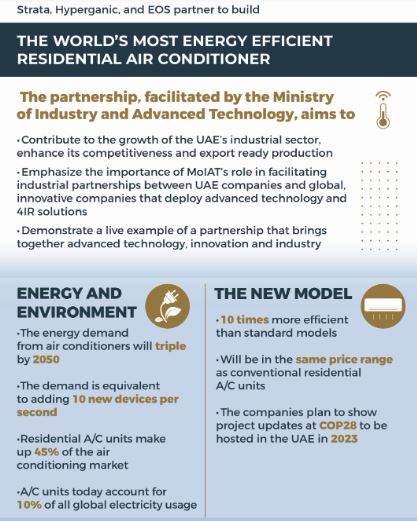
The International Energy Agency (IEA) is projecting that energy demand from air conditioners will triple by 2050 – which is the equivalent to adding 10 new devices every second for the next 28 years. A/C units today account for 10 percent of all global electricity usage, which proves how crucial it is to reduce their energy consumption to satisfy environmental requirements.

The three partners signed the agreement at an official ceremony witnessed by Dr. Sultan bin Ahmed Al Jaber, Minister of Industry and Advanced Technology, Sarah bint Yousif Al Amiri, Minister of State for Public Education and Advanced Technology, and Musabbeh Al Kaabi, CEO of UAE Investments at Mubadala Investment Company. The agreement was signed by Lin Kayser, CEO and Founder of Hyperganic, Dr. Hans Langer, Founder of EOS and a 3D printing pioneer, and Ismail Ali Abdullah, CEO of Strata Manufacturing.

Under the agreement, the partners will combine Hyperganic’s Algorithmic Engineering approach with the industrial metal 3D printing process pioneered by EOS, and Strata’s digital technologies, to produce a residential A/C unit that is up to 10 times more efficient than standard models – and, as such, will be highly coveted in global markets.

The companies plan to show project updates at the United Nations Framework Convention on Climate Change (UNFCCC) COP28 UAE to be hosted in Expo City Dubai in 2023. Hyperganic announced they will open their UAE Engineering Office at the beginning of July. Their team, which is set to grow to 20 engineers by the end of 2023, will cooperate with Strata’s team and the EOS team on implementing the project.

More on the story here.

Announcements

UAE bans under-15s from social media: Everything parents need to know

Published

on

Spread the love

The UAE has introduced one of its strongest measures yet to protect children online, setting a minimum age of 15 for social media use.The new rules mean that children under 15 will no longer be allowed to create or use personal social media accounts, even if they have their parents’ permission.

For many families, the announcement raises practical questions. Which apps are affected? Can parents make exceptions? How will age checks work? And what changes for teenagers aged 15 and 16?

Here’s a breakdown of what the new regulations mean for parents.

Which platforms are affected?

The rules apply broadly to almost any platform that functions as a social media service. This includes platforms that allow users to create profiles, share content, interact with others, join communities, or receive content recommendations through algorithms. Whether a service is free or paid does not matter. If it is available in the UAE or targets users in the country, it falls within the scope of the new regulations.

What is banned for children under 15?

The most significant change is the introduction of a minimum age of 15 for social media use. Children below this age will no longer be allowed to create, use or operate personal social media accounts.

The restriction goes beyond simply opening an account. Children under 15 will also be prohibited from accessing the full range of social media features, including posting content, commenting on posts, sharing material, participating in public groups or channels and engaging in wider social interactions through personal profiles.

In effect, the UAE has drawn a clear line by establishing 15 as the age at which children can begin accessing social media platforms.

Can parents give permission?

No. One of the most notable aspects of the new regulations is that parental consent cannot be used to bypass the age restriction.

The resolution explicitly states that permission from a parent or caregiver does not constitute a valid exemption from the rules. This means that even if a parent is comfortable with their child using social media before the age of 15, the platform is still required to prevent access.

The measure is designed to create a uniform national standard rather than leaving the decision entirely to individual families.

What happens when a child turns 15?

Turning 15 does not mean teenagers gain unrestricted access to social media. Instead, the regulations introduce a more controlled environment for young users aged between 15 and 16.

Teenagers in this age group will be allowed to have accounts, but platforms will be required to apply enhanced safety measures. These protections are expected to include stronger privacy settings, age-appropriate content filtering, restrictions on interactions with unknown users and tools that help manage the amount of time spent online.

The aim is to recognise that older teenagers are increasingly participating in the digital world while ensuring that they remain protected from some of the risks associated with social media use. The regulations describe this as part of a gradual transition towards healthier and more balanced digital habits.

What role will parents play?

While parents cannot override the age limit, they will still play a central role in supervising their children’s online activity.

For teenagers aged 15 and 16, caregivers will be able to use parental control tools provided by social media platforms to manage account settings and monitor usage. However, any changes made through these tools must remain within the limits established by the regulations.

The rules also place specific responsibilities on parents and caregivers. They are expected not to assist children in circumventing age-verification systems or accessing platforms in violation of the regulations. At the same time, they are encouraged to actively supervise their children’s digital activities, discuss online risks and promote safe and responsible internet use.

The message from regulators is clear: protecting children online is not solely the responsibility of technology companies but a shared responsibility involving families as well.

How will age verification work?

A key challenge for governments around the world has been ensuring that children cannot simply enter a false date of birth when signing up for social media accounts. The UAE’s new framework seeks to address that issue directly.

Under the regulations, platforms must implement effective and reliable age-verification systems. These may include digital identity checks, artificial intelligence-powered verification tools, biometric technologies or other mechanisms approved by the Child Digital Safety Council.

Importantly, self-declared ages will no longer be accepted as sufficient proof. Platforms will be expected to demonstrate that their systems can accurately determine whether a user meets the required age threshold.

At the same time, the regulations require companies to handle personal information responsibly. Data collected for verification purposes must be limited to what is necessary, stored securely and retained only for as long as required. Users must also be informed about how verification systems operate.

What new responsibilities will social media companies face?

The regulations place significant obligations on social media platforms, reflecting the UAE’s view that technology companies should play a more active role in protecting children online.

Platforms will be required to identify and remove accounts operated by children under 15, introduce measures to prevent users from bypassing safety systems and regularly assess risks to children’s digital wellbeing. They must also provide parental control tools and educational resources that help families navigate the online environment safely.

The rules further restrict how children’s data can be used. Platforms will not be permitted to target children with personalised advertising based on behavioural tracking, nor can they use information gathered from children’s online activities for commercial purposes.

The overall approach positions social media companies as active partners in child protection rather than simply providers of digital services.

When will the changes take effect?

The regulations will not be implemented overnight. Social media companies have been given a transition period of up to 12 months to introduce the necessary technical systems and compliance measures.

This period is intended to ensure that platforms have enough time to build age-verification mechanisms, introduce enhanced protections for teenagers and align their services with the new requirements.

Who will enforce the rules?

Responsibility for oversight will be shared between the National Media Authority and the Telecommunications and Digital Government Regulatory Authority. Both organisations have been granted powers to monitor compliance and take action where necessary.

Platforms that fail to comply could face a range of measures, including warnings, administrative penalties and, in serious cases, partial or full blocking of their services within the UAE.

Alongside these regulators, the Child Digital Safety Council will play an important role in assessing emerging risks, developing safety policies and ensuring that the framework continues to evolve as technology changes.

Why is the UAE introducing these measures?

The new social media rules form part of a broader effort to strengthen child protection in the digital age.They build on existing legislation, including Wadeema’s Law, which protects children from neglect, abuse and exploitation, and follow the establishment of the Child Digital Safety Council as part of the UAE’s wider family-focused initiatives.

Officials say the objective is not simply to restrict children’s access to technology but to ensure that young people can engage with the digital world in a safer, healthier and more age-appropriate way.

What does this mean for families?

For many parents, the new rules may provide welcome clarity. Families have long faced pressure from children who want to join social media because friends and classmates are already online. A nationally enforced minimum age may make those conversations easier by creating a clear and consistent standard.

At the same time, questions remain about how effectively the rules can be enforced in practice. Children around the world have historically found ways to bypass age restrictions by providing inaccurate information when signing up for accounts. Whether the new verification systems can close those loopholes will be closely watched.

What is clear, however, is that the UAE is signalling a major shift in its approach to children’s online safety. By placing greater responsibility on technology companies while giving parents clearer guidance and stronger tools, the country is seeking to reshape how young people engage with social media in the years ahead.

Continue Reading

Announcements

DWC expansion remains on track; first phase set to complete in 2032

Published

on

Spread the love

Work on the expansion of Al Maktoum International Airport is progressing on schedule, with Phase 1 expected to commence operations in 2032, His Highness Sheikh Hamdan bin Mohammed bin Rashid Al Maktoum, Crown Prince of Dubai, Deputy Prime Minister, Minister of Defence, and Chairman of The Executive Council of Dubai, , has announced.

In a post on social media platform X, Sheikh Hamdan said the project has recorded more than 10 million work hours over the past 15 months, reflecting steady progress across key construction phases.

He noted that contracts worth AED 13 billion are currently under execution, while additional contracts valued at AED 55 billion are expected to be awarded in the coming months as part of the expansion programme.

Once completed, the airport is designed to handle more than 250 million passengers annually, reinforcing Dubai’s long-term strategy to strengthen aviation capacity and support economic growth.

“Under the visionary leadership of His Highness Sheikh Mohammed bin Rashid Al Maktoum, Dubai’s major projects continue to advance with steady progress and confidence,” Sheikh Hamdan added.

Continue Reading

Announcements

Free Public Parking Announced In Dubai For Hijri New Year

Published

on

Spread the love

Dubai’s Road and Transport Authority (RTA) has announced free public parking and a revised public transport schedule for the Hijri New Year 1448 holiday on Monday June 15.

Public parking across Dubai, except for multi-storey parking facilities will be free with parking fees will resume on Tuesday June 16.

All RTA Customer Happiness Centres will be closed on Monday, but customers will still be able to access services through the Customer Happiness Centre in Umm Ramool and Smart Kiosks located in Deira, Al Barsha, Al Tawar, Al Kifaf and the RTA Headquarters.

Dubai Metro services on both the Red and Green Lines will run from 5am until midnight on Monday while Dubai Tram services will operate from 6am until 1am the following day.

Passengers using public buses are advised to check the S’hail app for updated holiday schedules.

The RTA also announced that Bus Route E100, which normally operates between Al Ghubaiba Bus Station and Abu Dhabi, will be suspended from June 13 to 15. Passengers heading to Abu Dhabi during this period can use Route E101 from Ibn Battuta Bus Station instead.

Marine transport services will be unaffected during this period.

Continue Reading

Popular

© Copyright 2025 HEADLINE. All rights reserved

https://headline.ae/