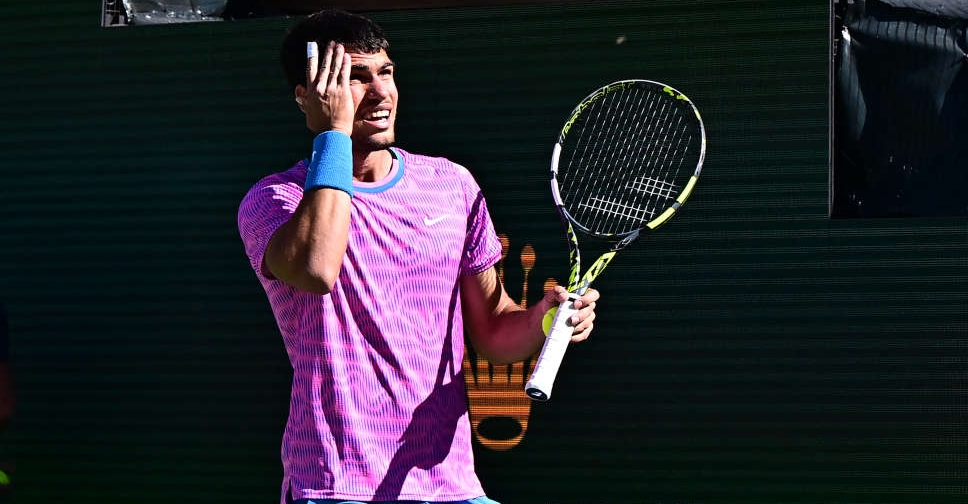
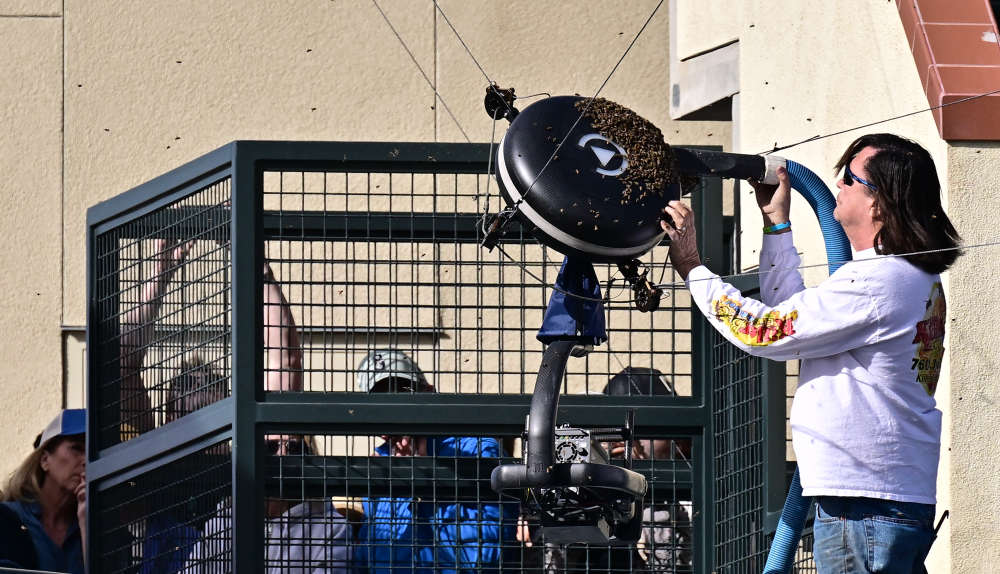
Carlos Alcaraz looked back at his best as he swatted aside a swarm of bees and world number six Alexander Zverev to reach the semi-finals at Indian Wells on Thursday, setting up a clash with the in-form Jannik Sinner.
The world number two took the interruption to clear the bees from the court in his stride before racing past Zverev 6-3 6-1 in little more than 90 minutes to keep his title defence on track.
Zverev did not play badly but Alcaraz’s all-court game was just too good, the 20-year-old Spaniard sealing the victory by breaking the German for the fourth time and taking his winning streak in the Californian desert to 10 matches.
“It was strange, I’ve never seen something like that at a tennis match,” twice major champion Alcaraz said of the invasion of bees, during which he was stung on the forehead before heading for cover.
“I’m not going to lie, I’m a little bit afraid of the bees. Once the match started again, I managed to stay away from the bees and do the things I needed to do.”
Italian Sinner earlier continued his perfect start to the season by cruising past Jiri Lehecka 6-3 6-3 to improve his win-loss record this year to 16-0.
A windy, cool day did little to slow down the hottest player on the men’s tour as Sinner was in control throughout, facing a single break chance the entire contest while his opponent piled up unforced errors.
“In the morning, it was really, really windy,” Sinner said in his court-side interview. “The first set was tough to handle.
“He has huge potential so I was really aware of every point that I made and in a way I am just happy because I make the semi-finals last year and this year I have again a chance to play in the semis in one of the greatest tournaments we have throughout the whole year.”
Lehecka reached his first Masters 1000 quarter-final with upset wins over fifth seed Andrey Rublev and 11th seed Stefanos Tsitsipas but had no answers for the lanky Australian Open champion.
The third seed quickly had his Czech opponent under pressure by collecting the first break in the third game with a massive forehand winner before closing out the set with a second break.
It was much the same business-like approach in the second as Sinner again claimed the early break to get 3-1 ahead and he held serve on the way to a 19th straight win including three from the end of last season.
Local hope Tommy Paul also reached the semi-finals with a 6-2 1-6 6-3 win over Casper Ruud and will take on Australian Open runner-up Daniil Medvedev, who powered past Holger Rune 7-5 6-4 to stay on course for his first title of the year.
Medvedev claimed a high-quality opening set and came from a break down in a tense second, during which he was struck on the body by a Rune backhand on the first point, before wearing down the young Dane for the victory.
Mexico City’s iconic Estadio Azteca was transformed into a global stage on Thursday Night as the FIFA World Cup 2026 officially got underway, marking the beginning of the biggest edition in the tournament’s history.
A vibrant opening ceremony showcased a blend of Mexican culture, music and modern spectacle, with performances from international stars including Shakira and Burna Boy. The ceremony was designed to reflect both the heritage of the host nation and the global nature of the tournament, which for the first time will be staged across three countries — Mexico, the United States and Canada.
Before the first whistle of the competition, the atmosphere inside the historic stadium reached a crescendo as thousands of fans filled the stands, waving flags and lighting up the arena in a sea of colour. The Estadio Azteca, already steeped in football history, has now become the first venue in the world to host matches across three separate FIFA World Cups, having previously staged the 1970 and 1986 finals.
In a further highlight of the ceremony, Italian tenor Andrea Bocelli performed the tournament’s official anthem, adding a classical flourish to an evening otherwise defined by high-energy performances and large-scale choreography.
FIFA officials described the opening event as a “symbolic bridge between continents”, underlining the expanded format of the 2026 tournament. For the first time, the World Cup will feature 48 teams — up from 32 — and a total of 104 matches, spread across 16 host cities across North America. The expansion is intended to increase global participation and bring the tournament to a wider range of supporters.
Immediately after the ceremony, hosts Mexico faced South Africa in the tournament’s opening match, kicking off what is expected to be a month-long football spectacle. The match began under heavy security and heightened global attention, with millions watching around the world.
The expanded format has also brought logistical challenges, with teams required to travel across vast distances between venues in multiple countries. Organisers have emphasised investments in transport infrastructure, stadium upgrades and sustainability measures aimed at reducing the environmental footprint of the tournament.
The 2026 edition also arrives at a time when football’s global profile continues to grow rapidly, with record broadcast deals, increased digital streaming access and heightened commercial interest from sponsors. Analysts expect the tournament to break previous viewership records, particularly given its tri-nation hosting model and expanded team lineup.
Estadio Azteca itself remains one of football’s most storied venues. It famously hosted Brazil’s Pelé lifting the trophy in 1970 and Diego Maradona’s “Hand of God” and “Goal of the Century” performances in 1986. Its role in opening the 2026 tournament has been widely seen as a nod to football’s rich history in Mexico, while also signalling a new era for the sport.
As fireworks lit up the Mexico City skyline following the ceremony, attention now turns to the next phase of the tournament’s opening schedule, with matches set to continue across North America in what promises to be the most geographically expansive World Cup ever staged.
For fans, players and organisers alike, the message from Mexico City was clear: the world’s biggest sporting event has begun, and it is set to be bigger, broader and more ambitious than ever before.
Emirati International Arbiter Abdullah Murad Al Mazmi has been appointed to the officiating panel for the 2026 FIDE World Rapid and Blitz Team Championships, one of the biggest events on the global chess calendar.
The championship will take place in Hong Kong from June 16 to 22 and is expected to feature many of the world’s leading grandmasters, including world number one Magnus Carlsen.
Al Mazmi’s selection highlights the growing international recognition of Emirati chess officials. He currently serves as Chairman of the Arab Chess Federation’s Arbiters Committee and Tournament Director of the prestigious Sharjah Masters International Chess Championship.
Speaking about the appointment, Al Mazmi said he was proud to represent the UAE at one of chess’s most prestigious global events. He described the selection as a reflection of FIDE’s confidence in Emirati arbiters and their ability to officiate at the highest international level.
He added that the role carries significant responsibility and offers a valuable opportunity to exchange expertise with some of the world’s top chess officials while showcasing the progress of UAE chess on the global stage.
The appointment marks another milestone for Emirati representation in international sports administration and reinforces the UAE’s growing presence in the world of chess.
Indian chess star Praggnanandhaa Rameshbabu produced a brilliant final-round victory to win Norway Chess 2026, capping a dramatic finish to one of the year’s most prestigious tournaments.
Entering the final day half a point behind leader Wesley So, Praggnanandhaa knew only a win would give him a realistic chance of claiming the title. The 19-year-old delivered under pressure, defeating Vincent Keymer with the white pieces to secure the full three points and surge to first place.
The victory lifted Praggnanandhaa to 18 points, enough to overtake Wesley So and clinch the Norway Chess crown in Oslo.
So, who had led the standings heading into the final round, drew his classical game against Alireza Firouzja before winning the Armageddon tiebreak. However, the extra points were not enough to keep him ahead of the charging Indian grandmaster.
Firouzja completed a strong campaign to finish third overall.
Elsewhere, world No. 1 Magnus Carlsen signed off in style with a classical victory over reigning world champion Gukesh Dommaraju, delighting home fans with a final-round win.
Final Standings
Praggnanandhaa Rameshbabu – 18 points
Wesley So – 17 points
Alireza Firouzja – 15.5 points
Assaubayeva dominates women’s event
In the Norway Chess Women’s tournament, Bibisara Assaubayeva completed a dominant campaign to secure the title after having already wrapped up first place with a round to spare.
The final day featured three decisive classical games, eliminating the need for Armageddon tiebreaks.
Women’s world champion Ju Wenjun handed Assaubayeva her first classical defeat of the tournament, while Zhu Jiner defeated Humpy Koneru to secure second place overall. Anna Muzychuk also ended her campaign on a high note with a victory over Divya Deshmukh to finish third.
Norway Chess women’s final standings
Bibisara Assaubayeva – 16.5 points
Zhu Jiner – 16 points
Anna Muzychuk – 15 points
Praggnanandhaa’s triumph marks another major milestone in the young Indian grandmaster’s rapidly rising career and further strengthens India’s growing influence at the highest level of world chess.