Connect with us

Business

Gulfood: India signs MoU with UAE’s Lulu Group to push millets’ exports

Published

on

Spread the love


India’s millet exports to the UAE can expect a boost in numbers after retail giant Lulu Hypermarket LLC and the Indian government agency Agricultural and Processed Food Products Export Development Authority (Apeda) signed a Memorandum of Understanding at the World Trade Centre in Dubai on Tuesday.

The agreement is one of the highlights of the Gulfood 2023, the world’s largest annual food exhibition. The UAE is third-biggest importer of Indian products. India is promoting its range of wheat, rice, maize and many millet-related products as it observes 2023 as the International Year of Millets.

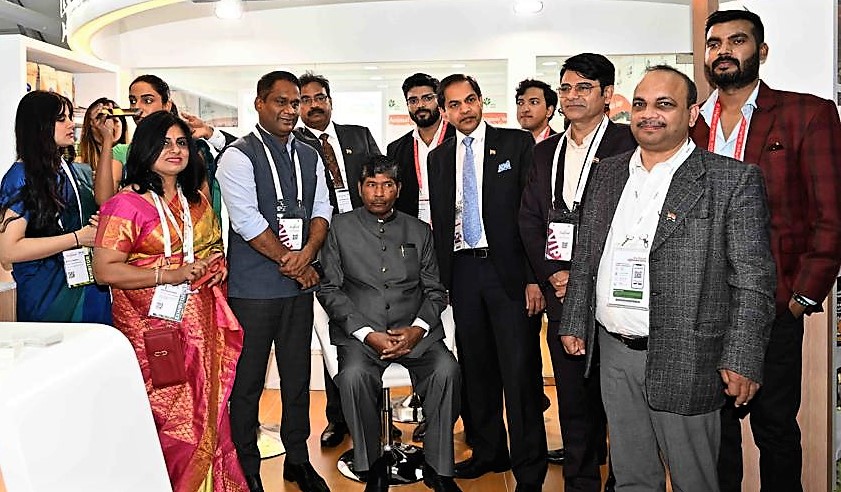
The MoU comes on the back of the CEPA agreement between the two countries, signed and improving by the day, to facilitate trade. Dr Tarun Bajaj, director at APEDA, and Saleem VI, chief operating officer of LuLu Group International (LLC) signed the MoU in the presence of the Ambassador of India Sunjay Sudhir, the APEDA chairman Dr M Angamuthu, Indian consul-general in Dubai Dr Aman Puri; and Lulu chairman MA Yusuff Ali.

India has exported millets worth US$46.05 million during April-November 2022. The new MoU will help Apeda reach the target of US$ 100 million for export of millets and its value-added products by 2025.

The LuLu Group International is a retail chain that operates 247 Lulu stores and 24 shopping malls across the GCC, Egypt, India and Far East. LuLu Group serves 1.2 million customers daily.

This year, the international trade show is focussing on export promotion of millets with trading partners from GCC, Asia, Africa and Europe participating in the event. A buyer-seller meet was also organised in the India Pavilion.

Apeda, which comes under the Ministry of Commerce of Government of India, is participating in 16 International Trade Fairs for export promotion of millets. The millets will be sourced from FPOs, FPCs, women and new entrepreneurs, start-ups, etc.

Apeda will also organise food sampling and tasting campaigns at the Lulu stores. Apeda will also assist Lulu in labelling the products according to the requirements of the importing countries.

Real estate

Dubai is testing tokenised property: What it means for first-time buyers

Published

on

Spread the love

Dubai is taking a new step in how people can invest in property, and it doesn’t require buying an entire apartment or villa.

The Dubai Land Department (DLD) has launched Phase II of its Real Estate Tokenisation Project, which allows property tokens to be resold in a controlled secondary market starting February 20. In simple terms, this means Dubai is testing how digital ownership shares in real estate can be bought and sold under official regulation.

What is “real estate tokenisation”?

Think of a property as a pizza. Instead of one person buying the whole pizza, tokenisation allows it to be cut into many digital slices. Each slice, called a token, represents a small ownership share in that property.

These tokens are recorded digitally and linked to official property records. Owners of tokens may benefit from price changes or rental income, depending on how the product is structured.

What’s new in Phase II?

Earlier this year, Dubai ran a pilot phase to test whether property tokenisation could work legally and technically.

Phase II is different because:

  • Tokens can now be resold in a secondary market
  • Real trading activity is being tested
  • Regulators are watching closely to ensure fairness and safety

About 7.8 million tokens will be available in this phase, but only through approved platforms and under strict rules.

Why is Dubai doing this?

The goal is to:

  • Make property investment more accessible
  • Attract new types of investors
  • Improve transparency and efficiency
  • Test innovation without risking the wider market

Dubai wants to modernise real estate — but in a careful, regulated way.

Is this crypto or risky trading?

Not in the usual sense.

While tokens are digital, this project:

  • Is overseen by the Dubai Land Department
  • Is regulated with support from the Virtual Assets Regulatory Authority (VARA)
  • Operates within existing property laws

This is not an open crypto marketplace. It’s a controlled government-backed test.

Can anyone invest right now?

Not everyone, and that’s intentional.

This phase is limited and focused on testing. Authorities are collecting data on:

  • Pricing
  • Demand
  • Liquidity
  • Investor behaviour

Future expansion will depend on how well this phase performs.

What should first-time investors keep in mind?

If you’re curious but new to property investing:

  • This is not a get-rich-quick scheme
  • It’s a long-term experiment
  • Rules may evolve as regulators learn from real use

Dubai has been clear: expansion will be based on data, not hype.

Why this matters long-term

If successful, tokenisation could:

  • Lower entry barriers to property investment
  • Allow people to invest smaller amounts
  • Increase market transparency
  • Strengthen Dubai’s position as a global real estate hub

For now, it’s best seen as a carefully supervised trial, not a finished product.

Continue Reading

Business

UAE unveils gold and silver coins to mark 5 years of Mohamed bin Zayed University of AI

Published

on

Spread the love

The Central Bank of the UAE (CBUAE) has unveiled a set of gold and silver commemorative coins to mark the fifth anniversary of the Mohamed bin Zayed University of Artificial Intelligence (MBZUAI).

The special issue celebrates five years since the university officially opened its doors in 2020, highlighting the UAE’s growing role as a global leader in artificial intelligence, innovation and advanced technology.

Limited-edition gold and silver coins issued

To mark the occasion, the CBUAE has issued:

  • 10 gold coins
  • 500 silver coins

Each commemorative coin weighs 50 grams and will be available for purchase through the Central Bank of the UAE and MBZUAI.

Coin design details

One side of the gold coin features an image of MBZUAI, along with the years 2020–2025. The reverse side displays the UAE national emblem, surrounded by the name “Central Bank of the UAE” in both Arabic and English.

The design also includes the inscription “Power from Knowledge to Serve”, encircled by the name “Mohamed bin Zayed University of Artificial Intelligence” in Arabic and English, alongside the university’s official logo.

The silver coin carries the same design, with its reverse side featuring a face value of Dh50.

Celebrating innovation and leadership

The commemorative release marks MBZUAI’s fifth anniversary and reflects the UAE’s commitment to advancing cutting-edge research, artificial intelligence and knowledge-based development.


Continue Reading

Announcements

Dubai Loop explained: What Elon Musk’s underground transport project means for city’s residents

Published

on

Spread the love

Getting around Dubai could soon become much faster and easier. The city has confirmed that work on the Dubai Loop, an underground high-speed transport system developed by Elon Musk’s Boring Company, is set to begin soon, starting in some of Dubai’s busiest areas.

The announcement was made by Matar Al Tayer, Director General and Chairman of the Board of Executive Directors of the Roads and Transport Authority (RTA), at the World Government Summit.

The project aims to cut travel times, reduce traffic congestion, and make daily commutes smoother, especially in high-density districts.

So, what exactly is the Dubai Loop?

The Dubai Loop is a network of underground tunnels where electric vehicles will transport passengers directly from one station to another, without stopping in between. Think of it as skipping traffic lights, junctions and road congestion altogether.

Once completed, the system will span 24 kilometres and could move up to 20,000 passengers every hour, with plans to expand capacity even further in the future.

Where will it start?

The first phase of the project will launch in key areas that many residents already commute through daily:

  • Dubai International Financial Centre (DIFC)
  • Dubai Mall area

These locations were chosen because they see some of the heaviest traffic in the city, especially during peak hours.

When is it happening?

According to Dubai’s Roads and Transport Authority (RTA), construction on the first phase will start immediately once contracts are finalised.

  • First phase: 6km (costing Dh600 million)
  • Total project: 24km (Dh2.5 billion)
  • Estimated completion: Around two years

How fast will it be?

Very fast. The vehicles inside the Dubai Loop could travel at speeds of up to 160km/h, meaning residents could move between major destinations in just minutes.

Why underground?

By going underground, Dubai avoids:

  • Road closures and surface disruption
  • Weather-related delays
  • Expensive road expansion projects

The tunnelling technology used is also cheaper and faster than traditional road construction, helping the city deliver infrastructure efficiently.

How will this help residents?

For people living and working in Dubai, the Dubai Loop could mean:

  • Shorter commutes in congested areas
  • Less time stuck in traffic
  • Better connections between business districts, malls and transport hubs
  • A smoother “first and last mile” journey to metro stations

The system is expected to serve around 13,000 passengers daily in its early stages, with numbers growing as the network expands.

Has this worked elsewhere?

Yes. A similar underground transport system already operates in Las Vegas, where it has carried more than 2 million passengers since 2021. Dubai’s version will build on that experience, adapted for local needs.

What’s next?

Dubai Loop is part of the emirate’s broader push towards smart, sustainable transport. If successful, the network could expand to more areas of the city, helping residents get from A to B faster, without adding more cars to the roads.

For Dubai residents, this could mark the beginning of a new era of stress-free commuting beneath the city streets.


Continue Reading

Popular

© Copyright 2025 HEADLINE. All rights reserved

https://headline.ae/