Connect with us

Business

Dubai’s Sheikh Mohammed launches UAE rail freight operations

Published

on

Spread the love

Abu Dhabi: Sheikh Mohammed bin Rashid Al Maktoum, Vice President, Prime Minister and Ruler of Dubai, launched the cargo train operations of the national rail network from its operations control centre in Al Fayah region, Abu Dhabi, on Friday.

Praising the efforts of those involved, Sheikh Mohammed said “connecting the Emirates via a national railway network strengthens our capabilities and competitiveness, and consolidates our unity,” he said.

Sheikh Theyab bin Mohamed Al Nahyan, member of the Abu Dhabi Executive Council and chairman of Etihad Rail, said: “Emirati talents, with the support of the UAE leadership, have turned the dream of our founding fathers into reality. We succeeded in launching a railway network with international specifications that extends to about 900 kilometres across the Emirates. We announce the inauguration operation of the freight trains throughout the UAE with a fleet of 38 locomotives and more than 1,000 wagons capable of transporting all types of goods.”

He pointed out that the completion of the network according to the schedule and the approved budget would not have been possible without the cohesion of the talented Emirati cadres.

The network contributes to supporting companies’ businesses and enhancing investment opportunities. The main line of the UAE National Rail Network extends from Ghuweifat on the border of the Kingdom of Saudi Arabia, to Fujairah, forming an essential part of the global supply network.

The stage one of the Network has been fully operational since January 2016, where the stage two of the project started in early 2020.
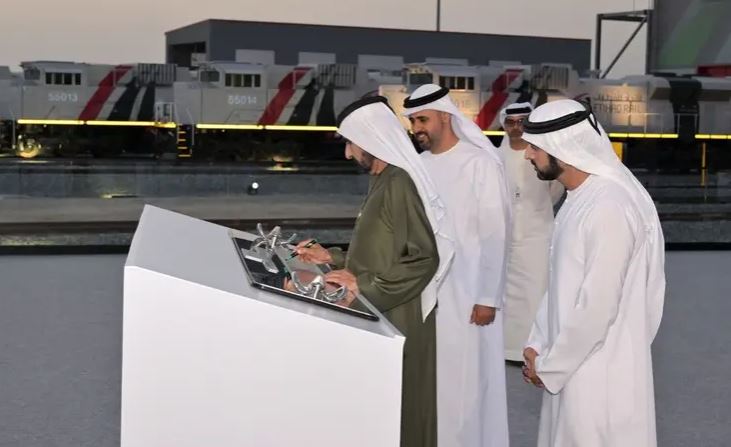
Sheikh Mohammed bin Rashid, Vice President and Ruler of Dubai, opens the UAE’s freight train network, the latest stage of Etihad Rail, the country’s mega national network project. WAM


The UAE national railway network will contribute to supporting the national economy at a value of AED200 billion, and saving AED8 billion in the cost of road maintenance. The network’s tourism benefits are estimated at AED23 billion.

The project has contributed to supporting the local industry by assigning 215 companies and local entities. also, 70 percent of the building materials used in the project are produced by the local industry.

The project also supports the UAE’s sustainable development goals and contributes to achieving the UAE Net Zero by 2050, through reducing carbon emissions in the road transport sector by 21 percent, and reducing road transportation emissions per capita by 40 percent, by 2050.

The project has enlisted 11 contractors, 25 consultants, and 28,000 specialists. It took 133 million working hours to complete, and 40,000 approvals from 180 government agencies.

More than 1,000 operational documents have been produced, including instructions, handbooks, guidelines, policies, operating procedures, agreements, and others.

The UAE national railway network passes through a variety of geographical terrains, within a large-scale engineering plan that includes the construction of 593 bridges and crossings of all types, and 9 tunnels with a length of 6.5 km. It took 120 million cubic metres of excavation work to complete, to ensure the highest levels of vehicular traffic flow under the tracks of the railway network.

The fleet of the most modern freight trains in the region includes 38 locomotives, with a capacity of 60 million tonnes of goods annually, and more than 1,000 multi-purpose vehicles.

Each goods transport’s locomotive operates with a power of 4,500 horsepower, equivalent to 3,400 kilowatts. It is one of the most powerful freight train engines in the Middle East.

The freight trains will run up to 120 km/h. The standard width of the rail is 1,435 metres, and it operates under the European ETCS level 2 signalling system. It has been specially designed to withstand the geographical nature, climatic conditions, high temperatures and humidity in the GCC region, to ensure high levels of performance, efficiency and sustainability.

The freight trains will connect four major ports. It will include seven logistics centres across the country, to serve trains and related businesses.

Business

UAE Central Bank assures public financial system is stable and fully operational

Published

on

Spread the love

Central Bank of the UAE has reassured residents and businesses that the country’s financial system remains strong, stable and fully operational despite rising geopolitical tensions across the region.

The regulator said banks, financial institutions and insurance companies across the UAE continue to operate normally, delivering services to customers without disruption.

Khaled Mohamed Balama said the sector remains resilient and well-positioned to navigate evolving regional developments.

“The UAE’s banking and financial sector continues to demonstrate the highest levels of resilience and stability,” he said.

Strong foundations of the financial sector

According to the central bank, the sector is built on strong governance frameworks, diversified institutions and proactive risk management systems designed to respond quickly to regional and global economic shifts.

Balama noted that the regulator has played a key role in strengthening the country’s financial stability and global reputation.

Strong capital and liquidity buffers

Financial indicators show that the UAE banking sector is entering the current period of regional uncertainty from a position of strength.

  • Capital adequacy ratio: around 17%
  • Liquidity Coverage Ratio: above 146.6%

Both indicators remain well above international regulatory requirements, reflecting strong financial buffers across the sector.

Total assets in the UAE banking system have also grown significantly, exceeding Dh5.42 trillion, highlighting the scale and stability of financial institutions operating in the country.

These strong capital and liquidity levels help banks absorb economic shocks and maintain lending activity even during periods of uncertainty.

The Central Bank also confirmed that banking infrastructure, digital platforms and payment networks continue to operate smoothly across the country.

“I reaffirm that the UAE’s banking systems, payment systems and national financial infrastructure continue to operate with full efficiency and stability,” Balama said.

Continuous monitoring and preparedness

Authorities said the financial sector remains under close monitoring, with ongoing coordination between the central bank, financial institutions and government entities.

Banks in the UAE operate under regulatory frameworks that require continuous risk monitoring, stress testing and business continuity planning aligned with international best practices.

The Central Bank said it maintains a wide range of monetary and prudential policy tools to support financial stability when needed.

Balama reaffirmed the regulator’s commitment to safeguarding the sector’s stability and supporting the UAE’s long-term economic growth.

“I reaffirm the Central Bank of the UAE’s unwavering commitment to closely monitor developments, maintain full operational readiness and provide the necessary support to safeguard the achievements realised over more than five decades of progress and prosperity,” he said.

Continue Reading

Business

Dubai to host ‘Billionaires for Peaceconclave as global movement calls for values-driven leadership

Published

on

Spread the love

As geopolitical tensions and conflicts intensify across the world, a growing global initiative is calling for renewed focus on peace, dialogue and shared human values.

The I Am Peacekeeper Movement is stepping up efforts ahead of the upcoming Billionaires for Peace Conclave, scheduled to take place in Dubai this May.

Founded by humanitarian leader Huzaifa Khorakiwala, the movement promotes seven core values — truth, gratitude, forgiveness, love, humility, giving and patience — as the foundation for inner harmony and lasting global peace.

“Peace is not merely the absence of conflict. It is a shared responsibility rooted in how we live, act and lead,” Khorakiwala said. “In a world facing unprecedented challenges, aligning our values with our actions is more important than ever.”

Global movement for peace

Launched in Dubai, the I Am Peacekeeper Movement aims to unite individuals, institutions and communities under a shared mission of harmony and mutual understanding.

The initiative has rapidly expanded into a global platform engaging millions of advocates worldwide through digital campaigns, grassroots networks and international events.

Organisers say the upcoming Billionaires for Peace Conclave will bring together influential leaders, entrepreneurs and changemakers to explore ways to advance peace-building, ethical leadership and global cooperation.

Building on a global peace summit

The initiative builds on the momentum generated by the Global Justice Love & Peace Summit held in April last year.

The summit brought together 10 Nobel Peace Laureates on a single stage and concluded with the release of a Peace Charter encouraging global solidarity, dialogue and values-driven leadership.

Organisers say the movement’s focus on “lived values” aligns closely with the UAE’s longstanding commitment to tolerance, coexistence and cross-cultural dialogue.

With Dubai hosting the upcoming conclave, supporters hope the city will once again serve as a global platform for conversations on peace and shared human responsibility.

About the movement

The I Am Peacekeeper Movement is a global initiative founded by Dr Huzaifa Khorakiwala to promote universal peace through core human values. Launched in Dubai, the movement engages communities worldwide through advocacy, education and international events such as the Global Justice Love & Peace Summit and the Billionaires for Peace Conclave.

More information is available at: www.i-am-peacekeeper.com

Continue Reading

Announcements

UAE announces early spring break for all educational institutions

Published

on

Spread the love

The Ministry of Education, along with the Ministry of Higher Education and Scientific Research, on Wednesday, March 4, announced that the commencement of spring break for all academic institutions has been pushed forward to March 9, with the last working day to be March 6. Normal classes are scheduled to resume from March 30. 

The academic calendar placed the spring break dates originally from March 16 and ending on March 29 which has now moved from March 9 to March 22. The change comes in light of the ongoing regional conflict, with the safety of students and staff at schools and universities as the highest priority. 

Classes had transitioned to online learning at the beginning of this week as a precautionary measure for all students and staff, which was further extended up to the end of this week. Exams for students have also been shifted to a remote format, allowing them to complete their assessments safely from home. 

Students, parents, and staff are advised to stay updated via official channels only, as the measures aim to protect the safety of all in the education sector.

(By Shura Kola)

Continue Reading

Popular

© Copyright 2025 HEADLINE. All rights reserved

https://headline.ae/