Connect with us

Announcements

Hamdan bin Mohammed gives green light for construction of Dubai’s first aerial taxi vertiport

Published

on

Spread the love

Sheikh Hamdan bin Mohammed bin Rashid Al Maktoum, Crown Prince of Dubai, Deputy Prime Minister and Minister of Defence of the UAE, and Chairman of The Executive Council of Dubai, in the presence of Sheikh Ahmed bin Mohammed bin Rashid Al Maktoum, Second Deputy Ruler of Dubai, gave the green light for the construction of Dubai’s first aerial taxi vertiport near Dubai International Airport. 
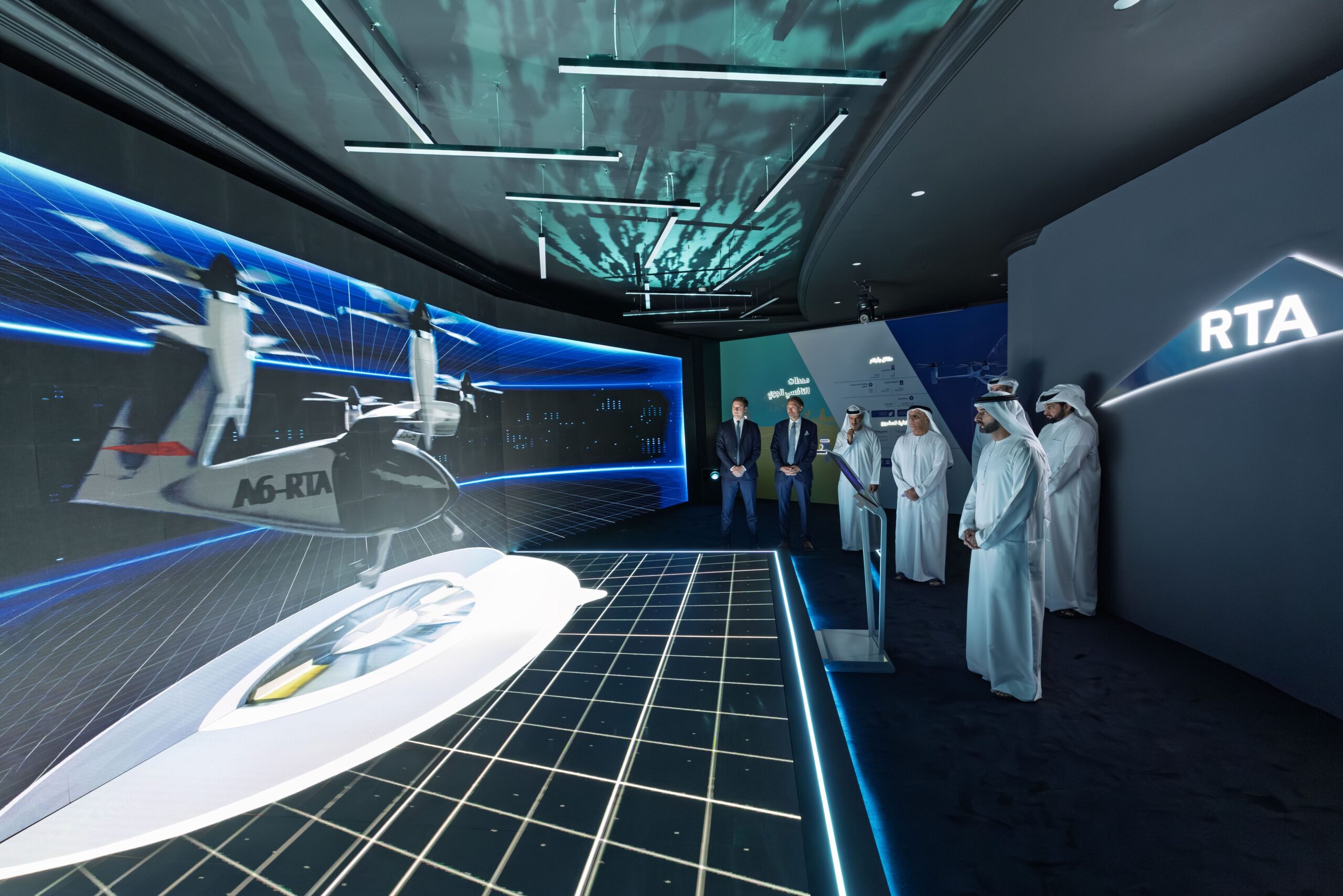
The initiative is set to make Dubai the world’s first city to offer urban aerial transport through an advanced aerial taxi take-off and landing network.

Featuring a modern design that complements Dubai’s urban landscape, the vertiport is set to offer passengers a unique, comfortable and seamless mobility experience.

Spanning 3,100 square metres, the vertiport features designated zones for take-off and landing, aircraft charging, a dedicated aerial taxi apron, and a parking area. With a capacity for approximately 42,000 landings annually, it is expected to serve around 170,000 riders per year.

Upon arrival at RTA headquarters, Sheikh Hamdan was welcomed by Mattar Al Tayer, Director-General, Chairman of the Board of Executive Directors of RTA, senior RTA officials, and JoeBen Bevert, Founder and CEO of Joby Aviation, the aerial taxi manufacturer, and Damien Kisly, Head of Infrastructure EMEA at SkyPorts, the company responsible for designing and constructing the vertiport’s infrastructure, Contemporary design.

Sheikh Hamdan bin Mohammed attended a presentation on the Aerial Taxi vertiport’s contemporary design, which reflects Dubai’s iconic urban aesthetic, offering users a seamless and comfortable travel experience. The vertiport includes air-conditioned facilities built to the highest global safety standards. In collaboration with leading international operators, Joby Aviation will manage aircraft manufacturing, operations, and passenger movement, while Skyports will oversee the design, construction, and operation of the vertiport’s infrastructure. RTA will be responsible for governance and integration with other transport modes. The aerial taxi service is expected to launch in Q1 2026.

The Joby S4 aerial taxi is capable of vertical take-off and landing, operating as a sustainable, eco-friendly electric vehicle with zero emissions. Known for safety, comfort, and speed, the aerial taxi incorporates advanced technology with six rotors and four battery packs, enabling a flight range of up to 161 km at a maximum speed of 321 km/h. With a capacity for four passengers plus a pilot, the aerial taxi generates significantly less noise compared to traditional helicopters.

Al Tayer elaborated on the project, stating: “In the initial phase, the aerial taxi service will operate from four strategic locations close to Dubai International Airport, Downtown Dubai, Dubai Marina, and Palm Jumeirah. This service provides Dubai residents and visitors with a new, rapid, and secure transport option to key city locations. For example, a journey from Dubai International Airport to Palm Jumeirah is anticipated to take approximately 12 minutes, compared to 45 minutes by car. The service also supports integration with public transport modes and individual transport solutions like e-scooters and bicycles, promoting multimodal transport and city-wide connectivity to deliver a smooth travel experience.”

Earlier this year, RTA signed an agreement to launch the aerial taxi service with the General Civil Aviation Authority (GCAA), the Dubai Civil Aviation Authority (DCAA), Skyports Infrastructure, a UK-based leader in advanced aerial mobility infrastructure development, and Joby Aviation, a US-based specialist in aerial vehicles.

As a trainee reporter and creative lead, I focus on curating engaging content and managing the social media presence for the company. I aim to connect audiences with relevant, impactful news through multiple digital platforms.

Announcements

Sheikh Mohammed appoints Abdulla bin Damithan to lead Dubai Ports body as DP World names new CEO

Published

on

Spread the love

In his capacity as Ruler of Dubai, His Highness Sheikh Mohammed bin Rashid Al Maktoum, Vice President and Prime Minister of the UAE, has issued a decree appointing Abdulla bin Damithan as Chairman of the Ports, Customs and Free Zone Corporation.

The appointment places one of the UAE’s most experienced trade and logistics leaders at the helm of one of Dubai’s most strategically important economic entities.

A Veteran in Ports and Global Trade

Abdulla bin Damithan brings more than two decades of experience in ports, logistics and international trade. He currently oversees DP World’s operations across the Gulf Cooperation Council (GCC) region, managing ports, economic zones, marine services and trade solutions.

He previously served as CEO and Managing Director of DP World UAE, where he led strategic growth across key regional markets. He oversees Jebel Ali Port and Jebel Ali Free Zone (Jafza).

Bin Damithan joined DP World in 2001 and has since held several senior leadership roles, contributing to the company’s transformation into a global provider of smart trade and logistics solutions.

New Leadership Appointments at DP World

Separately, DP World confirmed the appointment of Essa Kazim as Chairman of its Board of Directors, alongside the appointment of Yuvraj Narayan as Group CEO.

Kazim currently serves as Governor of the Dubai International Financial Centre (DIFC) and Chairman of Borse Dubai. He brings extensive expertise in financial and economic affairs, having held senior leadership positions across several national institutions.

Narayan, who joined DP World in 2004, has played a key role in leading strategic and transformational initiatives that strengthened the company’s global footprint.

Serving as Group Chief Financial Officer since 2005, Narayan has been instrumental in enhancing DP World’s financial resilience, operational efficiency and supply chain capabilities worldwide.

Continue Reading

Announcements

Dubai Loop explained: What Elon Musk’s underground transport project means for city’s residents

Published

on

Spread the love

Getting around Dubai could soon become much faster and easier. The city has confirmed that work on the Dubai Loop, an underground high-speed transport system developed by Elon Musk’s Boring Company, is set to begin soon, starting in some of Dubai’s busiest areas.

The announcement was made by Matar Al Tayer, Director General and Chairman of the Board of Executive Directors of the Roads and Transport Authority (RTA), at the World Government Summit.

The project aims to cut travel times, reduce traffic congestion, and make daily commutes smoother, especially in high-density districts.

So, what exactly is the Dubai Loop?

The Dubai Loop is a network of underground tunnels where electric vehicles will transport passengers directly from one station to another, without stopping in between. Think of it as skipping traffic lights, junctions and road congestion altogether.

Once completed, the system will span 24 kilometres and could move up to 20,000 passengers every hour, with plans to expand capacity even further in the future.

Where will it start?

The first phase of the project will launch in key areas that many residents already commute through daily:

  • Dubai International Financial Centre (DIFC)
  • Dubai Mall area

These locations were chosen because they see some of the heaviest traffic in the city, especially during peak hours.

When is it happening?

According to Dubai’s Roads and Transport Authority (RTA), construction on the first phase will start immediately once contracts are finalised.

  • First phase: 6km (costing Dh600 million)
  • Total project: 24km (Dh2.5 billion)
  • Estimated completion: Around two years

How fast will it be?

Very fast. The vehicles inside the Dubai Loop could travel at speeds of up to 160km/h, meaning residents could move between major destinations in just minutes.

Why underground?

By going underground, Dubai avoids:

  • Road closures and surface disruption
  • Weather-related delays
  • Expensive road expansion projects

The tunnelling technology used is also cheaper and faster than traditional road construction, helping the city deliver infrastructure efficiently.

How will this help residents?

For people living and working in Dubai, the Dubai Loop could mean:

  • Shorter commutes in congested areas
  • Less time stuck in traffic
  • Better connections between business districts, malls and transport hubs
  • A smoother “first and last mile” journey to metro stations

The system is expected to serve around 13,000 passengers daily in its early stages, with numbers growing as the network expands.

Has this worked elsewhere?

Yes. A similar underground transport system already operates in Las Vegas, where it has carried more than 2 million passengers since 2021. Dubai’s version will build on that experience, adapted for local needs.

What’s next?

Dubai Loop is part of the emirate’s broader push towards smart, sustainable transport. If successful, the network could expand to more areas of the city, helping residents get from A to B faster, without adding more cars to the roads.

For Dubai residents, this could mark the beginning of a new era of stress-free commuting beneath the city streets.


Continue Reading

Announcements

UAE NRIs can now own bigger stakes in Indian companies: Budget 2026 Doubles Investment Limits

Published

on

Spread the love

The Union Budget 2026-27 has opened up new opportunities for Non-Resident Indians (NRIs) looking to invest and participate in India’s growth story. From equity ownership to real estate and tax incentives, here’s what NRIs need to know:

Higher Equity Ownership Limits

  • Individual NRI investors can now hold up to 10% in listed Indian companies, double the previous limit of 5%.
  • The aggregate NRI ownership limit increases from 10% to 24%, allowing greater influence in high-growth sectors like technology, healthcare, and consumer goods.
  • This reform makes India’s capital markets more accessible and attractive for global Indian investors.

Simplified Real Estate Transactions

  • NRIs buying property from Indian residents no longer need a Tax Deduction and Collection Account Number (TAN) to deduct tax at source, reducing compliance burdens.

Tax Incentives for NRIs

  • Five-year tax exemption for overseas income earned by NRIs visiting India under government-notified schemes.
  • Exclusion of certain non-resident businesses under presumptive taxation from Minimum Alternate Tax (MAT).
  • Time-bound relief measures for small taxpayers with foreign assets or legacy non-disclosures, enabling voluntary compliance.

Why It Matters

  • Increased ownership gives NRIs more influence and strategic control in Indian companies.
  • Simplified regulations reduce compliance headaches for both investments and real estate transactions.
  • Encourages deeper NRI participation in India’s fast-growing economy.

NRI Action Points:

  • Review your portfolio exposure and consider increasing stakes in Indian equities.
  • Work with financial advisors familiar with NRI rules to ensure compliance.
  • Diversify across sectors while monitoring currency and tax implications.

India is signalling confidence in the global Indian diaspora by making it easier to invest and participate in the country’s economic growth. NRIs now have a clear pathway to take a larger stake in Indian companies, own property with ease, and enjoy tax benefits, making this a pivotal moment for global Indian investors.

Continue Reading

Popular

© Copyright 2025 HEADLINE. All rights reserved

https://headline.ae/