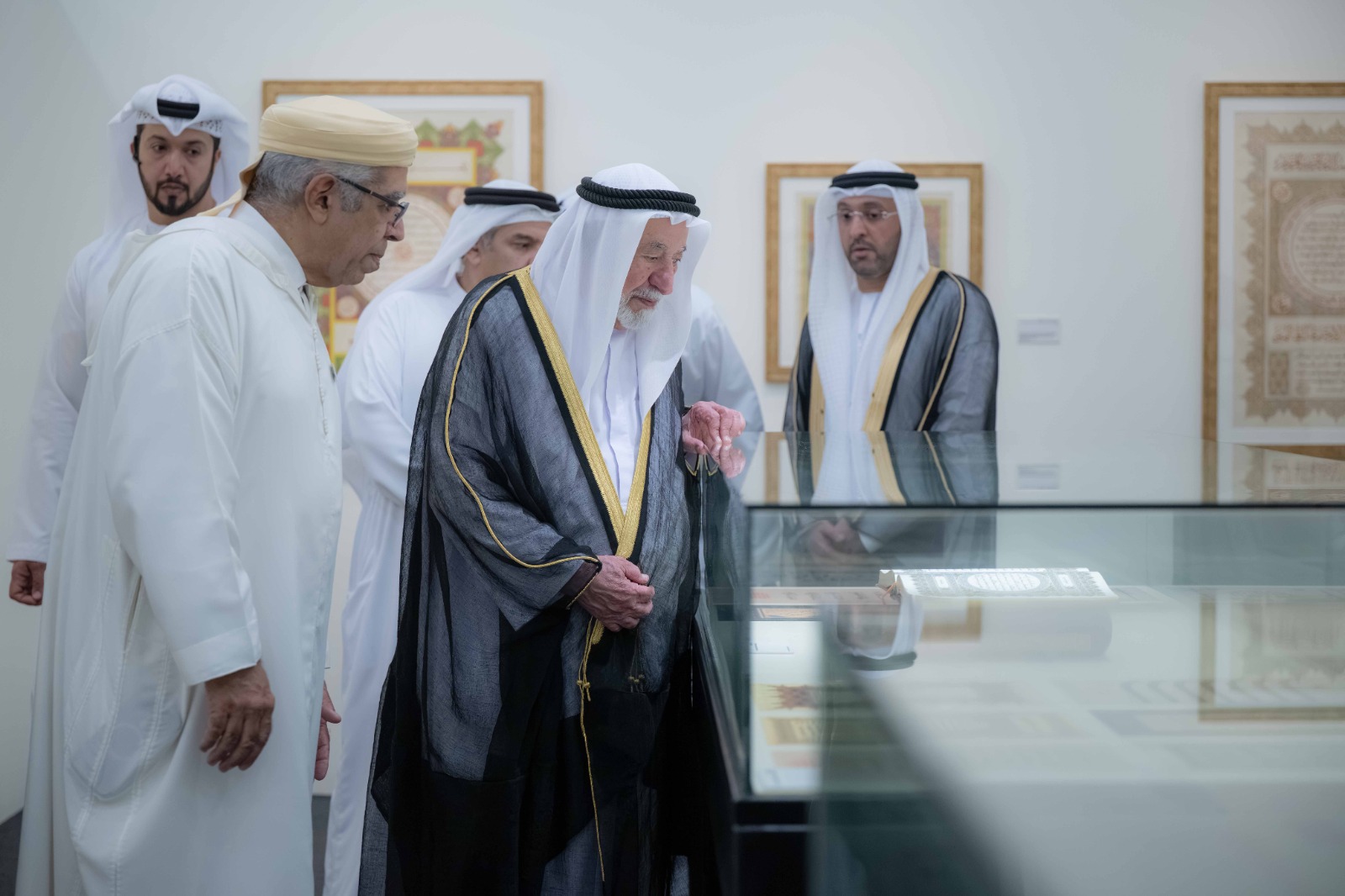
His Highness Sheikh Dr. Sultan bin Mohammed Al Qasimi, Member of the Supreme Council and Ruler of Sharjah, attended the opening of the 12th Sharjah Calligraphy Biennial on Wednesday evening. Organised by the Department of Culture, the Biennial runs until 15 November and is being held at Calligraphy Square in the Heart of Sharjah.
His Highness the Ruler of Sharjah honoured the winners of the Sharjah Calligraphy Biennial Awards. The Grand Prize was awarded to artist Farhad Yasin from Iraq for his work “Surah Ar-Rahman complete in five pages.” The Authentic Trend Award was presented to Abdul Baki Bin Abu Bakar from Malaysia for his work “The Reformer’s Covenant,” Ahmed Jalaluddin from Indonesia for his work “The Farewell Sermon (Khutbatul Wada),” and Mahfouz Ameen Al Dhnoon from Iraq for his work “Calligraphy artwork featuring Ayat al-Kursi (The Verse of the Throne) and Qasidat al-Burda.”
His Highness also honoured the winners of the Modern and Contemporary Calligraphic Arts Award: artist Shaimaa Hitou from Germany for her work “So race to do good deeds,” artist Naamiya Nizar from India for her work “Pleasing to the Observers,” and artist Hussein Al Mohasen from Saudi Arabia for his work “Blue Letter Space with Saduo.” The Special Jury Award was presented to Emirati calligrapher and artist Mahmood Al Abadi for his work “The Best of You Are Those Who Are Best to Their Families.”
His Highness also honoured three prominent figures who have contributed to enriching the field of Arabic calligraphy, in recognition of their artistic careers and contributions to developing the aesthetics of Arabic lettering. They were Emirati calligrapher Ali Al Hammadi, Moroccan academic and Arabic calligraphy specialist Belaid Hamidi, and Egyptian calligrapher and visual artist Khalifa Al Shimi. This recognition reflects continued support for Arabic calligraphy artists and the preservation of the art form’s aesthetic and cultural heritage.
During the opening ceremony, Mohammed Ibrahim Al Qaseer, Director of the Sharjah Calligraphy Biennial, delivered a speech in which he emphasised that the Biennial was established 20 years ago under the directives of His Highness the Ruler of Sharjah, reflecting His Highness’s belief in the importance of Arabic calligraphy as a vital part of Arab culture.
He noted that the Biennial, now in its 12th edition, has become an important reference in the field of Arabic calligraphy, supporting creative artists and encouraging the exploration of new horizons for this art form within the contemporary art scene.
Al Qaseer explained that, for more than two decades, the Biennial has continued its mission to restore the status of Arabic calligraphy, strengthen its presence, support its development and encourage its interaction with various art forms. Through the creative spaces it provides, the Biennial highlights the beauty of Arabic lettering and its artistic potential. He also outlined the highlights of the current edition, which features 90 events, including exhibitions, art workshops, lectures and seminars, alongside 681 artistic and calligraphic works by 272 artists and calligraphers from around the world.
The Director of the Sharjah Calligraphy Biennial noted that the current edition honours three prominent artists whose creative experiences have contributed to enriching Arabic calligraphy and strengthening its cultural and artistic presence. He emphasised that the Biennial reinforces Sharjah’s position as an international destination for culture, art and beauty, and as a hub for creative talents and artists from around the world.
His Highness the Ruler of Sharjah toured the participating exhibitions, which celebrate the artistic experiences of 145 artists from around the world. The exhibitions bring together diverse artistic visions and styles, highlighting the beauty of Arabic calligraphy and its wide range of expressive possibilities. His Highness listened to explanations about the participating works, which reflect various artistic approaches and draw inspiration from Arabic lettering as a visual and cultural element capable of transforming writing into visual art and words into images.
His Highness explored the diversity of the artworks and the different approaches to Arabic calligraphy, ranging from preserving its artistic heritage to exploring contemporary forms that present it through a new artistic language. During his tour, His Highness viewed an exhibition that offers visitors an opportunity to appreciate the richness of the participating artistic experiences and discover how Arabic calligraphy continues to maintain its presence in the global visual arts scene.
His Highness also visited the exhibition “My Family, My Paradise,” organised by the Emirates Society for Arabic Calligraphy and Islamic Ornamentation. The exhibition celebrates the importance of family and its central role in building a cohesive society, strengthening national identity and preserving traditional values. Inspired by Islamic principles of love, affection, mercy and family unity, the exhibition features works by 11 male and female artists from the UAE. His Highness viewed the exhibition’s highlights, which include artworks inspired by Quranic verses, Prophetic Hadiths, poetry and words of wisdom. Through the beauty of Arabic calligraphy and Islamic ornamentation, the artists express these values, reflecting the warmth of family life, its deep-rooted traditions and its role in preserving and passing down values from one generation to the next.