Connect with us

Technology

Putin Highlights Russia’s Role as a Hub for Advanced Technologies, with Sber and National AI Alliance Leading the Way at AI Journey Conference

Published

on

Spread the love

Dr. Aisha Bin Bishr, former Director General of the Smart Dubai Office (UAE), gave examples AI traffic lights now save every driver in Dubai 20 minutes a day, and traffic jams have been reduced by 15%. In general, the UAE is paying a lot of attention to the development of artificial intelligence: in 2017, the country became the first in the world to introduce the position of Minister of AI.

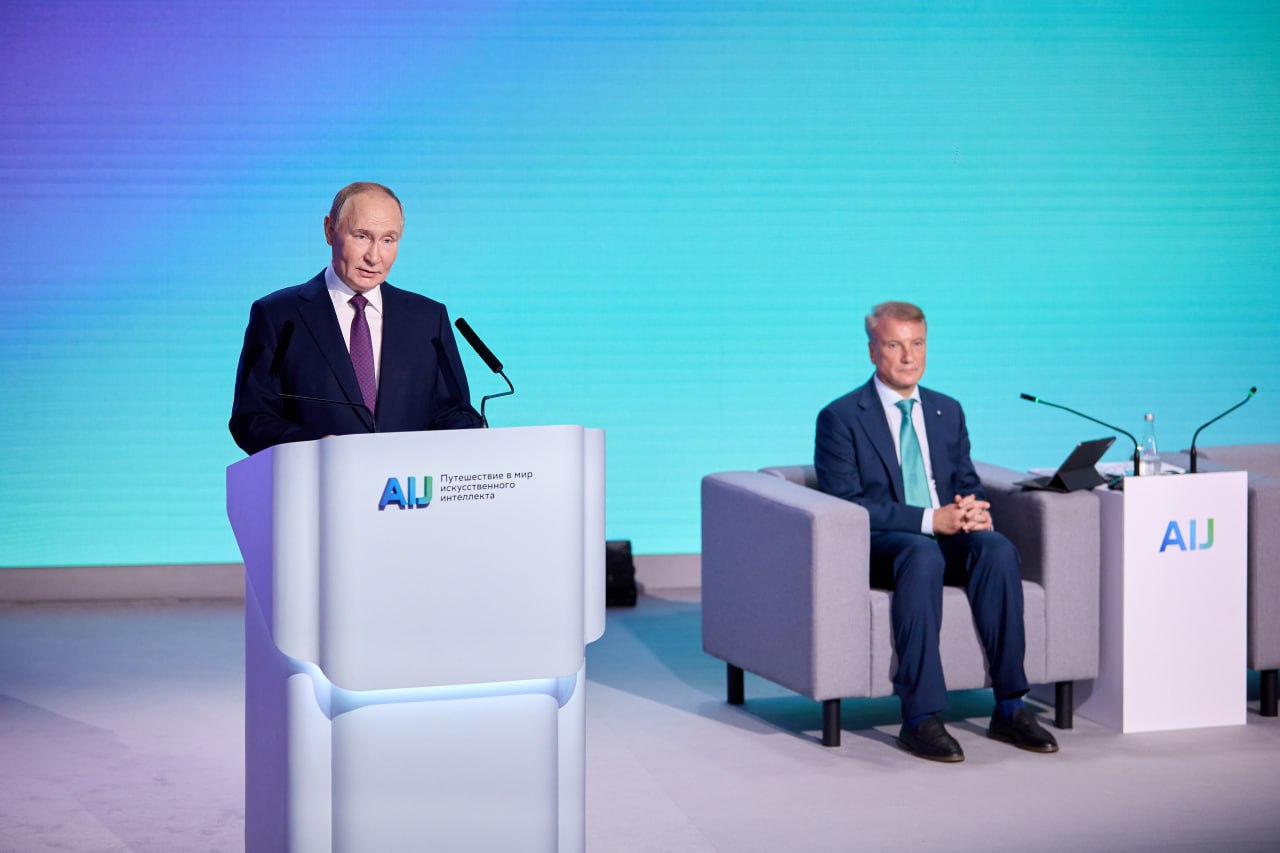
AI Journey, an international conference on artificial intelligence and machine learning, has hosted the main panel discussion, AI for Humans: Helping People. Uniting Countries, featuring Russian President Vladimir Putin and moderated by Sberbank CEO and Chairman of the Executive Board Herman Gref.

Vladimir Putin noted that Russia has become an important platform for discussing advanced technologies, and Sber and the National AI Alliance play a crucial role in this. In the past year alone, artificial intelligence has changed the face of entire industries, including the creative industry.

Dr. Aisha Bin Bishr, an expert on global digital transformation and smart cities and former Director General of the Smart Dubai Office (UAE), gave examples of practical smart city solutions. AI traffic lights now save every driver in Dubai 20 minutes a day, and traffic jams have been reduced by 15%. In general, the UAE is paying a lot of attention to the development of artificial intelligence: in 2017, the country became the first in the world to introduce the position of Minister of AI. 

This year Sber’s large language model GigaChat will, for the first time ever, process the questions of Russian citizens for the direct line with Vladimir Putin, which will be held on December 19, giving a full objective picture of what questions Russians are concerned about. These technologies will help create unique tools for feedback from citizens.

As Herman Gref noted, the analysis of the questions submitted for the call-in session showed that citizens are mostly concerned about urban development, public administration, education, social services, and healthcare. Artificial intelligence is able to provide effective solutions, which were shared by Russian and foreign experts who participated in the panel discussion.

Dr. Song Haitao, President of the Shanghai Artificial Intelligence Research Institute (SAIRI) and Director of the United Nations Industrial Development Organization’s (UNIDO) International Centre of Excellence for Development of AI in Industry and Manufacturing, described how AI is improving the Chinese government’s operations by automating data management, providing decision support, and optimizing resource allocation and budgets. AI is being used across a wide range of sectors in the Chinese economy and is attracting investors. In Shanghai alone, AI startups have attracted more than four billion yuan in investment.

Artificial intelligence also speeds up social welfare payments and benefits and improves the quality of such services, said Herman Gref. This is already being done in Lipetsk Region, and Olga Beloglazova, deputy governor of the region, spoke about it during the conference. More than 100 relief measures are available in Lipetsk Region. The adoption of an intelligent management system in this region has enabled process automation and reduced the time of service provision by half, while reducing the number of errors by a factor of ten. Accordingly, labor productivity has quadrupled. Soon, the region is set to reduce the time to distribute welfare by another half.

According to Herman Gref, artificial intelligence can accelerate scientific discoveries in medicine to an extent that progress in the next decade may be similar to progress made over the last 100 years. It is AI that can make medical services better and more accessible, and find new ways of providing medical care.

To unite efforts in driving AI worldwide, AI Journey 2024 has announced the establishment of the International AI Alliance Network with 18 participating associations from Azerbaijan, Belarus, Brazil, India, Indonesia, Iran, China, Cuba, Morocco, Russia, Serbia, Tunisia, Chile, Ethiopia, and South Africa. This move should take stakeholders to the next level of cooperation, Herman Gref emphasized, to make AI efforts open and transparent so that artificial intelligence would be proper and balanced to meet the needs and state of society.

As a trainee reporter and creative lead, I focus on curating engaging content and managing the social media presence for the company. I aim to connect audiences with relevant, impactful news through multiple digital platforms.

News

Dubai’s new DEWA headquarters is world’s tallest energy-positive government building

Published

on

Spread the love

Dubai has just unveiled another futuristic landmard, and this one could redefine sustainable government buildings worldwide.

His Highness Sheikh Mohammed bin Rashid Al Maktoum, Vice President and Prime Minister of the UAE and Ruler of Dubai, officially inaugurated Al Sheraa, the new headquarters of Dubai Electricity and Water Authority (DEWA) in Al Jaddaf.

Mind-blowing  numbers

Dubbed the tallest, largest, and smartest energy-positive government building in the world, Al Sheraa is designed to produce more energy than it consumes, making it a major milestone in Dubai’s sustainability journey.

The building features:
• 110,000 smart sensors
• 1,500+ wireless access points
• 3,200 connected smart devices
• Over 1.9 million automated control commands daily
• Solar energy systems generating up to 5 MW of electricity 

The building combines cutting-edge AI, automation, and renewable energy technologies to create a next-generation workspace focused on efficiency and sustainability.

Calling it a “global architectural icon,” Sheikh Mohammed said the project reflects Dubai’s leadership in innovation, smart technology, and green energy.

From AI-powered systems to solar-powered operations, Dubai is once again showing the world what the cities of the future could look like 

Continue Reading

News

Learning to drive in Dubai? The RTA just changed the training curriculum

Published

on

Spread the love

Dubai is getting a major tech upgrade for trainee drivers. The Roads and Transport Authority (RTA) has updated its light vehicle driver training curriculum to include modern smart driving technologies and Advanced Driver Assistance Systems (ADAS).

The move reflects the growing number of vehicles equipped with intelligent safety features on Dubai’s roads and aims to better prepare new drivers for modern driving conditions.

What’s included in the new training?

The updated curriculum now covers training on:

  • Forward collision warning
  • Blind spot monitoring
  • Lane departure alerts
  • Parking assist systems
  • Adaptive cruise control
  • ABS braking systems
  • Other advanced driver safety technologies

According to Sultan Al Akraf, Director of Drivers Licensing at the RTA, the revised programme is designed to improve driver behaviour, enhance road safety and help reduce traffic accidents.

Integrated into driving schools and tests

The new content has been added to:

  • Theoretical lessons
  • Practical driving sessions
  • Official driver handbooks

The programme was developed in collaboration with Dubai’s driving institutes to align training with internationally recognised road safety standards.

RTA says more than 250,000 trainees have already benefited from the updated curriculum in recent years, while workshops continue to be held for driving schools to ensure instructors stay updated on evolving vehicle technologies.

As cars become increasingly automated and technology-driven, understanding ADAS systems is becoming a key part of safe driving.

Continue Reading

News

New Dubai Smart Bus Station connects metro, taxis and buses in real time

Published

on

Spread the love

Roads and Transport Authority (RTA) has officially opened Dubai’s first Smart Bus Station at Mall of the Emirates, introducing a new tech-driven public transport experience for commuters across the city.

The station offers round-the-clock customer services through interactive smart platforms that reduce waiting times and improve the overall passenger experience.

Smart bus routes

The new station serves 11 bus routes, including Dubai Metro feeder buses, internal city routes and seasonal services. It also directly connects to the Dubai Metro via the Mall of the Emirates Metro Station.

The smart hub links commuters to major residential and commercial areas, including Al Barsha, Jumeirah Village Circle, Arabian Ranches, Dubai Studio City and Dubai Science Park, as well as tourist hotspots such as Dubai Miracle Garden and Global Village.

Covering around 147 square metres, the station can accommodate up to 20 passengers at a time and also includes a dedicated driver rest area.

Real-time Metro, taxi updates

Among its standout features are real-time digital displays showing bus and metro arrival times, taxi availability and local area navigation. The station also includes a smart kiosk with a virtual assistant for journey planning, Lost and Found support and direct access to customer service.

Passengers can additionally view live occupancy levels on arriving buses, helping them make more efficient travel decisions and reducing congestion during busy periods.

Continue Reading

Popular

© Copyright 2025 HEADLINE. All rights reserved

https://headline.ae/