Connect with us

Business

Q-com startup promises to address SME gap with Amazon, Noon and others

Published

on

Q-commerce-startup
Spread the love

Kumar Shyam

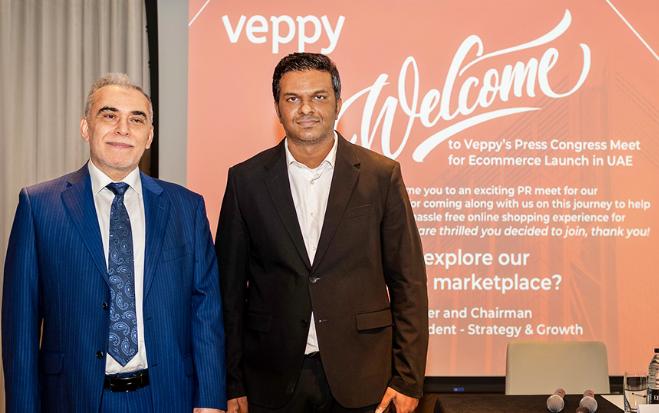
A new e-commerce marketplace startup is promising to fill “the gap” it sees with giants such as Amazon, Noon and others as it prepares for a launch on August 27.

Veppy.com will be a Q-commerce (Q for quick), the faster version of an e-commerce operation, and promises delivery for certain categories of products in less than three hours.

According to the top brass, founder-chairman Moustafa Banbouk and vice president Praveen Kumar, a large part of SMEs are “not yet on the digital platforms” for sales. And small and medium enterprises constitute more than 80 percent of UAE’s economy.

With Veppy, which takes its name from the company motto “very happy”, sellers can look forward to connecting with buyers over 14 categories to start with. Most of the focus will be on products, which are gift ideas mostly.

“Imagine we have an occasion we forgot and need to buy a gift – flowers, cakes, any tech product – urgently and we are at work … with Veppy we can address that,” Mr Banbouk told Headline at a hotel in Dubai.

His deputy Mr Kumar, who has built a career out of focusing on digital transformation for his clients, explained that the company will not be investing in warehouses and will directly connect the buyer with the seller to ensure the quickness of product delivery.

“There will be no fees for registering for the seller, and we will offer a consultative process during the onboarding of the seller. However, there will be a fee with each transaction involved for the seller,” Mr Kumar said.

___________________

ALSO READ: It is Prime time for Amazon faithful among UAE shoppers!
___________________

Mr Banbouk, a property developer in a family business in Lebanon, is excited about succeeding with his q-commerce model in UAE, the land of opportunities and where digital growth is the best in the region.

Q-Commerce – sometimes used interchangeably with ‘on-demand delivery’ and ‘e-grocery’ – is e-commerce in a new, faster form. It combines the merits of traditional e-commerce with innovations in last-mile delivery.

It is one of the fastest-growing businesses in the world. Driven by the changing consumer behavior dominated by last-minute shopping trends, the Q-Commerce market in the Middle East and North Africa (MENA) region is expected to grow from US$9 billion in 2020 to US$20 billion by 2024, according to Statista.com, a global market intelligence provider. Globally, the Q-Commerce market for food and grocery delivery is expected to grow to $72 billion by 2025, according to a report by Forbes magazine.

An analysis by the Dubai Chamber of Commerce and Industry revealed during the Gulfood Breakfast Briefing event at Gulfood 2021 that as per Euromonitor’s data, online sales within the UAE’s food and beverage market surged 255% year-over-year in 2020 to reach $412 million.

The analysis predicted the value of online food and beverage sales in the country to reach $619 million by 2025 and record a compound annual growth (CAGR) of 8.5% over the 2020-2025 period.

The latest estimates from Visa Middle East have forecasted the total MENA E-Commerce market size, including all categories, to be worth US$48.6 billion in 2022.


News

Big news for Khorfakkan: New mountain neighbourhood announced to ease housing shortage

Published

on

Spread the love

If you live in Khorfakkan and have been wondering what’s happening with housing in the area, here’s some reassuring news.

His Highness Sheikh Dr Sultan bin Mohammed Al Qasimi, Supreme Council Member and Ruler of Sharjah, has announced that a new residential neighbourhood will be built in Jabal Al Ashkel, directly responding to concerns about the shortage of homes in the city.

The new development, called Al Ashkel Neighbourhood, will be located along the mountainous area of Khorfakkan. It’s set to take place near the Khorfakkan Club for the Disabled, and to ensure the area is ready for construction, the road leading to Al Rafisah will be paved.

The announcement was made during a phone call on the programme Direct Line, where the Sharjah Ruler addressed concerns by Emiratis about the availability of residential plots in Khorfakkan. And it wasn’t just talk about plans, there’s already a lot happening on the ground.

Right now, 270 homes are under construction, including 120 homes in Al Mudeife. More residential plots in the Al Harray area are also being handed over to the municipality, with construction expected to take around two years.

And it’s not just Khorfakkan that’s seeing progress. The Sharjah Ruler also shared updates on housing projects in Kalba, with new neighbourhoods being developed along the ring road in areas like Al Ghayl, Al Saaf, and Al Tareef. Construction has already started in Al Dahiyat neighbourhood, with more developments on the way.

All in all, it’s a clear sign that efforts are being made to ease housing pressure across Sharjah’s East Coast, and the message is clear: Sharjah is moving fast to address housing needs with long-term, citizen-focused developments that balance community living and natural surroundings.

Continue Reading

Business

UAE launches new digital platform to manage federal government real estate

Published

on

Spread the love

The UAE Ministry of Finance has launched a new digital system to centralise and manage data on all federally owned real estate, marking another step in the country’s push to modernise public asset management and strengthen governance.

The platform, known as the Federal Government Real Estate Assets Platform, will act as a unified electronic registry for federal government properties. It is designed to document, update and classify real estate data, while linking assets directly to financial and operational systems across the federal government.

The ministry said the launch fulfils the requirements of Article 18 of Federal Decree-Law No. 35 of 2023 on Union-Owned Properties, which mandates the creation of a federal electronic registry for government real estate.

Supporting digital transformation

Younis Haji AlKhoori, Undersecretary at the Ministry of Finance, said the platform is designed to strengthen regulation, governance and oversight of federal real estate assets, while supporting the UAE government’s wider digital transformation agenda.

By automating real estate-related processes, the system aims to improve data accuracy and provide better insights for policymaking, planning and long-term asset management.

Federal entities can use the platform to register and update property data under standardised classifications, manage leasable spaces, and submit real estate-related requests through automated workflows. These include inspections, transfers, sales, demolitions and structural changes to properties.

The platform also integrates with other federal systems to ensure records remain up to date, while generating reports and performance indicators to support evidence-based decision-making.

Linking real estate and financial data

Mariam Mohamed Al Amiri said the platform was developed to unify real estate data across federal bodies and connect it directly to financial and operational procedures, helping improve planning, expenditure control and transparency.

The system records both financial and non-financial data, including property values, depreciation, operating costs, location, condition and technical specifications. It also stores digital documents such as architectural drawings, site maps and contracts.

A new four-tier classification structure, covering sites, buildings, floors and individual units, standardises how government real estate is recorded and enables faster access to information.

From paper to digital

According to the ministry, the platform replaces paper-based procedures with a fully digital framework that supports real-time tracking, automated approvals and structured lease management, including contract creation, amendments and terminations.

Officials said the move will improve the efficiency of federal real estate use, enhance governance and support long-term planning of government-owned properties as part of the UAE’s broader digital government strategy.

Continue Reading

Business

Middle East set to attract over $100bn a year in energy, healthcare and digital investment by 2026

Published

on

Spread the love

The Middle East is on track to attract more than $100 billion (Dh370 billion) a year in major investments by 2026, spanning energy, renewables, healthcare, digital infrastructure and manufacturing, according to a new industry outlook by Grand View Research (GVR).

Despite the global shift towards cleaner energy, the region, led by the UAE and Saudi Arabia, is expected to remain a global powerhouse in oil and gas, while rapidly scaling renewable energy, digital transformation and healthcare innovation.

Oil and gas remain central, with a tech-driven twist

The UAE and its Gulf neighbours currently account for around 30 per cent of global oil production and 17–18 per cent of gas output, cementing the region’s role as a key energy supplier.

While global oil demand growth is expected to remain modest through 2026, gas demand is forecast to rise by around 3.5 per cent, driven by power generation, industrial expansion and LNG exports.

“The Middle East’s oil and gas sector remains a market anchor, but technology adoption and LNG expansion will define competitiveness over the next few years,” said Swayam Dash, Managing Director at Grand View Research.

Across the UAE, producers are increasingly deploying AI, IoT, drones and robotics to cut costs and improve operational efficiency, alongside investments in carbon capture, storage and early-stage hydrogen projects under the UAE Energy Strategy 2050.

Renewables and battery storage gain pace

Renewable energy is expanding rapidly across the Gulf, with falling solar auction prices making clean energy increasingly competitive. Both the UAE and Saudi Arabia are mandating battery storage alongside new solar and wind projects, helping stabilise power grids as renewable capacity grows.

Dubai has announced plans for multi-gigawatt renewable additions by 2030, while Saudi Arabia continues to roll out large-scale solar and hydrogen projects under Vision 2030.

Healthcare becomes an economic growth engine

Healthcare is also emerging as a strategic investment sector. In 2023, Dubai welcomed more than 690,000 medical tourists, generating over Dh1 billion in healthcare revenue and boosting related sectors such as hospitality and travel.

The UAE’s National Digital Health Strategy, which integrates platforms like Riayati, Malaffi and Nabidh, has consolidated more than 1.9 billion medical records across 3,000 facilities, positioning the country as a regional leader in digital healthcare.

Data centres, cloud and advanced manufacturing

Digital infrastructure is another major growth driver. The GCC data centre market is expected to grow at around 13 per cent annually through 2030, with the UAE and Saudi Arabia accounting for up to 70 per cent of new capacity.

Cloud adoption is accelerating too, with nearly 75 per cent of organisations expected to rely mainly on cloud platforms by 2026, boosting demand for cybersecurity, AI and enterprise digital tools.

By 2026, GVR expects the region’s economy to reflect balanced diversification, combining energy leadership with rapid growth in renewables, healthcare, digital systems and advanced manufacturing.

“The scale of investment shows how the Middle East is shifting from resource reliance to technology-enabled growth,” Dash said.


Continue Reading

Popular

© Copyright 2025 HEADLINE. All rights reserved

https://headline.ae/