Connect with us

Business

Young Dubai businessman behind unique SDaaS for SMEs

Published

on

Spread the love

A Dubai-bred young serial entrepreneur is disrupting the local Software as a Service market with a unique AI-driven platform for the Middle East and North Africa (MENA) region, launched at the start of the year.

Called Zoftware, it is “Software Democratisation as a Service, where software products of the people (companies) are recommended by our people (the team), for the people (B2B clients) for any problems they face in their businesses,” says Aayushman Dalmia, 29.

Within the first quarter of operations, Zoftware already has arrangements with a growing list of over 6,000 companies – including the Microsoft and Zoho suites, Google, Adobe and others.

“You can find a packed suite of software just with a generic search, but do you require everything in that or can you customize it? Maybe not. Zoftware is free for the customers while we work with them to understand their needs and even do the work for them in customising solutions from the software companies. Consider us as the Zomato or Tripadvisor for the software industry.

“Avoiding wastage of resources by reducing the gap between the capability knowledge of any software’s offerings and solving the problems of the end users is core to Zoftware’s mission,” says Dalmia, who came up with the idea when he could not find such a solution while searching for his needs himself.

“Zoftware is about marrying software with the best of customer experience. We make it easy for customers to navigate the ocean of software to find the right tools for their business and purpose. We offer deep insights on software and match organisations to the right product, be it for accounting, customer relationship management (CRM), project management, IT, payroll and many more,” says Dalmia, confident his idea will revolutionise the convenience of running a business.
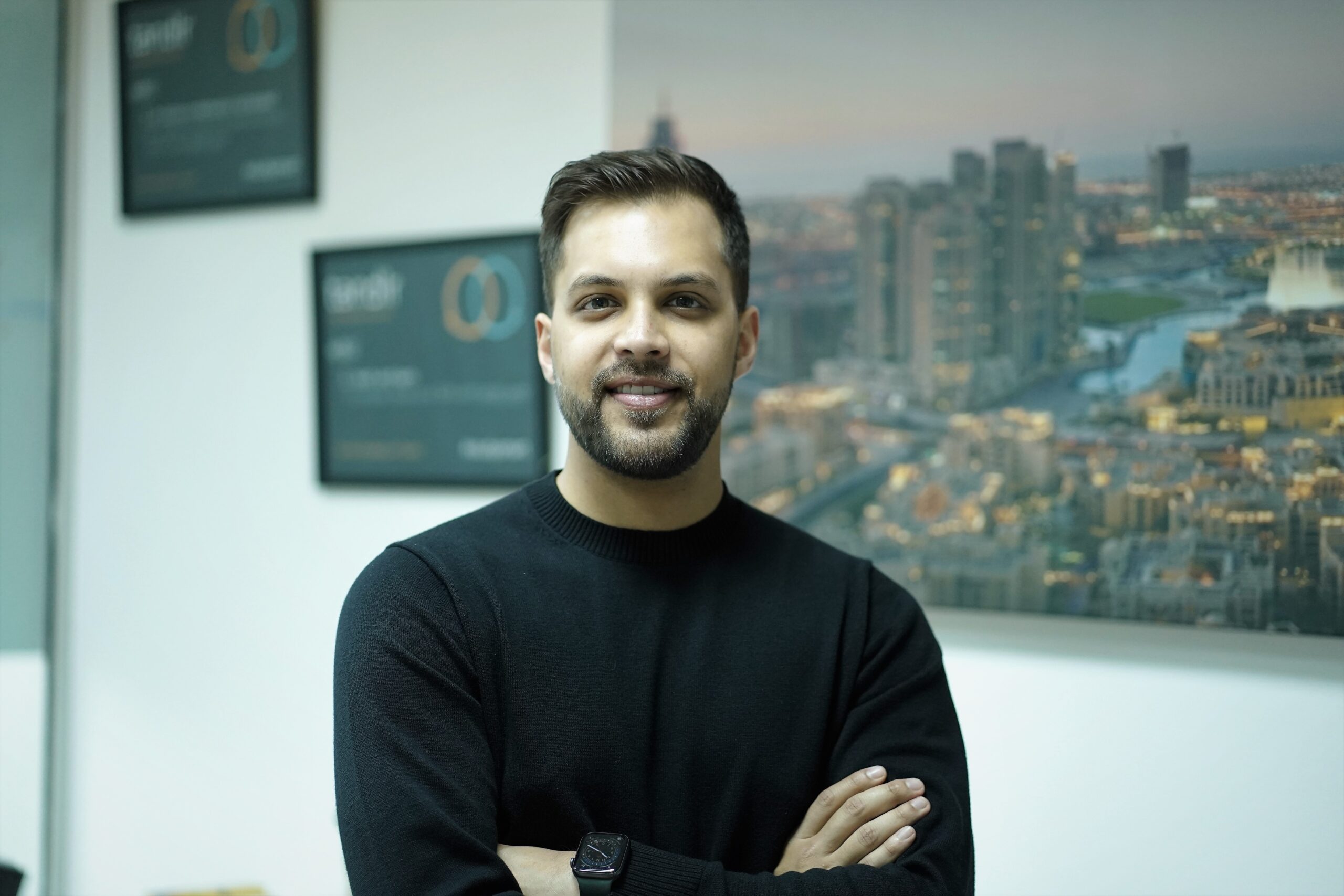
Aayushman Dalmia set up Zoftware after getting stuck with the wrong software as a choice for his family business. Supplied

Zoftware is a unique startup offering a choice of business tools in software with a personalised touch, using Open AI’s ChatGPT, for SME owners and companies. There are plans to take this to India, a huge market for SaaS providers and consumers.

“We have raised 500,000 dollars as a convertible note. And there are plans to raise another $1.5 million in the next round,” he says. “We are aiming for a revenue of $1.5 million by end of 2023.”

The rise of ChatGPT has only become an enabler for the Zoftware team. “Our technical analysts have been nimble to stay ahead on the transformation curve. We are in the process of setting up an AI bot with whom people can converse with, we understand what the customers want from the platform and give them the relevant output data while connecting with the vendors.

“If they want, we can also onboard it for them. With ChatGPT, it can give you out the names, but it cannot do comparisons and the prices that are out there. It cannot help you come to a decision, while we can help find the best value for the clients.

“According to studies, 75 percent of businesses fail in their software implementation. We want to make it to zero, because it is a waste of capital and resources such as time, effort and money. In the SME section, that is not something one can afford. We want to reduce the wastage cycle as much as possible. And we want to build the trust of our customers.”

Zoftware is Dalmia’s latest fruit of labour, coming from his own personal experiences when he saw a gap in the market. He set up Yalla Referral, a referral and benefits platform, is co-founder of an online diamond-purchasing platform Carat Finder and Director of Growth and Innovation at Data Direct Group.

“I remember, in 2018, when I wanted to implement CRM for my sales team, I ended up putting so much effort and money only to realise a year later that I had a complex setup which wasn’t needed at all. Several dollars went in waste apart from the time and effort. Many startups and SMEs may not be able to come out of the wrong direction taken.”

Business

UAE launches new digital platform to manage federal government real estate

Published

on

Spread the love

The UAE Ministry of Finance has launched a new digital system to centralise and manage data on all federally owned real estate, marking another step in the country’s push to modernise public asset management and strengthen governance.

The platform, known as the Federal Government Real Estate Assets Platform, will act as a unified electronic registry for federal government properties. It is designed to document, update and classify real estate data, while linking assets directly to financial and operational systems across the federal government.

The ministry said the launch fulfils the requirements of Article 18 of Federal Decree-Law No. 35 of 2023 on Union-Owned Properties, which mandates the creation of a federal electronic registry for government real estate.

Supporting digital transformation

Younis Haji AlKhoori, Undersecretary at the Ministry of Finance, said the platform is designed to strengthen regulation, governance and oversight of federal real estate assets, while supporting the UAE government’s wider digital transformation agenda.

By automating real estate-related processes, the system aims to improve data accuracy and provide better insights for policymaking, planning and long-term asset management.

Federal entities can use the platform to register and update property data under standardised classifications, manage leasable spaces, and submit real estate-related requests through automated workflows. These include inspections, transfers, sales, demolitions and structural changes to properties.

The platform also integrates with other federal systems to ensure records remain up to date, while generating reports and performance indicators to support evidence-based decision-making.

Linking real estate and financial data

Mariam Mohamed Al Amiri said the platform was developed to unify real estate data across federal bodies and connect it directly to financial and operational procedures, helping improve planning, expenditure control and transparency.

The system records both financial and non-financial data, including property values, depreciation, operating costs, location, condition and technical specifications. It also stores digital documents such as architectural drawings, site maps and contracts.

A new four-tier classification structure, covering sites, buildings, floors and individual units, standardises how government real estate is recorded and enables faster access to information.

From paper to digital

According to the ministry, the platform replaces paper-based procedures with a fully digital framework that supports real-time tracking, automated approvals and structured lease management, including contract creation, amendments and terminations.

Officials said the move will improve the efficiency of federal real estate use, enhance governance and support long-term planning of government-owned properties as part of the UAE’s broader digital government strategy.

Continue Reading

Business

Middle East set to attract over $100bn a year in energy, healthcare and digital investment by 2026

Published

on

Spread the love

The Middle East is on track to attract more than $100 billion (Dh370 billion) a year in major investments by 2026, spanning energy, renewables, healthcare, digital infrastructure and manufacturing, according to a new industry outlook by Grand View Research (GVR).

Despite the global shift towards cleaner energy, the region, led by the UAE and Saudi Arabia, is expected to remain a global powerhouse in oil and gas, while rapidly scaling renewable energy, digital transformation and healthcare innovation.

Oil and gas remain central, with a tech-driven twist

The UAE and its Gulf neighbours currently account for around 30 per cent of global oil production and 17–18 per cent of gas output, cementing the region’s role as a key energy supplier.

While global oil demand growth is expected to remain modest through 2026, gas demand is forecast to rise by around 3.5 per cent, driven by power generation, industrial expansion and LNG exports.

“The Middle East’s oil and gas sector remains a market anchor, but technology adoption and LNG expansion will define competitiveness over the next few years,” said Swayam Dash, Managing Director at Grand View Research.

Across the UAE, producers are increasingly deploying AI, IoT, drones and robotics to cut costs and improve operational efficiency, alongside investments in carbon capture, storage and early-stage hydrogen projects under the UAE Energy Strategy 2050.

Renewables and battery storage gain pace

Renewable energy is expanding rapidly across the Gulf, with falling solar auction prices making clean energy increasingly competitive. Both the UAE and Saudi Arabia are mandating battery storage alongside new solar and wind projects, helping stabilise power grids as renewable capacity grows.

Dubai has announced plans for multi-gigawatt renewable additions by 2030, while Saudi Arabia continues to roll out large-scale solar and hydrogen projects under Vision 2030.

Healthcare becomes an economic growth engine

Healthcare is also emerging as a strategic investment sector. In 2023, Dubai welcomed more than 690,000 medical tourists, generating over Dh1 billion in healthcare revenue and boosting related sectors such as hospitality and travel.

The UAE’s National Digital Health Strategy, which integrates platforms like Riayati, Malaffi and Nabidh, has consolidated more than 1.9 billion medical records across 3,000 facilities, positioning the country as a regional leader in digital healthcare.

Data centres, cloud and advanced manufacturing

Digital infrastructure is another major growth driver. The GCC data centre market is expected to grow at around 13 per cent annually through 2030, with the UAE and Saudi Arabia accounting for up to 70 per cent of new capacity.

Cloud adoption is accelerating too, with nearly 75 per cent of organisations expected to rely mainly on cloud platforms by 2026, boosting demand for cybersecurity, AI and enterprise digital tools.

By 2026, GVR expects the region’s economy to reflect balanced diversification, combining energy leadership with rapid growth in renewables, healthcare, digital systems and advanced manufacturing.

“The scale of investment shows how the Middle East is shifting from resource reliance to technology-enabled growth,” Dash said.


Continue Reading

Automobile

Abu Dhabi unveils $2bn Global Water Platform targeting 10 million beneficiaries

Published

on

Spread the love

Abu Dhabi has launched a $2 billion Global Water Platform aimed at strengthening water and food security in developing countries and expanding access to clean and safe water worldwide.

Developed by the Abu Dhabi Fund for Development (ADFD), the initiative will support high-impact water projects while championing innovative technologies and sustainable solutions for water resource management.

Goal to reach 10 million beneficiaries

The platform plans to mobilise $2 billion (Dh7.34 billion) in funding from local and international financing institutions. Its first phase will allocate $1 billion (Dh3.67 billion) over five years, from 2026 to 2030, to reach around 10 million beneficiaries globally.

The initiative aligns with the UN Sustainable Development Goal 6, which focuses on ensuring universal access to clean water and sanitation while promoting inclusive and resilient development.

Mohamed Saif Al Suwaidi, Director-General of ADFD, called on local and international partners to collaborate through joint financing, strategic partnerships and knowledge exchange to accelerate solutions that enhance water security and empower developing nations.

Fatima Ateeq Al Mazrouei, Support Services Department Director at ADFD, said the initiative will also finance innovative programmes, support scientific research and youth-led initiatives, and organise awareness campaigns focused on water-related challenges.

Why it matters to investors

  • Defensive, long-term asset class: Water infrastructure and security projects offer stable, long-duration returns backed by essential demand and government support.
  • $2bn capital mobilisation opportunity: Abu Dhabi’s platform signals a sizeable pipeline of bankable projects, co-financing opportunities and public-private partnerships across developing markets.
  • Climate-resilient growth sector: Rising water scarcity, population growth and climate pressure are driving sustained global investment into water, sanitation and food security solutions.
  • Policy-aligned investment: The platform aligns with UN SDG 6, increasing eligibility for development finance, blended capital structures and ESG-focused funds.
  • Innovation upside: Focus on pioneering technologies and scalable solutions opens opportunities for investors in water tech, infrastructure, data, desalination and resource management.
  • Strong sovereign backing: Led by the Abu Dhabi Fund for Development, the initiative benefits from institutional credibility, risk mitigation and long-term policy commitment.

Continue Reading

Popular

© Copyright 2025 HEADLINE. All rights reserved

https://headline.ae/